01Facts
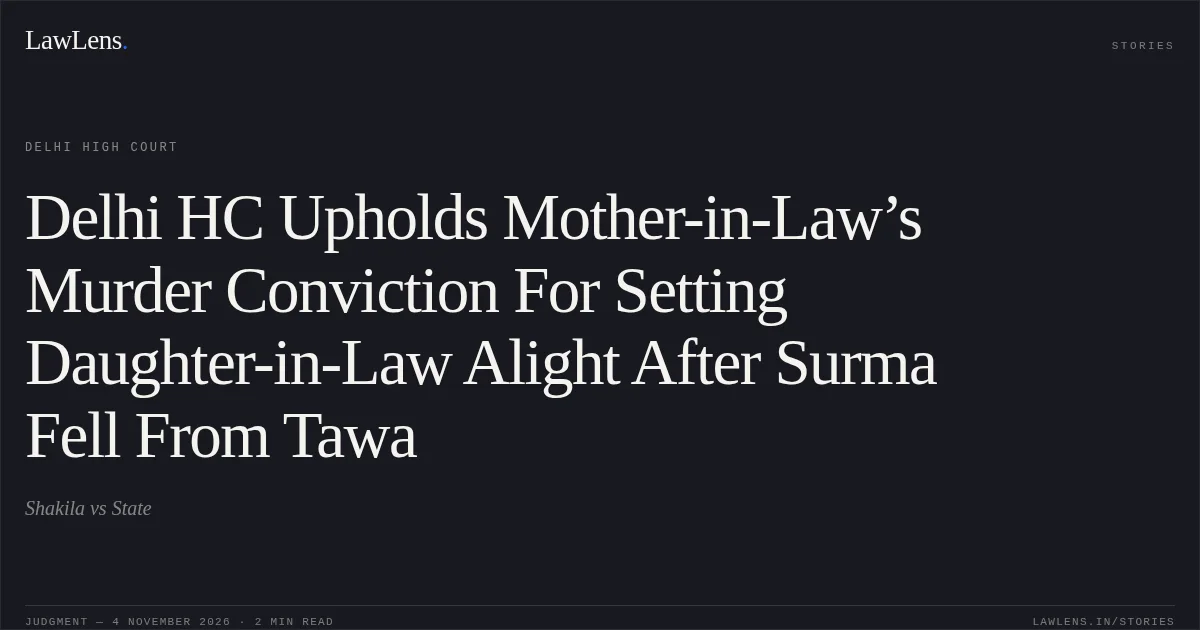
Shahzadi, wife of Hashmat and daughter-in-law of Shakila, suffered extensive burns in her jhuggi on 2 November 2000 and later died.
¶ 8–18, 23–35In two statements recorded at the hospital, each after a doctor certified her fit to speak, she said Shakila poured kerosene on her and set her alight with a matchbox supplied by Rukhsana, her sister-in-law.
¶ 8–18, 23–35The Trial Court convicted Shakila under Sections 302 and 498A IPC, and Hashmat under Section 498A IPC.
¶ 8–18, 23–35Shahzadi’s parents and brother did not support the prosecution at trial; the appellants relied, among other things, on accidental burning from a stove and defence witnesses’ accounts. Both appellants appealed
¶ 8–18, 23–3502Issues
i.1. Whether the deceased’s two statements were sufficiently reliable to prove that Shakila intentionally caused her death, notwithstanding the defence case of accidental burning and the family witnesses’ lack of support
¶ 36–41, 69–72, 92–104ii.2. Whether the evidence established cruelty punishable under Section 498A IPC by Shakila or Hashmat
¶ 81–88, 105–10803Law Applied
Section 302 IPC applies where the prosecution proves that the accused committed murder. A dying declaration may, if true, voluntary and reliable, sustain a conviction without corroboration; the court must scrutinise whether it was made in a fit state of mind and was free from tutoring, prompting or imagination (Kalawati v. State of Maharashtra, (2009) 4 SCC 37; Ramilaben Hasmukhbhai Khristi v. State of Gujarat, (2002) 7 SCC 56)
¶ 102–104Section 498A IPC requires proof of legally cognisable cruelty; petty or isolated quarrels that resolve are not, without more, cruelty for that section (Manju Ram Kalita v. State of Assam, (2009) 13 SCC 330)
¶ 107–108The Court also applied Section 154 of the Evidence Act principles concerning the court’s discretion to permit questions to a party’s own witness, including during examination, with an opportunity for the opposing party to cross-examine on the answers elicited (Dahyabhai Chhaganbhai Thakkar v. State of Gujarat, 1964 SCC OnLine SC 20)
¶ 64–68Provisions in the judgment · 7 · Linked ones open on LawLens
Indian Penal Code, 1860 Section 307Section 34Section 302Section 109
Code of Criminal Procedure, 1973 Section 161Section 313Section 231
04Reasoning
The Court found the two hospital statements consistent on the material account of the burning and supported by medical endorsements that Shahzadi was fit to make them.
¶ 37–41, 70–72, 77–80, 104It rejected the stove-accident theory, noting that the stove was undamaged and the evidence did not support accidental burning; it also found the defence witnesses’ accounts unpersuasive
¶ 37–41, 70–72, 77–80, 104The deceased’s statements were therefore sufficient to sustain Shakila’s conviction under Section 302 IPC.
¶ 37–41, 70–72, 77–80, 104By contrast, the Court considered that the alleged motorcycle demand and other marital grievances were described by Shahzadi as small quarrels that later settled, and that she attributed the fatal incident to the dispute over surma falling from the tawa.
¶ 83–88, 105–110It held that this evidence did not establish cruelty under Section 498A against either appellant
¶ 83–88, 105–11005Holding
The Court upheld Shakila’s conviction under Section 302 IPC and directed her to surrender within two weeks to serve the remaining sentence, with arrest steps to follow if she did not surrender.
¶ 108–113It set aside the Section 498A convictions of both Shakila and Hashmat; Hashmat’s appeal was allowed, and Shakila’s appeal was partly allowed.
¶ 108–113Hashmat’s bail bonds were to stand discharged after eight weeks
¶ 108–113Original Court PDF
ShakilavsState
Click to open original judgment
Original judgment, available to read, download and summarize on LawLens.in