Facts
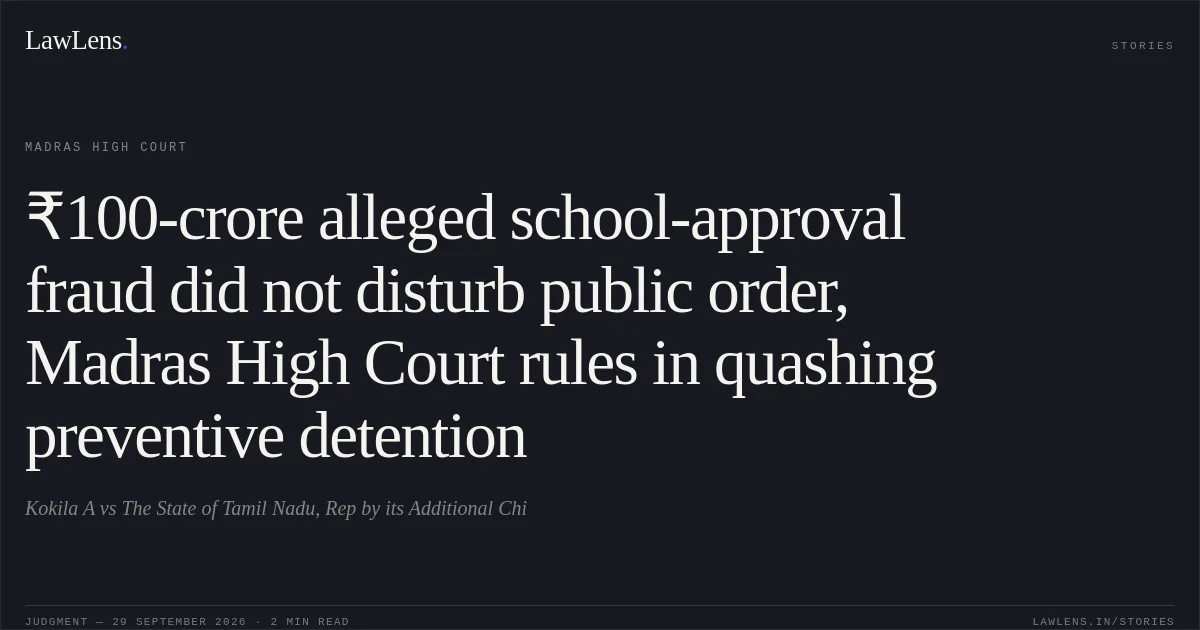
The petitioner, the detenu’s wife, challenged the Commissioner of Police’s detention order dated 11 July 2026, which classified her husband as a “Goonda” under the Tamil Nadu Prevention of Dangerous Activities Act, 1982.
Source reference: pp. 2–5The detention arose from allegations that the detenu and others had collected substantial sums from private-school managements by promising to obtain approvals and other permissions, but had failed to do so; a criminal case was registered and the detenu was arrested on 27 June 2026.
Source reference: pp. 2–5The detenu’s representation, dated 23 July 2026, was received by the Government on 27 July, dealt with by officials on 30 and 31 July, and rejected on 5 August 2026.
Source reference: pp. 8–9The petitioner challenged the detention on several grounds, including delay in considering the representation and the absence of any impact on public order.
Source reference: pp. 5–8Issues
Whether the unexplained delay in considering the detenu’s representation vitiated the detention order
Source reference: pp. 8–9Whether the alleged cheating of school managements affected public order, rather than constituting a law-and-order issue
Source reference: pp. 9–13Law Applied
Section 2(f) of the Tamil Nadu Prevention of Dangerous Activities Act, 1982 defines the relevant “Goonda” category, and Section 3(1) empowers the detaining authority to make a preventive detention order.
Source reference: pp. 2, 5A representation against preventive detention must be considered without unexplained delay; unexplained delay in its consideration may vitiate the detention.
Source reference: pp. 8–9Applying Nenavath Bujji v. State of Telangana, 2024 (17) SCC 294, the Court reiterated that public order is narrower than law and order: the relevant conduct must have sufficient reach or potential to disturb the even tempo of life of the community, rather than affect only a few individuals.
Source reference: pp. 11–12The Court considered the petition under Article 226 of the Constitution.
Source reference: p. 2Reasoning
The Government’s account showed that after the file was dealt with on 31 July, it was not placed for further circulation until 5 August; the Government also gave no explanation for that interval or for the initial period between receipt on 27 July and circulation on 30 July. The Court held that the unexplained delay vitiated the detention.
Source reference: pp. 8–9On public order, the alleged victims were school managements who had voluntarily approached the association, and the alleged conduct was directed at those managements rather than the public at large. The Court therefore found that the allegations, though potentially criminal, did not demonstrate the community-wide impact required to affect public order.
Source reference: pp. 10–13Holding
The Court held that both the unexplained delay in considering the representation and the absence of a demonstrated effect on public order vitiated the detention order.
It set aside the detention order dated 11 July 2026, allowed the habeas corpus petition, and directed that the detenu be released forthwith unless required in another case; the connected miscellaneous petitions were closed.
Source reference: p. 13Acts & Sections Cited
3 provisions across 1 statute referred to in this judgment. Each provision opens on LawLens.
Bharatiya Nyaya Sanhita, 20233
Original Court PDF
Kokila AvsThe State of Tamil Nadu, Rep by its Additional Chi
Click to open original judgment
Original judgment, available to read, download and summarize on LawLens.in