Facts
On November 15, 2005, the appellant sustained a head injury resulting in total paralysis after his scooter was struck by a car driven rashly and negligently by the first respondent
Source reference: para. 3The appellant filed a claim under Section 166 of the Motor Vehicles Act, 1988, seeking ₹20,54,000 in compensation
Source reference: para. 3The Motor Accident Claims Tribunal (MACT) awarded ₹4,56,340
Source reference: para. 4On appeal, the Rajasthan High Court enhanced the compensation to ₹8,45,120 by accounting for 100% disability and future prospects
Source reference: para. 5The appellant moved the Supreme Court seeking further enhancement, arguing that his monthly income was undervalued and compensation for attendant charges and pain and suffering was insufficient
Source reference: para. 6Issues
1. Whether the notional income and multiplier applied by the lower courts were consistent with the evidence on record regarding the appellant's age and earnings
Source reference: para. 8, 8.12. Whether the compensation awarded for future medical expenses, attendant charges, and loss of amenities was "just" in light of the appellant’s 100% functional disability
Source reference: para. 8.2, 8.3, 8.4Law Applied
The Court applied the principle of "just compensation" under the Motor Vehicles Act, 1988
Source reference: para. 3It utilized the Minimum Wages Act standards to determine the notional income of a skilled laborer in the absence of specific evidentiary proof of higher earnings
Source reference: para. 8It further followed the established multiplier method for calculating the loss of future income and recurring future liabilities (such as attendant charges) based on the victim's age and life expectancy
Source reference: para. 8.1, 8.3Reasoning
The Court found that the notional income of ₹2,400 per month was correctly determined, as the appellant failed to produce evidence to justify his claim of earning ₹6,000
Source reference: para. 8The age of 35 (and the resulting multiplier of 16) was also upheld as it was based on the appellant’s medical discharge ticket
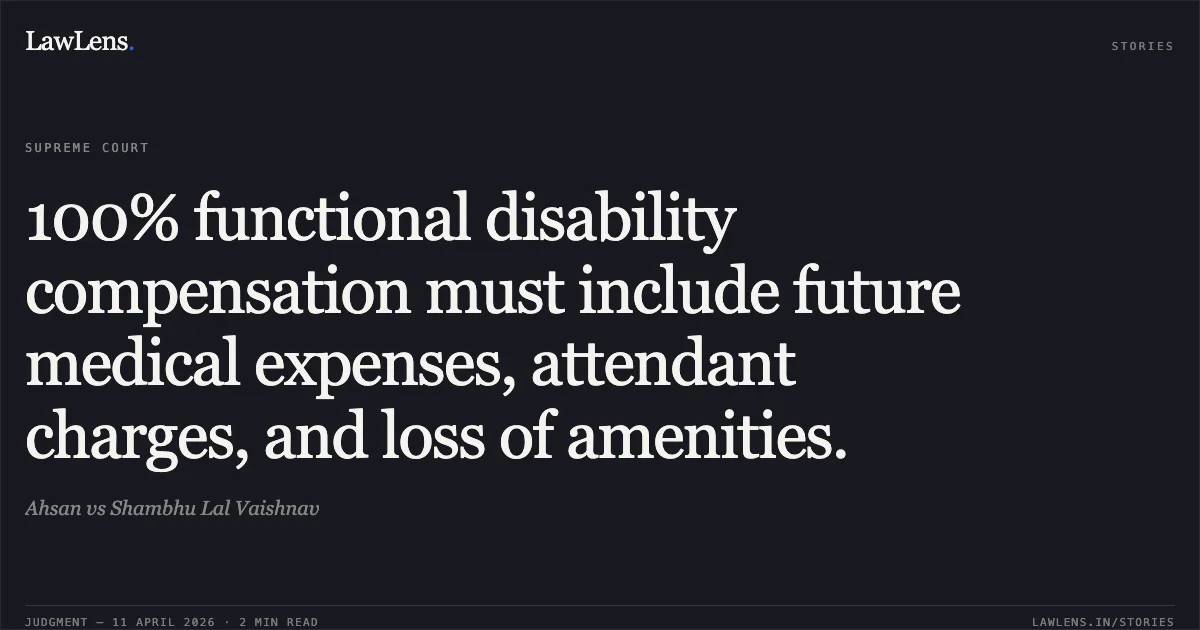
Source reference: para. 8.1However, the Court determined that the lower courts failed to provide adequate relief for the long-term consequences of 100% paralysis.
Source reference: para. 8.2It increased future medical expenses to ₹7,00,000 to cover average life expectancy
Source reference: para. 8.2Regarding attendant charges, the Court rejected the High Court’s lump sum of ₹1,00,000, ruling that a person with 100% functional disability requires daily assistance.
Source reference: para. 8.3Using a rough estimate of ₹3,500 per month and applying a multiplier of 16, it recalculated this head to ₹6,72,000
Source reference: para. 8.3Lastly, the Court awarded ₹2,00,000 for "loss of amenities," noting that the High Court had entirely omitted this head
Source reference: para. 8.4Holding
The Court held that the appellant was entitled to higher amounts for future medical needs, attendant care, and loss of amenities due to the severity of his injuries
The Supreme Court allowed the appeal and enhanced the total compensation to ₹23,69,996
Source reference: para. 9It directed the respondents to pay the enhanced amount with interest at 6% per annum from the date of filing the claim petition until realization, within twelve weeks
Source reference: para. 9Acts & Sections Cited
2 provisions across 1 statute referred to in this judgment. Each provision opens on LawLens.
Motor Vehicles Act, 19882
Original Court PDF
AhsanvsShambhu Lal Vaishnav
Click to open original judgment
Original judgment, available to read, download and summarize on LawLens.in