Facts
The Respondent No. 1, a minor child aged two years at the time of the accident on September 18, 2021, was struck by an offending vehicle (DL-1ZD-1980) driven at high speed.
Source reference: para 2The victim sustained grievous injuries, including post-traumatic brain injury, right hemiplegia, facial nerve palsy, and vision/hearing loss, resulting in a certified 77% permanent multiple disability.
Source reference: para 2, 4The Motor Accidents Claims Tribunal (MACT) awarded Rs. 74,54,467.4/- with 9% interest, assessing the child's functional disability at 100%.
Source reference: para 1, 5The Appellant-Insurance Company challenged the award, contesting the 100% functional disability assessment and the quantum of non-pecuniary damages.
Source reference: para 3, 10Issues
1. Whether the functional disability of the minor claimant could be assessed at 100% despite the medical certificate stating 77% permanent disability.
Source reference: para 32. Whether the award of non-pecuniary damages totaling Rs. 13,00,000/- was excessive.
Source reference: para 10Law Applied
The court primarily relied on the Supreme Court’s decision in Raj Kumar v. Ajay Kumar (2011) 1 SCC 343, which establishes that the Tribunal must assess the actual impact of permanent disability on the claimant’s earning capacity, distinguishing between medical disability and functional disability.
Source reference: para 7-8It further applied R.D. Hattangadi v. Pest Control (India) (P) Ltd. (1995) 1 SCC 551, which provides principles for awarding non-pecuniary damages (pain, suffering, and loss of amenities), emphasizing that while money cannot restore a physical frame, it must provide a "conventional sum" deemed fair by society.
Source reference: para 11The court also followed the multiplier and future prospects guidelines set in Sarla Verma v. DTC (2009) 6 SCC 121 and National Insurance Co. Ltd. v. Pranay Sethi (2017).
Source reference: para 5Reasoning
The Court observed that assessment of functional disability is not a "one size fits all" exercise and must be done on a case-to-case basis.
Source reference: para 9In this instance, the claimant was only two years old and suffered catastrophic brain injuries and hemiplegia.
Source reference: para 6The Court reasoned that such severe injuries at a nascent stage would effectively prevent her from ever obtaining gainful employment or eking out a decent living.
Source reference: para 6Applying Raj Kumar, the Court held that the Tribunal correctly determined that the 77% medical disability translated into 100% loss of earning capacity.
Source reference: para 5, 22Regarding non-pecuniary damages, the Court applied the Hattangadi principle, noting that for a child rendered a "helpless invalid" who has lost everything that makes life worthwhile, the judicial task is to calculate the "incalculable".
Source reference: para 11The Court found no reason to interfere with the Tribunal’s assessment given the permanent deprivation suffered at such a young age.
Source reference: para 12Holding
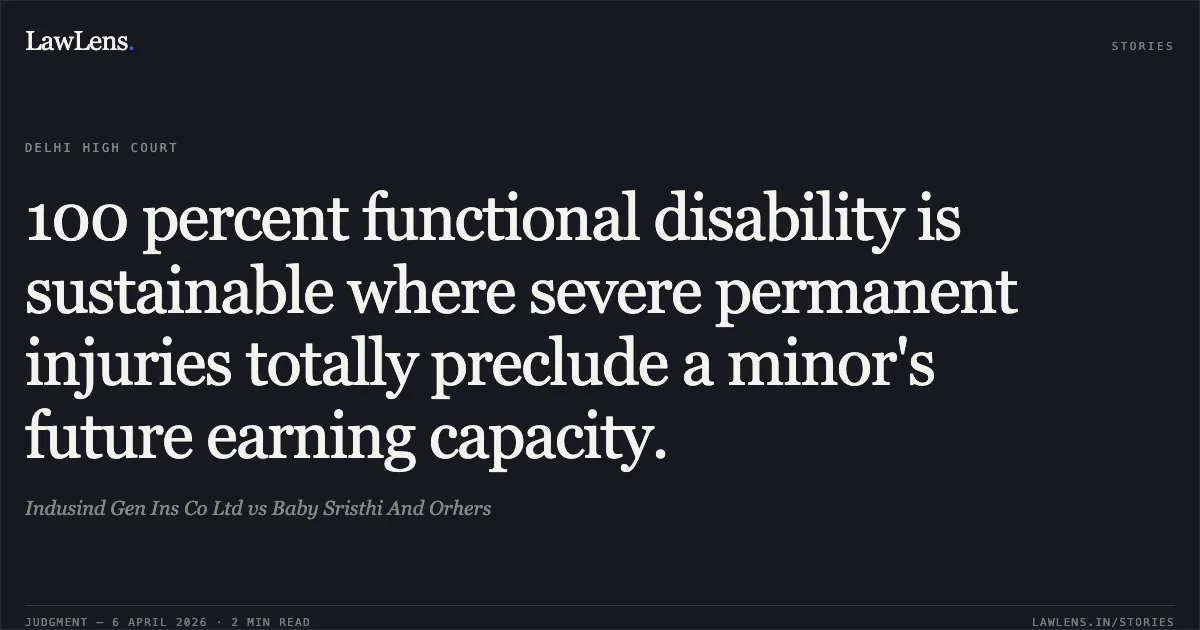
The Court held that a 100% functional disability assessment was sustainable given the impact of the 77% permanent multiple disability on a two-year-old’s future earning potential.
The High Court dismissed the appeal and confirmed the MACT’s award of Rs. 74,54,467.4/- with 9% interest.
Source reference: para 13, 15The Appellant was directed to deposit the compensation amount, and the statutory deposit was ordered to be refunded to the Appellant.
Source reference: para 15-16Original Court PDF
Indusind Gen Ins Co LtdvsBaby Sristhi And Orhers
Click to open original judgment
Original judgment, available to read, download and summarize on LawLens.in