Facts
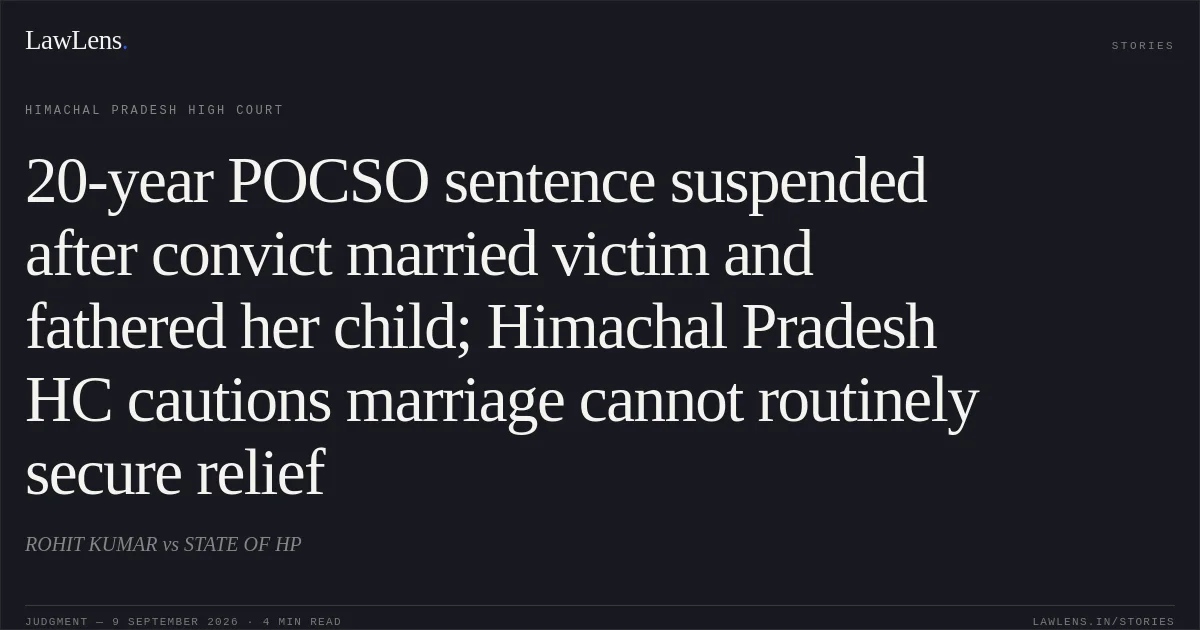
The applicant-appellant was convicted by the Additional Sessions Judge, Fast Track Special Court (Rape/POCSO), Sirmaur, under Section 376(3) IPC and Section 6 read with Section 5(j) of the POCSO Act, arising from FIR No. 16 of 2023 registered at Police Station Pachhad, District Sirmaur.
Source reference: paras. 1–2He was sentenced to 20 years’ rigorous imprisonment and a fine of ₹20,000, with one year’s simple imprisonment in default of payment of fine.
Source reference: paras. 1–2The prosecution case was that the applicant developed a relationship with the victim when she was a minor, repeatedly subjected her to sexual intercourse, and caused her to become pregnant.
Source reference: paras. 8–10, 20–24During the trial, after the victim attained majority, the applicant and the victim married on 2 September 2025; the marriage was registered, and they had a child who was being cared for by the victim’s parents.
Source reference: paras. 6–7, 10, 25–26The original application sought quashing of the conviction judgment but contained no proper prayer for quashing the FIR or compounding the proceedings.
Source reference: paras. 3–4Upon the Court’s objection, counsel did not press the quashing prayer and requested that the application be treated as one for suspension of sentence under Section 430 of the Bharatiya Nagarik Suraksha Sanhita, 2023 (BNSS).
Source reference: paras. 3–4Issues
Whether the defective application seeking quashing of the conviction judgment could be considered, at the applicant’s request, as an application for suspension of sentence during pendency of the appeal under Section 430 BNSS?
Source reference: paras. 3–4Whether the applicant’s sentence should be suspended in view of the subsequent marriage between the applicant and the victim, their child, the victim’s expressed position, and the alleged settlement between the families?
Source reference: paras. 27–35, 42–43Whether marriage between an accused and a former minor victim can, by itself, justify suspension of sentence or be treated as a basis for terminating or quashing POCSO proceedings?
Source reference: paras. 35–41Law Applied
The Court applied Section 430 of the Bharatiya Nagarik Suraksha Sanhita, 2023, concerning suspension of sentence pending appeal.
Source reference: para. 4The conviction arose under Section 376(3) of the IPC and Section 6 read with Section 5(j) of the Protection of Children from Sexual Offences Act, 2012, which criminalise aggravated penetrative sexual assault against a child.
Source reference: paras. 1–2The Court recognised that POCSO is a protective statute enacted to safeguard children from sexual abuse and that sexual relations with a minor remain punishable irrespective of the parties’ subsequent marriage or claimed consensual relationship.
Source reference: para. 28It further held that marriage after the victim attains majority is not, by itself, a ground for suspension of sentence, compounding, quashing, or termination of criminal proceedings; each case must be assessed on its own facts, with particular attention to the victim’s free will, the nature of the prior relationship, and the possibility of coercion or family pressure.
Source reference: paras. 35–41Reasoning
The Court treated the application as one for suspension of sentence because the applicant abandoned the defective prayer for quashing and was already incarcerated during the pendency of the appeal.
Source reference: paras. 3–4In balancing the protective purpose of POCSO against the subsequent family circumstances, the Court considered that the victim had attained majority, voluntarily married the applicant, had a child with him, maintained cordial relations with both families, and expressed that the applicant’s release would benefit her and the child.
Source reference: paras. 10–19, 25–26The Court also noted that the FIR had originated from the hospital’s information rather than a complaint voluntarily initiated by the victim, and that her statements reflected an earlier romantic relationship and her unwillingness to pursue the matter after the marriage.
Source reference: paras. 21–24, 34It nevertheless expressly cautioned that marriage must not become a device for avoiding criminal liability, particularly in POCSO cases, and that courts must ensure that the victim has not been compelled, pressured, or abandoned by the families.
Source reference: paras. 35–41On the peculiar facts, the Court concluded that suspension would protect the welfare of the victim and child and preserve the family unit, while clarifying that the order was not to operate as a general precedent.
Source reference: paras. 31–35, 42Holding
The Court suspended the substantive sentence of Rohit Kumar during the pendency of the appeal.
His release was made subject to a personal bond of ₹50,000 with one surety in the like amount, an undertaking to appear before the High Court when directed, and an undertaking to surrender if the appeal was dismissed.
Source reference: para. 43The applicant was directed to properly maintain the victim-wife and their child; the applicant and his parents were directed to keep the victim and child with him as family members; and any harassment of the victim by the applicant or his family could result in revocation of the suspension.
Source reference: para. 43The application was disposed of with liberty to the applicant to pursue any legally permissible remedy for compounding or quashing of the criminal proceedings.
Source reference: paras. 44–45Acts & Sections Cited
6 provisions across 4 statutes referred to in this judgment. Each provision opens on LawLens.
Indian Penal Code, 18601
Bharatiya Nagarik Suraksha Sanhita, 20231
Code of Criminal Procedure, 19732
Original Court PDF
ROHIT KUMARvsSTATE OF HP
Click to open original judgment
Original judgment, available to read, download and summarize on LawLens.in