Facts
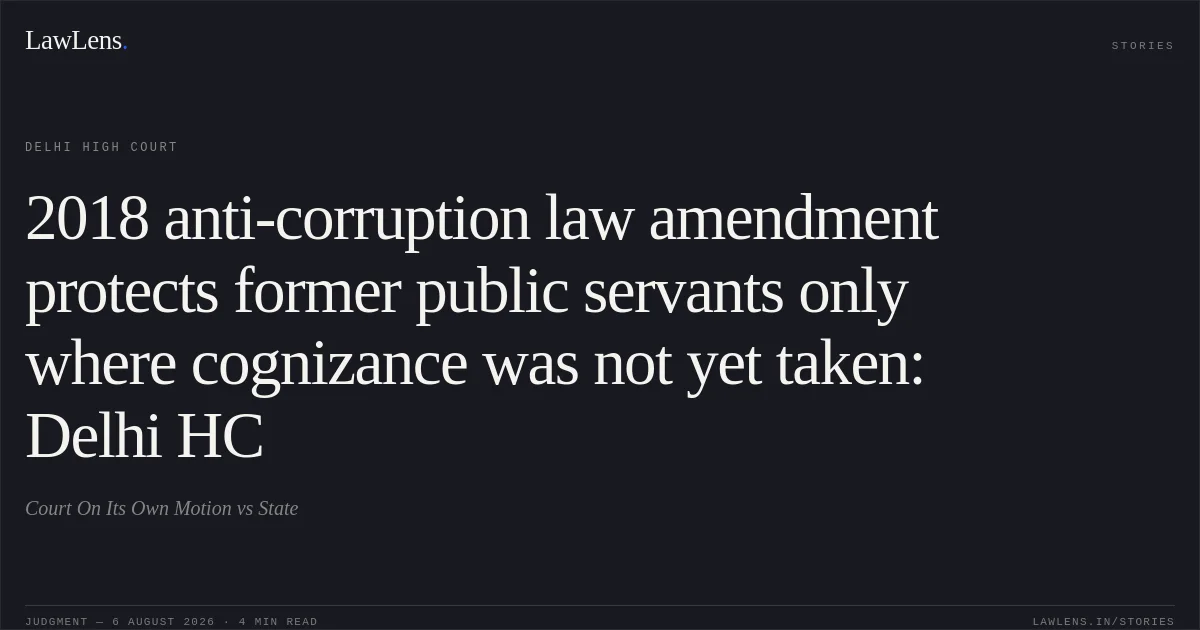
A reference under Section 395 read with Section 482 of the Code of Criminal Procedure, 1973 was made by the Special Judge (PC Act), CBI-01, Central District, Tis Hazari Courts, Delhi, concerning the interpretation and temporal application of Section 19 of the Prevention of Corruption Act, 1988, as amended by the Prevention of Corruption (Amendment) Act, 2018.
Source reference: pp. 2–3, para. 1The reference arose from pending corruption proceedings involving questions regarding the necessity of prior sanction where the accused was a former public servant or was holding an office different from the one allegedly abused.
Source reference: pp. 2–3, para. 1The High Court clarified that it would not examine the facts of the underlying case, but would answer the legal questions for application by the Special Judge.
Source reference: p. 3, para. 2The 2018 amendment came into force on 26 July 2018 and extended the expression “public servant” under Section 19(1) to include persons who had ceased to hold the office in which the offence was allegedly committed, or who held a different office at the time of cognizance.
Source reference: pp. 20–24, paras. 18–22Issues
Whether, under Section 19(1) of the Prevention of Corruption Act, cognizance is taken merely of the offence or is taken of the offence qua a specific accused/public servant, thereby requiring sanction for that particular person?
Source reference: pp. 25–29, paras. 25–31Whether the relevant date for applying the amended Section 19(1) is the date of commission of the offence, the date of cognizance, or some other date in pending proceedings?
Source reference: pp. 29–30, paras. 32–35Whether the amendment to Section 19(1), effective from 26 July 2018, operates retrospectively because it is beneficial to accused persons who are former public servants or hold a different office?
Source reference: pp. 30–32, paras. 35–43Whether prior sanction under the amended Section 19 is necessary where cognizance had already been taken before 26 July 2018 against a former or ex-public servant?
Source reference: pp. 55–56, para. 60Whether any other issue concerning the vires of the Prevention of Corruption (Amendment) Act, 2018, particularly Section 19, arose for determination?
Source reference: p. 60, para. 61Law Applied
The Court applied Section 19(1) of the Prevention of Corruption Act, 1988, both before and after its amendment, which bars a court from taking cognizance of specified corruption offences against a public servant without prior sanction of the competent authority.
Source reference: pp. 16–24, paras. 13–19Relying principally on S.A. Venkataraman v. State, R.S. Nayak v. A.R. Antulay, Parkash Singh Badal v. State of Punjab, Abhay Singh Chautala v. CBI, and L. Narayana Swamy v. State of Karnataka, the Court held that, under the unamended provision, the relevant date was the date of cognizance and sanction was generally unnecessary where the accused had ceased to hold the relevant office or held a different office.
Source reference: pp. 5–20, paras. 7–17However, following Dilawar Singh v. Parvinder Singh, the Court held that Section 19 is a special provision overriding the general rule under Sections 190 and 319 Cr.P.C.; cognizance must be understood as being taken in respect of the offence qua the particular accused, and sanction must exist for that accused.
Source reference: pp. 26–29, paras. 29–31Applying the principles governing retrospectivity from Hitendra Vishnu Thakur, Vatika Township, Nani Gopal Mitra, Shyam Sunder, Zile Singh, and Gottumukkala Venkata Krishamraju, the Court held that the amendment operates retrospectively only insofar as it applies to offences committed before 26 July 2018 where cognizance was yet to be taken, but it does not reopen cognizance already taken before that date.
Source reference: pp. 34–55, paras. 47–59Reasoning
The Court treated Section 19 as a special statutory bar that operates against cognizance being taken against a particular accused without the requisite sanction; the general proposition that cognizance is taken of an offence and not of an offender does not apply in this context because of the specific language and purpose of Section 19.
Source reference: pp. 26–29, paras. 29–31The Court identified the date of cognizance—not the date of commission of the offence—as the operative date for determining the necessity of sanction.
Source reference: pp. 29–30, para. 34The 2018 amendment materially expanded protection by including former public servants and persons holding a different office, thereby imposing a new prohibition and corresponding obligation on the prosecution.
Source reference: no citationSince the amendment was brought into force expressly from 26 July 2018 and contained no clear retrospective direction, it could not invalidate or reopen cognizance lawfully taken before that date under the unamended law.
Source reference: pp. 43–45, paras. 50–53Nevertheless, where cognizance had not been taken as of 26 July 2018, the amended Section 19 applied even if the alleged offence had been committed earlier; in such cases, sanction was mandatory for a former public servant or a public servant holding a different office.
Source reference: pp. 55–56, para. 60Holding
under Section 19 of the Prevention of Corruption Act, cognizance is required to be understood qua the specific accused, and no cognizance of offences under Sections 7, 11, 13 and 15 can be taken against a public servant without prior sanction for that person.
the amended Section 19 applies from 26 July 2018 and extends protection to former public servants and persons holding a different office even where the alleged offence predates the amendment.
Source reference: pp. 55–58, paras. 60, 62However, the amendment is prospective regarding cases in which cognizance had already been taken before 26 July 2018; such proceedings are not to be reopened and no fresh sanction is required.
Source reference: pp. 55–58, paras. 60, 62The Court did not answer the general question concerning the vires of the Amendment Act.
Source reference: p. 60, para. 61The reference was disposed of, and the matter was directed to be transmitted to the concerned Special Judge for further proceedings.
Source reference: p. 58, paras. 63–65Original Court PDF
Court On Its Own MotionvsState
Click to open original judgment
Original judgment, available to read, download and summarize on LawLens.in