Facts
The petitioner developed a 61-villa project within Samethanahalli Gram Panchayat limits and a notified planning area.
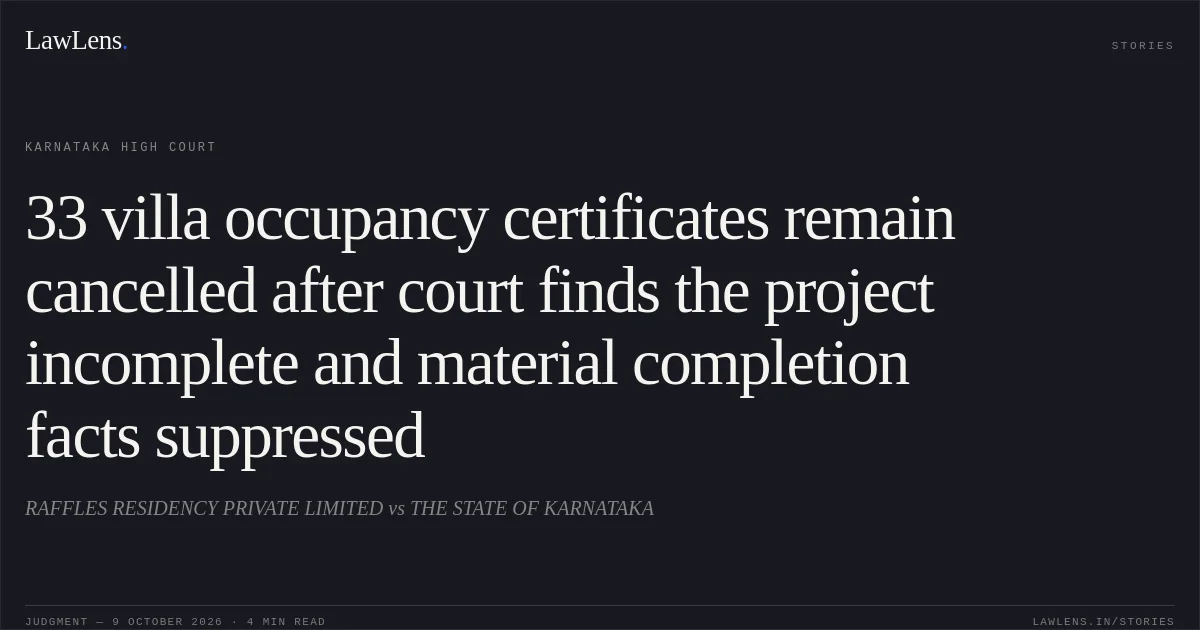
Source reference: para. 2–9, 34–50The Gram Panchayat issued Occupancy Certificates for 33 villas between September 2016 and May 2017.
Source reference: para. 2–9, 34–50Following an inspection in December 2022 that identified incomplete works, the Panchayat withdrew those certificates on 10 January 2023.
Source reference: para. 2–9, 34–50The petitioner challenged the withdrawal; on 11 December 2023, the High Court quashed it and restored the certificates subject to completion of works and payment of taxes.
Source reference: para. 2–9, 34–50Two purchasers of other villas then sought impleadment and recall, alleging that the project was incomplete and that material facts had been withheld from the Court.
Source reference: para. 2–9, 34–50During the proceedings, the Court examined the applicable statutory framework and obtained inspection reports and State submissions on the process for issuing Occupancy Certificates.
Source reference: para. 2–9, 34–50The purchasers relied, in particular, on the petitioner’s 12 May 2017 letter to BESCOM stating that completion of the remaining 41 villas was delayed.
Source reference: para. 59.29–59.34Issues
1. Whether the purchasers were proper parties to the writ petition.
Source reference: para. 56(i), 58.7–58.152. Whether the order dated 11 December 2023 should be recalled for suppression of material facts.
Source reference: para. 56(ii), 59.24–59.433. What statutory regime applied to Occupancy Certificates for buildings in Gram Panchayat limits within a Local Planning Area, and which authority was competent to issue them.
Source reference: para. 56(iii)–(v), 60–624. Whether the Occupancy Certificates were issued after adequate inspection and verification, and whether the project was complete and fit for occupation at the relevant time.
Source reference: para. 56(vi)–(viii), 63–655. Whether the subsequent cancellation of the certificates was lawful and consistent with natural justice.
Source reference: para. 56(ix), 66.1–66.156. Whether the Court should determine whether the project was an “ongoing project” under RERA.
Source reference: para. 56(x), 67.1–67.15Law Applied
Section 64 of the Karnataka Gram Swaraj and Panchayat Raj Act, 1993 empowers a Gram Panchayat to regulate building construction; that power includes the incidental authority to verify compliance before permitting occupation.
Source reference: para. 60.5–60.12Section 64(5A) requires compliance with the Karnataka Town and Country Planning Act, 1961, while Section 316(2) provides that Model Bye-laws require adoption by the relevant Panchayat.
Source reference: para. 60.21–60.25Under the planning framework, the Planning Authority issues development permission and a commencement certificate under Sections 4-A and 15 of the KTCP Act, while the State’s stated statutory position was that the KTCP Act does not empower it to issue Occupancy Certificates.
Source reference: para. 60.5–60.12, 60.21–60.25, 62.2–62.12The 2015 Model Bye-laws, including Rules 12 and 13 on completion and occupancy, did not bind this Panchayat because it had not adopted them.
Source reference: para. 62.3–62.7The Court applied the doctrine of implied powers in Sakiri Vasu v. State of Uttar Pradesh, (2008) 2 SCC 409, and the principles that fraud or suppression of material facts may justify recall of a judicial order in Meghmala v. G. Narasimha Reddy, (2010) 8 SCC 383, and Badami v. Bhali, (2012) 11 SCC 574.
Source reference: para. 59.11–59.14, 62.10–62.12The 5 August 2024 Circular prescribed joint verification and technical opinion for future applications but could not retrospectively impose new requirements on certificates issued in 2016–2017.
Source reference: para. 60.29–60.31The question of RERA’s application, including whether the project was ongoing, was left to the RERA Authority under the Act’s statutory scheme, including Section 89.
Source reference: para. 67.10–67.15Reasoning
The purchasers were proper, though not necessary, parties because the petitioner relied on the earlier order in pending RERA proceedings and the Court’s consideration of the project’s certificates could affect the purchasers’ asserted interests.
Source reference: para. 58.9–58.15The petitioner’s own BESCOM letter stating that 41 villas remained to be completed was material to the earlier order restoring the Occupancy Certificates; its non-disclosure, considered alongside later construction-linked financing and the Villa No. 38 sale and possession timeline, justified recall for suppression.
Source reference: para. 59.29–59.43Although the Gram Panchayat had authority under Section 64 to issue Occupancy Certificates notwithstanding its non-adoption of the Model Bye-laws, the contemporaneous inspection report did not show meaningful verification of construction against the sanctioned plan or of fitness for occupation.
Source reference: para. 62.8–62.16, 63.8–63.16The Court therefore found the certificates inadequately verified and the project not complete and fit for occupation when they were issued.
Source reference: para. 64.7–64.16The petitioner had been given notice and an opportunity to participate in a further inspection but did not avail itself of that opportunity; the Court accordingly upheld the Panchayat’s withdrawal of the certificates.
Source reference: para. 66.8–66.15The Court did not determine RERA applicability, leaving that question and the parties’ related rights and liabilities to the Authority.
Source reference: para. 67.10–67.15Holding
I.A. No. 1/2024 was allowed, and the purchasers were impleaded as proper parties for the limited purposes stated by the Court.
I.A. No. 2/2024 was allowed, and the order dated 11 December 2023 was recalled for suppression of material facts.
Source reference: para. 68.5–68.10The writ petition was dismissed; consequently, the Panchayat’s order dated 10 January 2023 withdrawing the Occupancy Certificates for the 33 villas was revived and upheld.
Source reference: para. 70.1(i)–(iii)The Court directed that fresh applications for occupancy be considered under the applicable procedure, including site inspection and technical verification; required completion of pending works and payment of specified outstanding taxes; and left the status of other subsisting Occupancy Certificates, including those for Villa Nos. 8 and 53, unaffected.
Source reference: para. 69.4.1–69.4.4Whether the project was an “ongoing project” under RERA was expressly left for independent determination by the RERA Authority.
Source reference: para. 67.14–67.15Acts & Sections Cited
11 provisions across 4 statutes referred to in this judgment. Each provision opens on LawLens.
Real Estate (Regulation and Development) Act, 2016.4
KARNATAKA TOWN AND COUNTRY PLANNING ACT, 19614
Securitisation and Reconstruction of Financial Assets and Enforcement of Security Interest Act, 20021
Maharashtra Regional and Town Planning Act, 1966.2
Original Court PDF
RAFFLES RESIDENCY PRIVATE LIMITEDvsTHE STATE OF KARNATAKA
Click to open original judgment
Original judgment, available to read, download and summarize on LawLens.in