Facts
Ozone Urbana Infra Developers Pvt. Ltd. and its directors/office-bearers developed the “Ozone Urbana” township at Devanahalli, Bengaluru. The project involved multiple residential developments, including apartments, villas and plots.
Source reference: pp.16–18, paras 2–3Home buyers alleged that they had paid substantial consideration—often through tripartite loan and subvention arrangements—but were neither given possession nor refunded their money. They further alleged diversion and siphoning of project funds, non-payment of pre-EMIs, double sale or multiple mortgaging of units, and use of funds in other group entities and projects.
Source reference: pp.16–18, paras 2–3Six writ petitions were heard together. W.P. No.20063/2022 concerned a contractor’s claim for unpaid dues arising from excavation and civil works. W.P. No.25722/2022 challenged an Enforcement Case Information Report (“ECIR”) registered under the Prevention of Money Laundering Act, 2002 (“PMLA”), based on predicate offences concerning home buyers.
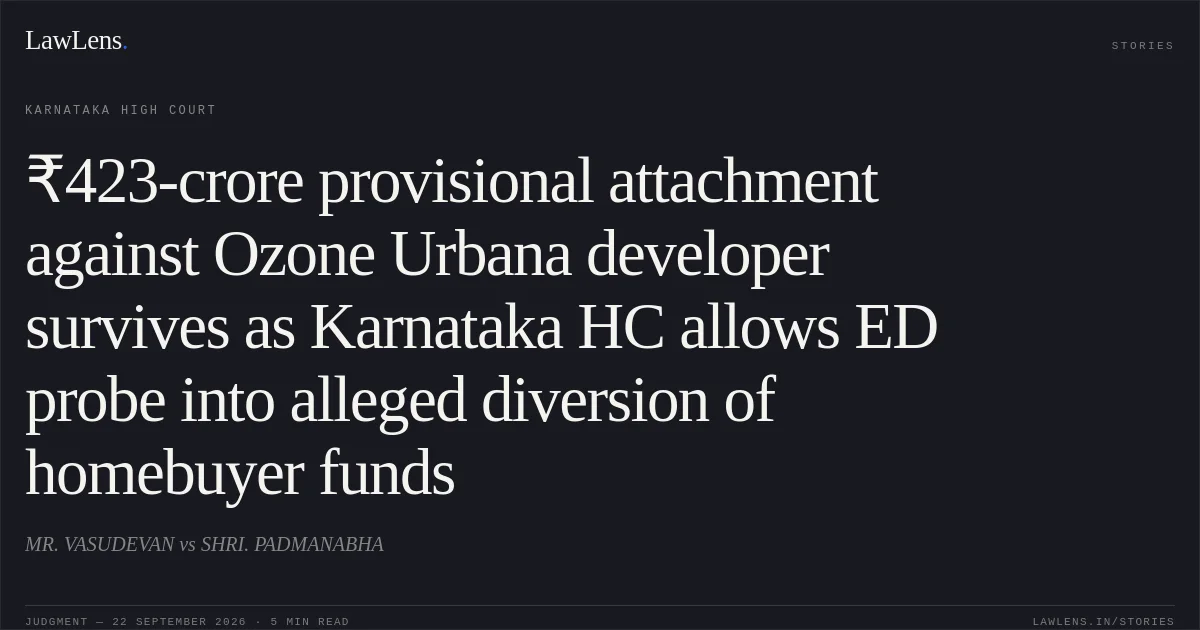
Source reference: pp.18–30, paras 4–9The Enforcement Directorate subsequently registered a 2025 ECIR based on multiple crimes, including a CBI FIR registered pursuant to proceedings before the Supreme Court concerning alleged collusion between builders and financial institutions under subvention schemes. On 4 October 2025, the Enforcement Directorate provisionally attached properties valued at approximately ₹423.38 crores under Section 5(1) of the PMLA.
Source reference: pp.27–30, para 9; pp.182–198, paras 24.5–24.6Issues
1. Whether the criminal proceedings arising from the contractor’s complaint, which principally sought recovery of unpaid contractual dues, disclosed offences under the IPC or amounted to an abuse of process of law?
Source reference: pp.46–58, para 192. Whether the 2022 ECIR and the consequential summons under Section 50 of the PMLA were liable to be quashed because the predicate FIRs had subsequently been quashed or stayed?
Source reference: pp.58–89, para 203. Whether the criminal proceedings initiated by home buyers under Sections 406 and 420 of the IPC and Section 15 of the Karnataka Ownership of Flats Act were merely civil disputes and therefore liable to be quashed at the threshold?
Source reference: pp.90–106, paras 21–224. Whether the KPIDFE Act could prima facie apply to monies collected from home buyers under subvention, buy-back and tripartite arrangements?
Source reference: pp.106–149, para 235. Whether the 2025 ECIR and the provisional attachment order under Section 5(1) of the PMLA were liable to be quashed for want of a surviving scheduled offence or for absence of a sufficient nexus between the alleged proceeds of crime and the attached properties?
Source reference: pp.149–208, para 24Law Applied
The Court applied Sections 406, 409, 420 and 120-B of the IPC; Section 15 of the Karnataka Ownership of Flats Act, which permits prosecution of a company and persons responsible for its business; and Sections 2(2), 2(3), 2(4) and 9 of the KPIDFE Act concerning “deposit,” “depositor,” “financial establishment” and fraudulent default.
Source reference: pp.96–99, para 21; pp.117–120, para 23It applied the principles governing quashing under Section 482 Cr.P.C. and Articles 226 and 227, including State of Haryana v. Bhajan Lal, that proceedings may be quashed where allegations, even if accepted in full, do not disclose an offence or constitute an abuse of process, but that disputed facts and legitimate investigations should not be prematurely examined.
Source reference: pp.50–58, para 19.4Relying on Anukul Singh v. State of U.P., Indian Oil Corporation v. NEPC India Ltd., Inder Mohan Goswami v. State of Uttaranchal, Ganga Dhar Kalita v. State of Assam and Shailesh Kumar Singh v. State of Uttar Pradesh, the Court held that criminal law cannot be used as a debt-recovery mechanism, although a contractual transaction may also disclose criminality where the requisite ingredients are pleaded.
Source reference: pp.50–58, para 19.4Under Vijay Madanlal Choudhary v. Union of India, money-laundering proceedings require a scheduled offence and proceeds of crime, but may continue where the predicate complaint or investigation survives; quashing of a predicate case on technical or procedural grounds does not automatically extinguish the ECIR.
Source reference: pp.80–89, para 20.9–20.11For attachment proceedings, the Court relied on Sections 5, 8 and 26 of the PMLA and JSW Steel Ltd. v. Enforcement Directorate, holding that provisional attachment is subject to adjudication by the Adjudicating Authority and appeal to the Appellate Tribunal, making writ interference ordinarily premature.
Source reference: pp.200–205, paras 24.10–24.12In interpreting the KPIDFE Act, the Court relied on State of Maharashtra v. 63 Moons Technologies Ltd., Alka Agrawal v. State of Maharashtra and Manohar Bhimrao Mahalle v. State of Maharashtra, which recognise a broad meaning of “deposit” and permit monies paid by flat purchasers against a promised construction service to fall within the statutory concept.
Source reference: pp.121–149, paras 23.5.1–23.10Reasoning
The Court distinguished the contractor’s complaint from the home-buyers’ complaints. In W.P. No.20063/2022, the allegations concerned completed civil works, part-payment and recovery of the alleged balance amount. The assertions of threats and cheating were treated as embellishments to a fundamentally contractual monetary claim; the complaint did not disclose the dishonest intention or other ingredients necessary for cheating or criminal breach of trust. Criminal proceedings could therefore not be used to compel payment of a disputed debt.
Source reference: pp.46–58, para 19In contrast, the home-buyers’ complaints contained allegations of inducement, receipt of approximately 95% of the sale consideration, failure to complete or deliver the units, diversion of project funds, non-payment of agreed EMIs and, in one case, sale of the same unit to another purchaser. These allegations, taken at face value, disclosed sufficient prima facie criminal content and required investigation rather than a mini-trial at the quashing stage.
Source reference: pp.70–78, paras 20.2–20.6; pp.94–106, paras 21–22The omission to array the company as an accused in one case was held curable; it did not justify quashing the entire crime, and the police were permitted to array the company in accordance with law.
Source reference: pp.96–99, para 21.5–21.6The Court further held that the surviving private complaint in PCR No.20/2022 preserved the substratum of the scheduled offence despite the quashing of the consequential FIR on procedural grounds. Accordingly, the 2022 ECIR and Section 50 summons were not foundationless.
Source reference: pp.78–89, paras 20.6–20.11The allegations concerning subvention, buy-back schemes and promised services also justified investigation under the KPIDFE Act, since the statutory concept of “deposit” is determined by the substance and return obligation of the transaction, not its nomenclature.
Source reference: pp.146–149, paras 23.6–23.10Finally, the 2025 ECIR was supported by surviving predicate proceedings, including the CBI FIR, while the merits of the alleged diversion, layering and nexus between properties and proceeds of crime were matters for investigation and statutory adjudication. The provisional attachment could not be invalidated merely because the petitioners disputed the ED’s factual conclusions.
Source reference: pp.182–208, paras 24.5–24.16Holding
W.P. No.20063/2022 was allowed. All proceedings arising from P.C.R. No.54725/2022 pending before the X Additional Chief Metropolitan Magistrate, Bengaluru, were quashed qua the petitioners, as the complaint was essentially a money-recovery dispute arising from a civil works contract.
All other writ petitions were dismissed. The Court declined to quash the 2022 and 2025 ECIRs, the Section 50 PMLA summons, the criminal proceedings arising from the home-buyers’ complaints, or the provisional attachment order.
Source reference: p.210, order (iii)The attachment-related objections were left open for consideration before the Adjudicating Authority and, thereafter, the Appellate Tribunal under the PMLA.
Source reference: p.205, paras 24.10–24.12Pending applications were disposed of.
Source reference: p.210Acts & Sections Cited
47 provisions across 14 statutes referred to in this judgment. Each provision opens on LawLens.
Bharatiya Nagarik Suraksha Sanhita, 20231
Code of Criminal Procedure, 19735
Indian Penal Code, 1860
Prevention of Money-Laundering Act, 20028
Prevention of Corruption Act, 19882
KARNATAKA PROTECTION OF INTEREST OF DEPOSITORS IN FINANCIAL ESTABLISHMENTS ACT, 20043
KARNATAKA OWNERSHIP FLATS (REGULATION OF THE PROMOTION OF CONSTRUCTION, SALE, MANAGEMENT AND TRANSFER) ACT, 1972.1
Maharashtra Protection of Interest of Depositors (in Financial Establishments) Act, 19994
Maharashtra Ownership Flats (Regulation of the promotion of construction, sale, management and transfer) Act, 19631
Banking Regulation Act, 19491
Chit Funds Act, 19821
General Clauses Act, 18971
Protection of Women from Domestic Violence Act, 20051
Insolvency and Bankruptcy Code, 2016.1
Original Court PDF
MR. VASUDEVANvsSHRI. PADMANABHA
Click to open original judgment
Original judgment, available to read, download and summarize on LawLens.in