01Facts
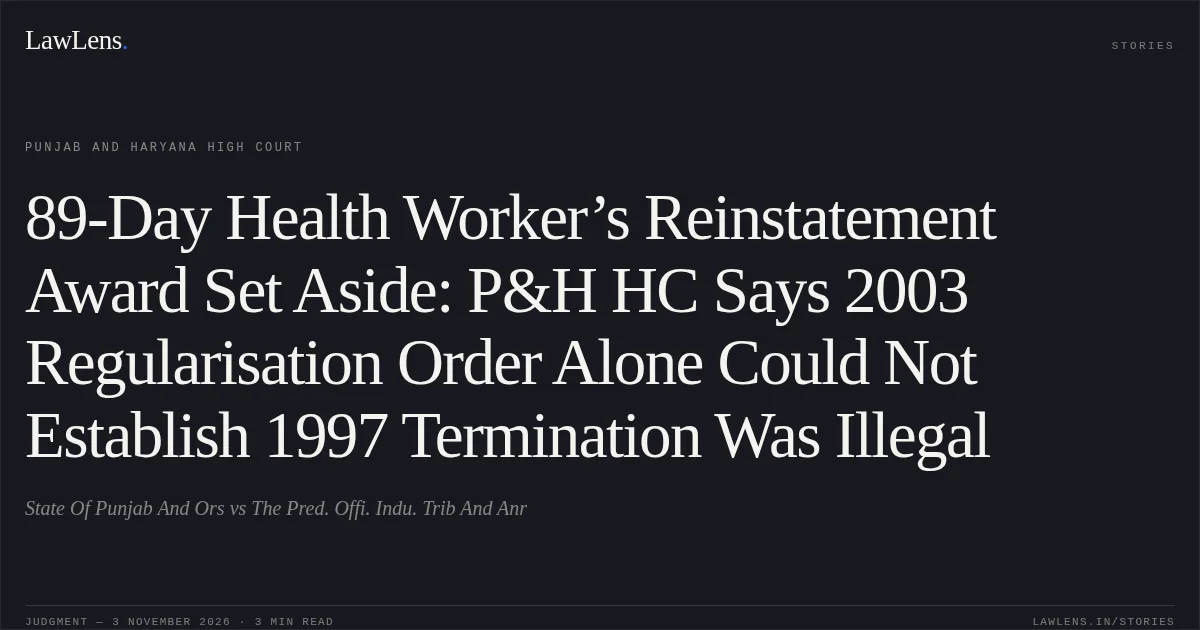
Respondent No. 2 was engaged as a Ward Attendant on successive 89-day/ad hoc appointments from 2 September 1993 until 6 July 1997, with intervening breaks. After participating in a regular selection process on 27 June 1997, he was not selected, and his engagement ended shortly thereafter
¶ 2–3, 17–18 · pp. 2–3, 9–10He challenged the cessation, alleging non-compliance with the Industrial Disputes Act, 1947, and entitlement to regularisation under Government instructions. The Industrial Tribunal held in his favour and ordered reinstatement with continuity of service and 50% back wages from the date of his demand notice
¶ 1, 5 · p. 1, 3The State challenged the award under Articles 226 and 227 of the Constitution
¶ 1 · p. 102Issues
i.1. Whether the Tribunal was justified in holding the cessation of the workman’s engagement illegal and awarding reinstatement, continuity of service and back wages, particularly in light of his successive 89-day appointments and the regularisation instructions
¶ 11 · p. 5ii.2. Whether the Tribunal properly considered the appointment terms, the circumstances of cessation, the applicability of Section 25-F and the exception under Section 2(oo)(bb) of the Industrial Disputes Act, 1947
¶ 17–20 · pp. 9–10iii.3. Whether the Tribunal adequately addressed the workman’s asserted entitlement under the Government instructions and the State’s objections concerning delay and the applicability of the Act
¶ 13–16, 21–22 · pp. 6–8, 1103Law Applied
Under Articles 226 and 227 of the Constitution, the High Court does not reappreciate evidence merely because another view is possible, but may intervene where an award contains an error of law, is perverse, or fails to consider material evidence and issues
¶ 12 · p. 6Under the Industrial Disputes Act, 1947, Section 25-F applies where cessation amounts to retrenchment; completion of 240 days alone does not resolve that question, which requires consideration of the definition of retrenchment in Section 2(oo), including the exclusion in Section 2(oo)(bb) for cessation in accordance with a contractual stipulation
¶ 20 · p. 10A later regularisation instruction does not, without examination of its terms and scope, establish that an earlier cessation was illegal
¶ 14–15 · pp. 7–8Reasons are an essential component of judicial and quasi-judicial decisions; the Court relied on Kranti Associates (P) Ltd. v. Masood Ahmed Khan, (2010) 9 SCC 496, for that principle
¶ 22 · p. 11Provisions in the judgment · 3
Industrial Disputes Act, 1947 Section 2ASection 25FSection 2
04Reasoning
The Tribunal based its award substantially on an office order regularising certain employees in District Mansa, without examining the underlying 2003 instructions, whether they covered the workman’s engagement in District Ferozepur, or whether they affected the legality of a cessation in 1997
¶ 14–15, 23 · pp. 7–8, 12It also failed to assess the successive appointment terms, intervening breaks, expiry of the final spell, and the workman’s non-selection in the regular recruitment process
¶ 17–18 · pp. 9–10Although the evidence included an admission that no retrenchment compensation had been paid, the Tribunal had not first determined whether the cessation constituted retrenchment or whether Section 2(oo)(bb) applied
¶ 20 · p. 10The Tribunal also did not give reasoned consideration to the objections concerning delay and the department’s coverage by the Act
¶ 21 · p. 11These omissions rendered the award unsustainable under the applicable supervisory-review standard
¶ 22–23 · pp. 11–1205Holding
The High Court allowed the writ petition and set aside the Tribunal’s award of 4 October 2010, holding that the award could not stand because material evidence and legal issues had not been properly examined
¶ 23–24 · p. 12The judgment records no remand direction
¶ 24 · p. 12Original Court PDF
State Of Punjab And OrsvsThe Pred. Offi. Indu. Trib And Anr
Click to open original judgment
Original judgment, available to read, download and summarize on LawLens.in