Facts
The petitioner claimed that his caste had been incorrectly recorded in his school records as Hindu Lingayat instead of Hindu Navi.
Source reference: p. 3–7He obtained a civil-court decree in 2009 directing correction of the school records, but applied for a Village Accountant post in 2009 under Category III-B and was not selected.
Source reference: p. 3–7In 2024, he sought consideration under Category II-A; the request was rejected.
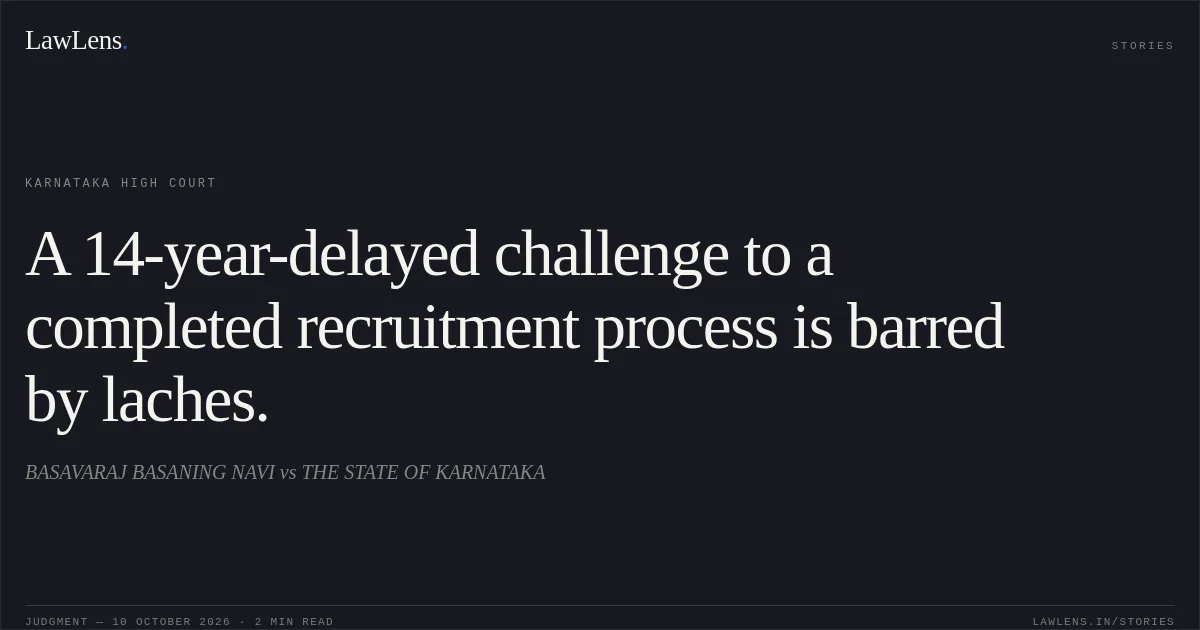
Source reference: p. 3–7The Karnataka State Administrative Tribunal dismissed his application, finding that the recruitment challenge was brought after an inordinate delay and that the civil decree directed correction of school records, not issuance or correction of a caste certificate.
Source reference: p. 3–7The petitioner challenged the Tribunal’s order before the High Court.
Source reference: p. 2, 7–8Issues
1. Whether the Tribunal’s dismissal of the petitioner’s application on the grounds of delay and laches warranted interference under Articles 226 and 227 of the Constitution
Source reference: p. 2, 6–82. Whether the petitioner should be permitted to approach the appropriate forum to seek correction of his caste records or certificate
Source reference: p. 7–8Law Applied
The Court considered the principles of delay and laches and the need for finality in a recruitment process that had concluded and in which selected candidates had already joined service.
Source reference: p. 7It also proceeded on the distinction between a civil-court decree directing correction of school records and the authority competent to issue or rectify a caste certificate; the judgment identifies no statute or precedent by name on this point.
Source reference: p. 6–7The Court did not set out a separate statutory test or precedent governing the exercise of its jurisdiction under Articles 226 and 227.
Source reference: no citationReasoning
The High Court found no fault with the Tribunal’s conclusion that the petitioner had approached it many years after the 2009 recruitment and that the recruitment process was complete.
Source reference: p. 7–8It also noted the petitioner’s submission that his caste-certificate error required correction, while observing that the civil suit had not involved the State and that the decree concerned school records rather than the competent authority’s power over caste certificates.
Source reference: p. 7Rather than reopen the completed selection or grant appointment-related relief, the Court left the petitioner to pursue any available remedy before the appropriate forum.
Source reference: p. 7–8Holding
The High Court did not interfere with the Tribunal’s order or disturb the completed recruitment process.
It disposed of the writ petition while reserving the petitioner’s liberty to approach the appropriate forum, if a remedy remained available in law, concerning the purpose for which he had filed the civil suit; all contentions were left open.
Source reference: p. 8Original Court PDF
BASAVARAJ BASANING NAVIvsTHE STATE OF KARNATAKA
Click to open original judgment
Original judgment, available to read, download and summarize on LawLens.in