Facts
The petitioner challenged the opinion dated 28 October 2019 passed by the Foreigners Tribunal–XI, Barpeta, in Bpt/11th F.T. Case No. 1468/2017, declaring him a foreigner who entered India post-1971.
Source reference: p.2, para.1Before the Tribunal, he examined himself and his brother and relied upon voters’ lists of 1966, 1970 and 1985. The 1966 voters’ list contained the names of his parents, while the 1970 and 1985 voters’ lists contained the petitioner’s name.
Source reference: p.3, para.4The petitioner contended that his inclusion in the 1970 voters’ list established his presence in India before 1971.
Source reference: p.4, para.6The State disputed the sufficiency of the evidence, particularly the absence of documentary proof showing continuous residence after 1970.
Source reference: p.4, para.6The High Court also found no documentary linkage establishing that the petitioner was in India before 1966.
Source reference: p.5, para.10Issues
Whether the Foreigners Tribunal erred in declaring the petitioner a post-1971 foreigner despite the 1970 voters’ list containing his name.
Source reference: p.3, paras.4–5; p.5, para.9Whether, in the absence of documentary evidence establishing the petitioner’s presence in India before 1966, the petitioner could nevertheless be declared a foreigner in the 1966–1971 stream.
Source reference: p.5, paras.10–12Law Applied
The Court applied Section 9 of the Foreigners Act, 1946, under which the burden of proving that a person is not a foreigner lies upon that person, notwithstanding anything contained in the Indian Evidence Act, 1872.
Source reference: p.4, para.8The Court reiterated that this burden remains on the proceedee and does not shift.
Source reference: p.4, para.8It further applied the principle that reliable documentary evidence, including a voters’ list showing a person’s presence in India before the relevant cut-off date, must be properly considered; however, oral evidence of a projected relative cannot, by itself, establish citizenship.
Source reference: p.5, para.9Reasoning
The Court found that the 1966 voters’ list did not contain the petitioner’s name and therefore did not establish his own presence in India before 1966.
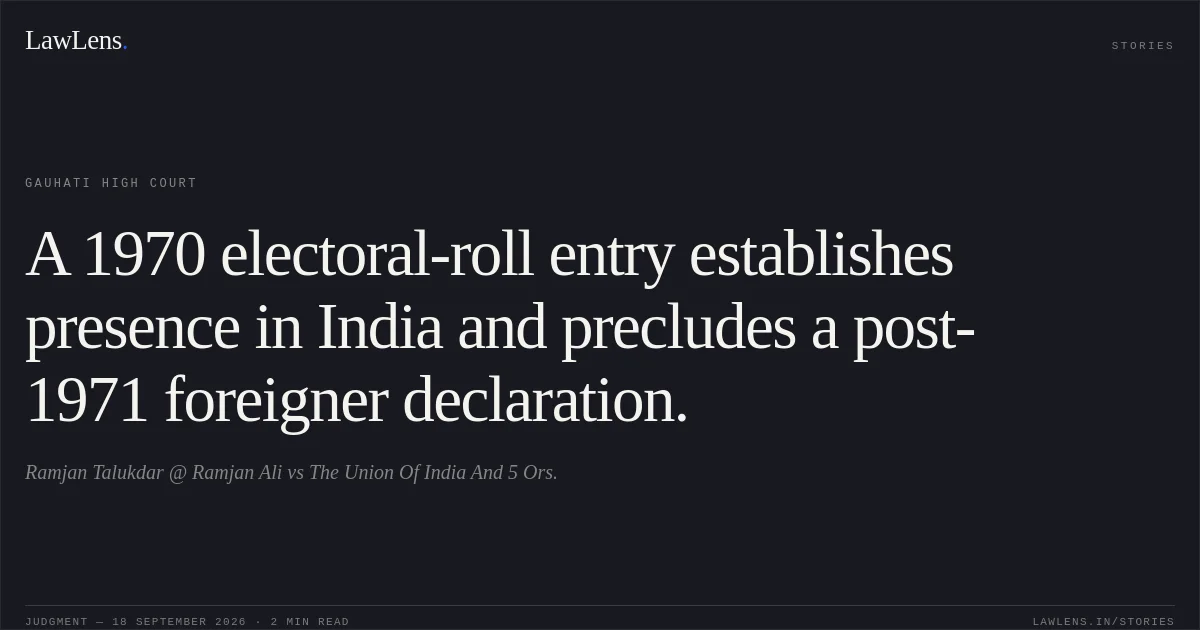
Source reference: p.5, para.9However, the 1970 voters’ list expressly included the petitioner along with his parents, and the 1985 voters’ list further corroborated his presence in India.
Source reference: p.5, para.9Since the 1970 voters’ list established that the petitioner was present in India before 1971, the Tribunal could not validly classify him as a post-1971 foreigner.
Source reference: p.5, para.9At the same time, the absence of documentary or otherwise acceptable evidence proving his presence in India before 1966 prevented the Court from treating him as an Indian citizen for the earlier period.
Source reference: p.5, paras.10–12The appropriate legal consequence was therefore to place the petitioner in the 1966–1971 foreigner stream rather than the post-1971 stream.
Source reference: p.5, paras.10–12Holding
The High Court set aside the Foreigners Tribunal’s opinion insofar as it declared the petitioner a post-1971 foreigner.
However, because the petitioner failed to establish his presence in India before 1966, the Court held that his declaration as a foreigner would operate in the 1966–1971 stream.
Source reference: p.5, para.12The writ petition was accordingly allowed, the petitioner was directed to take the consequential steps prescribed by law, and the records were ordered to be returned to the Tribunal.
Source reference: p.6, paras.13–15Acts & Sections Cited
2 provisions across 1 statute referred to in this judgment. Linked provisions open on LawLens.
Foreigners Act, 19462
Original Court PDF
Ramjan Talukdar @ Ramjan AlivsThe Union Of India And 5 Ors.
Click to open original judgment
Original judgment, available to read, download and summarize on LawLens.in