Facts
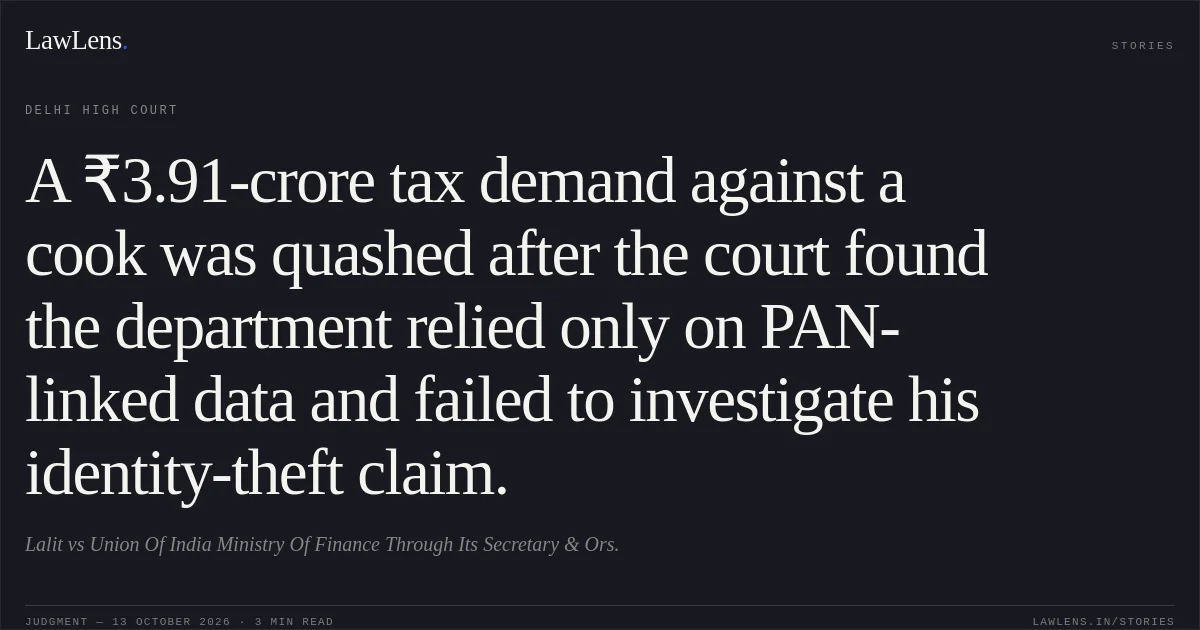
The petitioner, a contractual security guard and cook, received a notice under Section 148A(b) of the Income-tax Act, 1961, alleging transactions involving cash purchases of ₹24,86,63,500 and cash sales of ₹24,62,01,485 linked to his PAN for AY 2017–18.
Source reference: para. 2–3He denied conducting the transactions, alleged misuse of his PAN, filed police and cyber-cell complaints, and sought particulars of the transactions.
Source reference: para. 4–5The Assessing Officer treated the combined amounts as turnover, estimated income at 8%, and raised a demand of approximately ₹3.91 crore.
Source reference: para. 5–6The petitioner challenged the assessment by writ petition; the respondents objected that he should pursue the statutory appeal.
Source reference: para. 10, 12Issues
1. Whether the petitioner should be relegated to the statutory appeal remedy, or whether the writ petition was maintainable in view of the alleged breach of natural justice, the scale of the demand, and the petitioner’s limited means.
Source reference: para. 12–182. Whether the assessment could stand where the petitioner denied the transactions and the Assessing Officer relied on PAN-linked information without supplying the requested material or conducting independent inquiry.
Source reference: para. 14, 19–233. Whether the Assessing Officer correctly treated the purchase and sale figures as separate components of turnover.
Source reference: para. 23Law Applied
Article 14 requires non-arbitrary State action, and Article 21 protects life and dignity, including mental health; the Court relied on Maneka Gandhi v. Union of India, (1978) 1 SCC 248, Francis Coralie Mullin v. Administrator, Union Territory of Delhi, (1981) 1 SCC 608, and Sukdeb Saha v. State of Andhra Pradesh, 2025 INSC 893.
Source reference: para. 14, 16A writ court may entertain a petition despite an alternative statutory remedy where that remedy is ineffective in the circumstances or the proceedings disclose a breach of natural justice.
Source reference: para. 14An assessment based on undisclosed adverse material, without due consideration of the assessee’s response or adequate inquiry, is unsustainable.
Source reference: para. 14Section 133(6) of the Income-tax Act was identified as a means by which the Assessing Officer could have sought information from the alleged vendor.
Source reference: para. 20The Court also referred to the CBDT Office Memorandum dated 31 July 2017, under which a 20% deposit was the standard condition for stay of disputed demand, and to the continuing interest liability under Section 220(2).
Source reference: para. 13Reasoning
The Court held that the appeal remedy was not effective for this petitioner: a stay could require a deposit of approximately ₹78 lakh, which he could not afford, while interest and recovery exposure continued.
Source reference: para. 12–18On the merits, he had denied the transactions, produced complaints and bank statements, and presented a plausible account of employment as a contractual worker; the Assessing Officer had not supplied the requested transaction material or independently verified the alleged dealings with Montage Enterprises Pvt. Ltd.
Source reference: para. 14, 19–22The Court also found that the officer had added the purchase and sale figures together despite the Form 26AS information showing a net amount after tax collection, thereby overstating turnover.
Source reference: para. 23In these circumstances, the assessment was arbitrary and procedurally unfair, and the demand had serious consequences for the petitioner’s ability to protect his rights.
Source reference: para. 14–18, 21–23Holding
The Court entertained the writ petition notwithstanding the alternative remedy and quashed and set aside the assessment order dated 17 March 2025.
It left open the respondents’ ability to initiate proceedings afresh if they find cogent material linking the petitioner to the transactions, subject to the applicable limitation period.
Source reference: para. 26The writ petition was allowed on those terms.
Source reference: para. 27Acts & Sections Cited
3 provisions across 1 statute referred to in this judgment. Linked provisions open on LawLens.
Income Tax Act, 19613
Original Court PDF
LalitvsUnion Of India Ministry Of Finance Through Its Secretary & Ors.
Click to open original judgment
Original judgment, available to read, download and summarize on LawLens.in