Facts
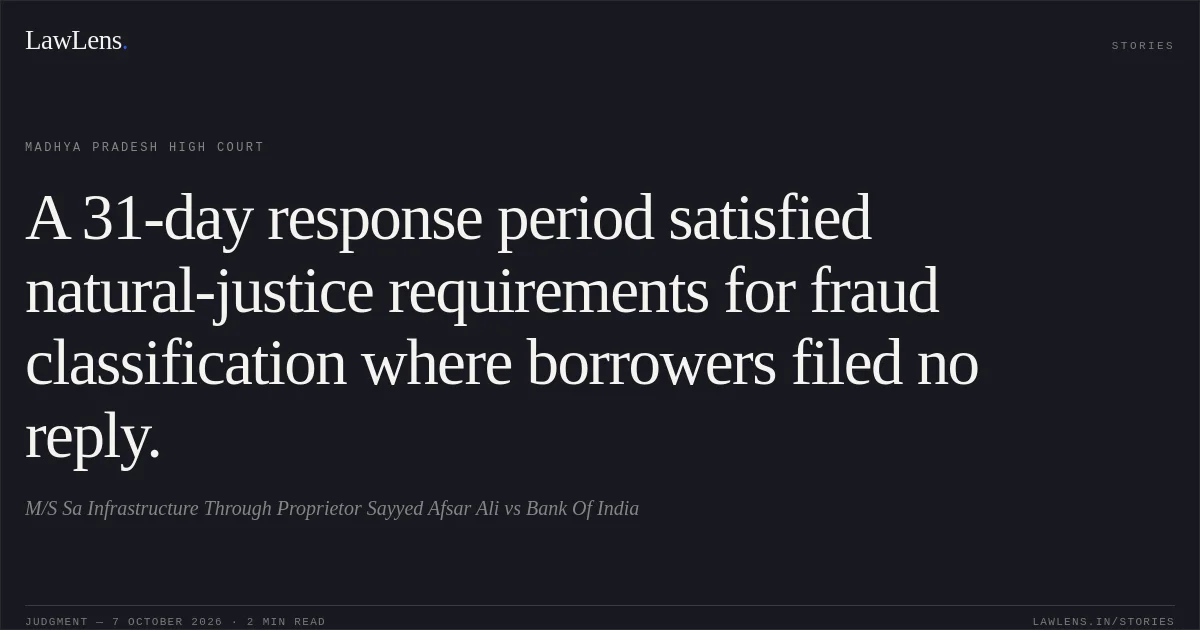
Three connected writ petitions challenged Bank of India orders classifying the petitioners’ accounts as “fraud”: the order concerning SA Infrastructure was dated 24 August 2026, and the orders concerning the accounts of SMO Ferro Alloys Ltd. and V.R. Construction were dated 10 September 2026.
Source reference: para. 1–5, 9The petitioners contended that they could not submit a complete reply because their records were with the GST Department, and challenged the opportunity afforded and the decision-making process.
Source reference: para. 1–5, 9The Bank maintained that the petitioners had been given 31 days to respond, exceeding the 21-day period under the applicable directions, and that the classifications were based on forensic audit material.
Source reference: para. 1–5, 9Issues
1. Whether the Bank’s procedure for classifying the accounts as fraud complied with natural justice and the RBI Master Directions, including the opportunity to respond to the audit material.
Source reference: para. 3–5, 8–92. Whether the petitioners established a procedural defect warranting interference under Article 226, including on the grounds that their records were with the GST Department and that the notice and decision were issued by different Bank authorities.
Source reference: para. 3, 9Law Applied
Under Article 226, the Court reviews the legality of the decision-making process rather than sitting in appeal over the merits of the Bank’s decision.
Source reference: para. 4State Bank of India v. Rajesh Agarwal, (2023) 6 SCC 1, recognizes the serious civil and penal consequences of fraud classification and requires a fair procedure, including a reasoned decision reflecting due application of mind.
Source reference: para. 6–7, quoting Rajesh Agarwal paras. 49–50 and 94The Court also applied State Bank of India v. Amit Iron Private Limited, Civil Appeal Nos. 4243–4244 of 2026, decided 7 April 2026, which held that Rajesh Agarwal does not create a right to a personal hearing and affirmed the procedure under the RBI Master Directions of 15 July 2024; where an audit report, including a forensic audit report, is relied upon, it must be furnished to the borrower, subject to justified withholding of portions affecting third-party rights.
Source reference: para. 8, quoting Amit Iron para. 126The Court treated 21 days as the applicable minimum response period under the Master Directions.
Source reference: para. 9Reasoning
The Court found that the petitioners had been allowed 31 days to respond, exceeding the stated 21-day minimum, but had not submitted a reply.
Source reference: para. 9It rejected the explanation that the records were with the GST Department as insufficient to establish that the Bank failed to follow the prescribed procedure.
Source reference: para. 9It also found no illegality in the notice being issued by the Zonal Manager and the decision being made by the Fraud Monitoring Group: the decision was based on available material, including forensic audit findings, and the petitioners had not shown arbitrariness, impropriety or illegality in the process.
Source reference: para. 9Accordingly, the Court held that the asserted procedural grounds did not justify writ intervention.
Source reference: para. 9Holding
The Court found no procedural illegality or breach of natural justice warranting interference under Article 226 and dismissed all three writ petitions.
No relief was granted.
Source reference: para. 9–11Acts & Sections Cited
1 provisions across 1 statute referred to in this judgment. Each provision opens on LawLens.
Central Goods and Services Tax Act, 20171
Original Court PDF
M/S Sa Infrastructure Through Proprietor Sayyed Afsar AlivsBank Of India
Click to open original judgment
Original judgment, available to read, download and summarize on LawLens.in