Facts
The appellant’s husband, Lakshman Das, was allegedly taken from his home on 12 February 2020 by Jageshwar Das and Narayan Das on the pretext of withdrawing money; the appellant alleged that others later joined them and that the group conspired to kill him.
Source reference: p. 2; p. 4The appellant lodged a case on 16 February 2020, and the deceased’s body was found in a well the following day.
Source reference: p. 4The post-mortem attributed death to asphyxia due to throttling and estimated the time since death as 24–36 hours.
Source reference: p. 5The accused were charged under Sections 363/34, 364/34, 302/34, 201/34 and 120B IPC; the trial court acquitted them, and the appellant challenged that acquittal.
Source reference: p. 1; p. 3Issues
1. Whether the prosecution established a complete and reliable chain of circumstantial evidence sufficient to prove the respondents’ guilt for the charged offences
Source reference: p. 3; p. 52. Whether the evidence of motive, last-seen circumstances and alleged conspiracy warranted interference with the trial court’s acquittal
Source reference: p. 4; p. 5Law Applied
The respondents faced charges under Sections 363, 364, 302, 201 and 120B IPC, read with Section 34 IPC.
Source reference: p. 1; p. 3In a case resting on circumstantial evidence, where the evidence reasonably permits two views—one consistent with guilt and the other with innocence—the view favourable to the accused must be adopted.
Source reference: p. 3; p. 4The Court relied on Shivaji Chintappa Patil v. State of Maharashtra, (2021) 5 SCC 626, which restated this principle with reference to Sharad Birdhichand Sarda v. State of Maharashtra, (1984) 4 SCC 116, and Kali Ram v. State of H.P., (1973) 2 SCC 808.
Source reference: p. 3; p. 4It also relied on Devi Lal v. State of Rajasthan, (2019) 19 SCC 447, on the benefit of the view favourable to the accused in cases based on circumstantial evidence.
Source reference: p. 4Reasoning
The Court found no eyewitness to the murder.
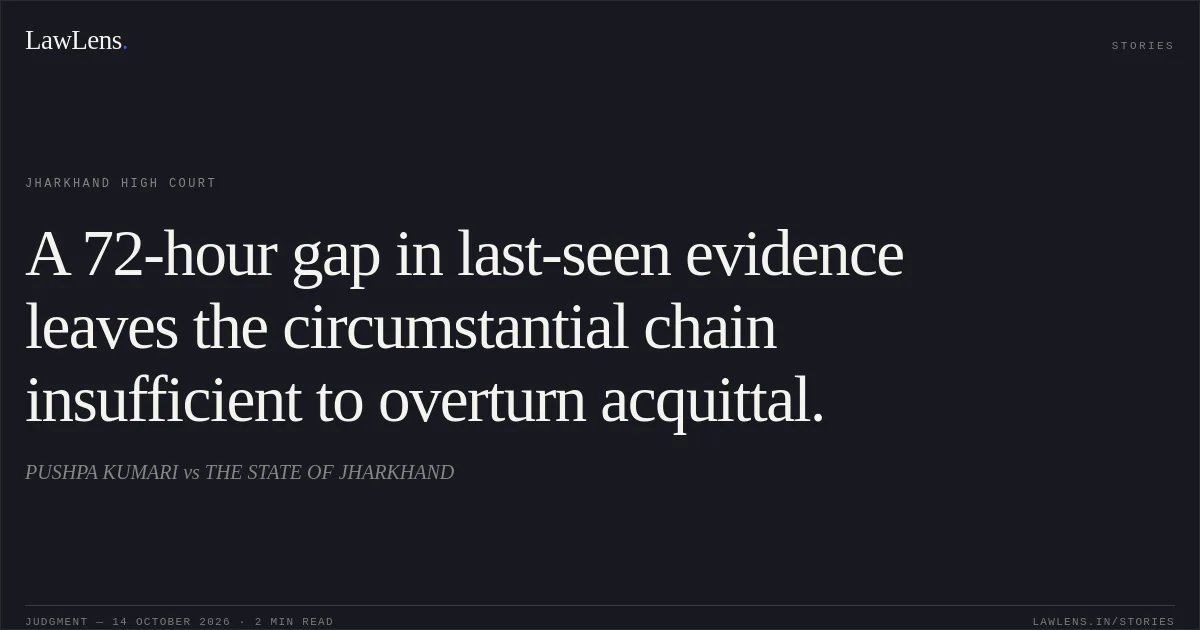
Source reference: p. 5Although witnesses placed the deceased in the company of some accused on 12 February, the post-mortem evidence indicated death around 15 or 16 February, leaving an interval of approximately 72 hours that the prosecution had not satisfactorily explained.
Source reference: p. 5The alleged motive was stated by the appellant but did not, by itself, establish the accused’s guilt.
Source reference: p. 4; p. 5The alleged presence of the son-in-law of Jageshwar Das at the chowmin stall was not corroborated: PW-4’s account was based on what she had heard from villagers, while the stall owner, PW-2, did not identify him as one of the customers.
Source reference: p. 5The doctor also found no finger marks on the deceased’s body.
Source reference: p. 5Taken together, these circumstances were insufficient to exclude the reasonable possibility consistent with the respondents’ innocence.
Source reference: p. 3; p. 5Holding
The Court held that the circumstantial evidence was too weak to sustain conviction and found no reason to interfere with the trial court’s acquittal.
The acquittal appeal was dismissed, and any pending interlocutory applications were disposed of.
Source reference: p. 6Acts & Sections Cited
5 provisions across 1 statute referred to in this judgment. Each provision opens on LawLens.
Indian Penal Code, 18605
Original Court PDF
PUSHPA KUMARIvsTHE STATE OF JHARKHAND
Click to open original judgment
Original judgment, available to read, download and summarize on LawLens.in


