Facts
The petitioner and respondent no. 6 contested the election for Ward No. 8, Lezam (Kha), of No. 13 Chunari Gaon Panchayat. Polling took place on 7 May 2025 and counting on 11 May 2025. The petitioner secured 360 votes, respondent no. 6 secured 358 votes, and the third candidate secured 60 votes; accordingly, the petitioner was declared elected under Form XVII(A).
Source reference: p. 3–4; para. 4Respondent no. 6 challenged the election under Section 127 of the Assam Panchayat Act, 1994, alleging discrepancies between Forms VIII and IX(A), non-counting of a postal ballot, arbitrary rejection of valid votes, unauthorized interference in the counting process, and corrupt practices. She sought recounting of the ballots and setting aside of the petitioner’s election.
Source reference: p. 4–5; paras. 5–6, 13Before any evidence was recorded, the Election Tribunal, Goalpara, by order dated 6 March 2026, directed the District Commissioner to produce the ballot papers in sealed trunks to facilitate recounting.
Source reference: p. 5–7; paras. 8, 11The petitioner challenged that order under Article 226 of the Constitution, contending that recounting could not be ordered merely on the basis of unproved allegations.
Source reference: p. 10; para. 12Issues
Whether an Election Tribunal can direct production and recounting of ballot papers before recording evidence and merely on the basis of allegations made in the election petition?
Source reference: p. 10–11; paras. 12, 20–21Whether the Election Tribunal’s order dated 6 March 2026 directing production of the ballots for recounting was legally sustainable in the circumstances of the case?
Source reference: p. 6–7, 10–11; paras. 11, 20–21Whether the secrecy of the ballot and the statutory safeguards governing counting permit recounting without a prima facie evidentiary foundation demonstrating counting irregularities?
Source reference: p. 7–10; paras. 14–19Law Applied
The Court exercised judicial review under Article 226 of the Constitution and considered Section 127 of the Assam Panchayat Act, 1994, under which the election petition had been filed, together with Rule 44 of the Assam Panchayat (Constitution) Rules, 1995, which prescribes the procedure for counting votes and declaring election results.
Source reference: p. 5–6, 10; paras. 8, 12–13, 19Applying Suresh Prasad Yadav v. Jai Prakash Mishra, (1975) 4 SCC 822, the Court held that inspection or recounting cannot be ordered as a matter of course; the election petition must contain adequate material facts, the allegations must be prima facie established on the basis of evidence, and recounting must be imperatively necessary for deciding the dispute.
Source reference: p. 7–8; para. 15Vadivelu v. Sundaram, (2008) 8 SCC 355, establishes that recounting is an exceptional remedy requiring specific pleadings and proof of improper acceptance of invalid votes or rejection of valid votes, consistent with the sacrosanct nature of ballot secrecy.
Source reference: p. 8–9; para. 16Udey Chand v. Surat Singh, (2009) 10 SCC 170, further requires adequate material facts and evidentiary material demonstrating a prima facie case before recounting; the order must not be based mechanically on allegations or on the result of a subsequent recount.
Source reference: p. 9–10; paras. 17–17.1The Court also followed Apsara Begum v. State of Assam.
Source reference: p. 10; para. 18Reasoning
The Tribunal directed production of the ballots and proposed recounting before any party had led evidence.
Source reference: p. 6; para. 8Although respondent no. 6 alleged a one-vote discrepancy between Forms VIII and IX(A), wrongful rejection of votes, and irregularities in the counting process, the Tribunal did not record findings based on evidence establishing these allegations prima facie.
Source reference: p. 4–5, 6–7; paras. 6, 11Under Rule 44 and the governing Supreme Court precedents, the narrow margin of two votes and the existence of allegations were insufficient by themselves to justify disturbing ballot secrecy.
Source reference: p. 5–7, 10–11; paras. 10–12, 20–21The Tribunal was required first to assess the pleadings and evidence and determine whether recounting was imperatively necessary.
Source reference: p. 5–7, 10–11; paras. 10–12, 20–21Since the impugned order was passed mechanically, without considering the petitioner’s defence and before the evidentiary stage, it failed to satisfy the legal threshold for ordering recounting.
Source reference: p. 5–7, 10–11; paras. 10–12, 20–21Holding
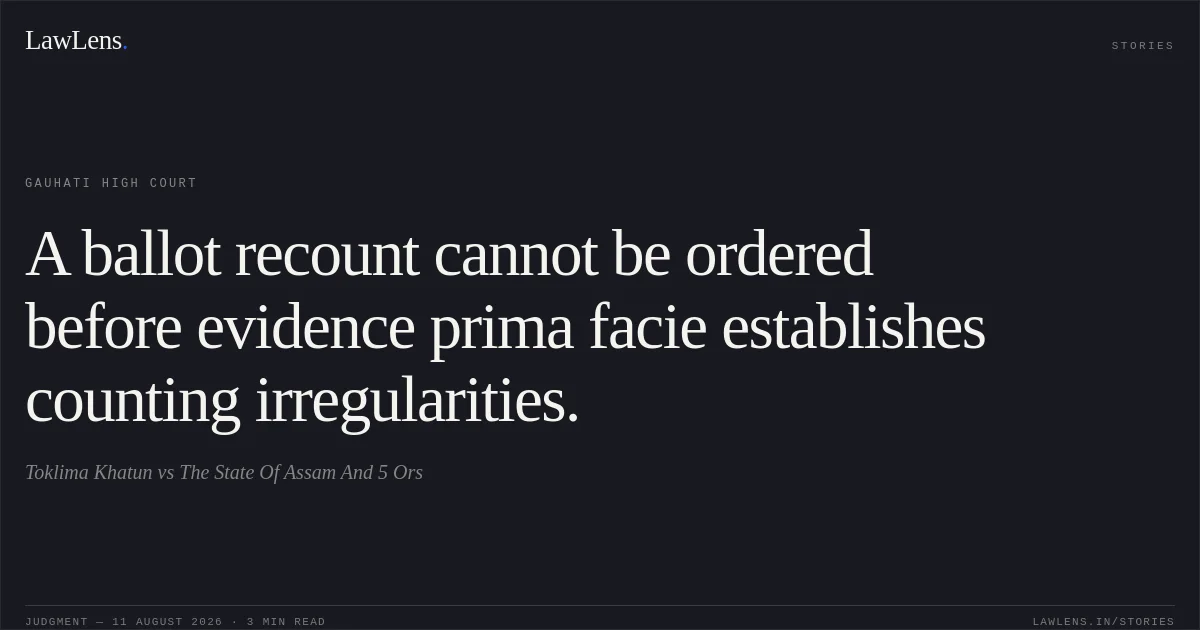
The Gauhati High Court held that the Election Tribunal could not order production and recounting of the ballot papers before evidence was recorded and solely on the basis of unproved allegations.
The order dated 6 March 2026 was therefore set aside and quashed, and the writ petition was allowed.
Source reference: p. 11; para. 21The District Commissioner, Goalpara, was directed to preserve the ballot papers relating to the election for Ward No. 8, Lezam (Kha), for production before the Tribunal if and when required in accordance with law.
Source reference: p. 11; para. 22Acts & Sections Cited
1 provisions across 1 statute referred to in this judgment. Each provision opens on LawLens.
Assam Panchayat Act, 19941
Original Court PDF
Toklima KhatunvsThe State Of Assam And 5 Ors
Click to open original judgment
Original judgment, available to read, download and summarize on LawLens.in