Facts
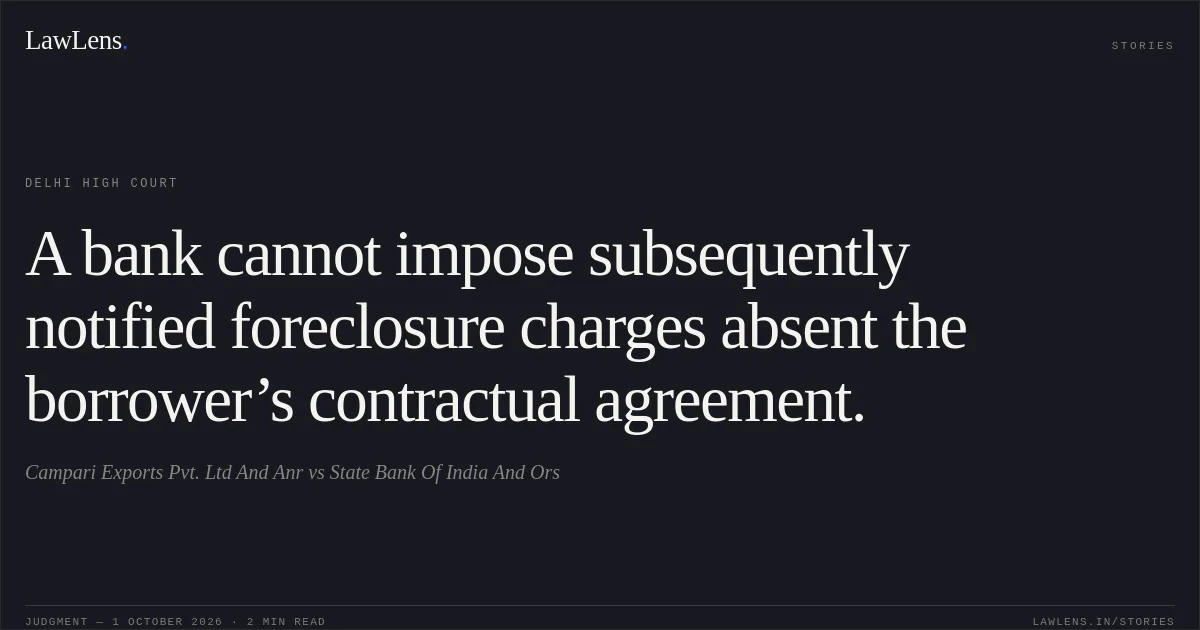
The petitioners challenged SBI’s deduction of ₹83,41,632 as foreclosure charges when petitioner No. 1, an MSME, closed its loan facility.
Source reference: p. 1–3, 7–8The facility had been renewed by arrangement letters dated 18 February 2022, 20 December 2022 and 24 March 2023; none expressly provided for foreclosure charges.
Source reference: p. 1–3, 7–8SBI relied on a circular dated 24 February 2023, effective from 1 April 2023, and on contractual language referring to other charges notified on its website from time to time.
Source reference: p. 1–3, 7–8The petitioners sought a refund under Article 226.
Source reference: p. 1–3, 7–8Issues
Whether SBI could levy foreclosure charges under a circular that took effect after the last renewal of the loan facility, where the arrangement letters did not expressly provide for those charges.
Source reference: p. 7–8Whether a general clause permitting charges notified on the bank’s website from time to time bound the petitioners to subsequently introduced foreclosure charges without their specific agreement.
Source reference: p. 7–8Law Applied
The Court applied the principles of contract formation and variation: contractual terms must be clear and unambiguous, and a subsequent alteration cannot bind a contracting party without that party’s specific agreement.
Source reference: p. 8–9It considered Union of India v. Krupanidhi Education Trust, (2021) 18 SCC 318, for the proposition that a concluded loan agreement incorporating pre-payment charges binds the parties; the Court distinguished that decision because the charges there were included in the agreement and the relevant circular pre-dated it.
Source reference: p. 6, 8–9Article 226 was the procedural basis for the petition.
Source reference: p. 1Reasoning
The arrangement letters contained no specific provision for foreclosure charges, and the circular relied on by SBI became effective on 1 April 2023—after the final renewal on 24 March 2023.
Source reference: p. 7–8The general reference to charges notified from time to time did not, in the Court’s view, incorporate the later charge into the parties’ contract or amount to the petitioners’ specific agreement to an alteration of its terms.
Source reference: p. 7–8The cited Supreme Court decision did not assist SBI because, unlike in that case, the charge and applicable circular were not part of, or in force before, the relevant agreement.
Source reference: p. 9The Ombudsman’s decision concerned deficiency of service, not contractual alteration, and did not resolve the issue before the Court.
Source reference: p. 9Holding
The Court allowed the petition.
The Court directed SBI to refund ₹83,41,632 to the petitioners within four weeks of uploading the order.
Source reference: p. 9If SBI failed to do so, the amount would carry interest at 9% per annum.
Source reference: p. 9Original Court PDF
Campari Exports Pvt. Ltd And AnrvsState Bank Of India And Ors
Click to open original judgment
Original judgment, available to read, download and summarize on LawLens.in