Facts
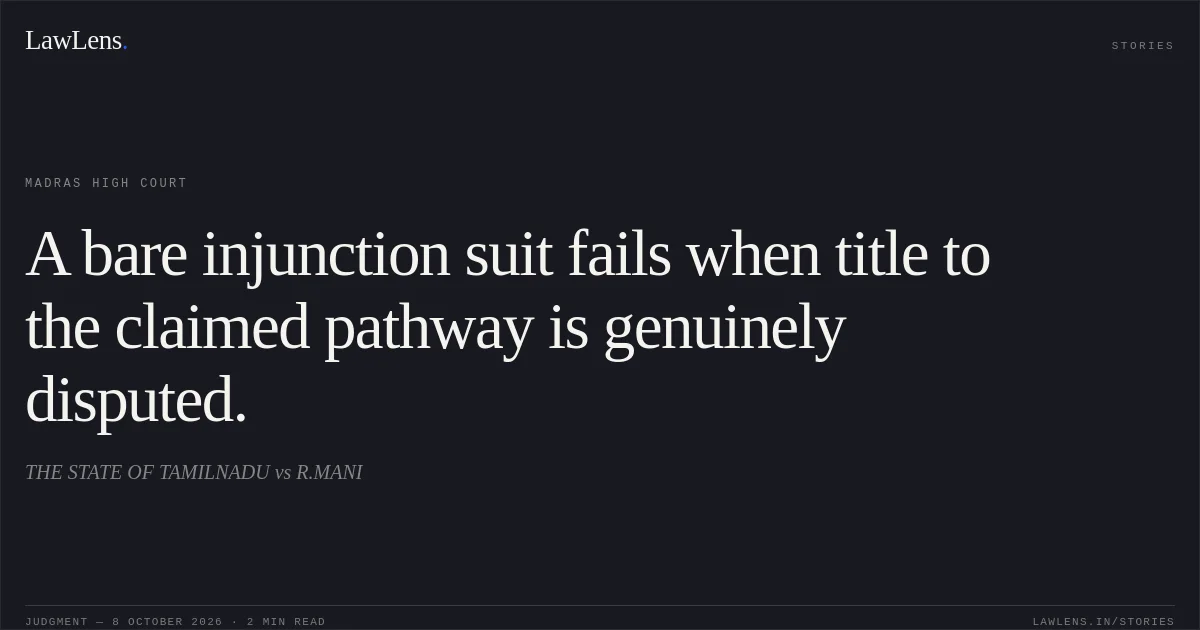
The plaintiff sought mandatory and permanent injunctions requiring the defendants, police officials, to remove a structure allegedly built across a pathway and to refrain from further construction.
Source reference: para. 4He claimed that villagers had long used the disputed portion of Survey No.148/5 to access the main road.
Source reference: para. 4The defendants denied that it was a pathway and asserted that the land formed part of property allotted to the Police Department.
Source reference: para. 4The trial court decreed the suit, and the first appellate court affirmed that decree.
Source reference: para. 4–9Issues
Whether the courts below could grant an injunction when the revenue settlement “A” Register recorded Survey No.148/5 in the defendants’ name.
Source reference: para. 10(i)Whether the decree could stand despite the alleged absence of documentary evidence establishing a pathway through Survey No.148/5, and the FMB records relied on by the defendants.
Source reference: para. 10(ii)Whether the suit was maintainable without a prayer for declaration where the defendants disputed the plaintiff’s asserted right over the property.
Source reference: para. 10(iii), 24–26Law Applied
Under Section 101 of the Indian Evidence Act, 1872, the party asserting a fact necessary to obtain judgment bears the burden of proving it.
Source reference: para. 16(1), 22Under Section 100 of the Code of Civil Procedure, concurrent factual findings may be interfered with in second appeal in recognized circumstances, including where they are based on no evidence, ignore material evidence, apply the law erroneously, or wrongly cast the burden of proof.
Source reference: para. 20–21Applying Anathula Sudhakar v. P. Buchi Reddy, the Court treated a suit for bare injunction as inappropriate where a cloud over title required adjudication; a court should not determine title without the necessary pleadings and issues, and parties may need to pursue a comprehensive suit for declaration.
Source reference: para. 16(2), 25It also relied on Bachhaj Nahar v. Nilima Mandal for the principle that an easementary right must be specifically pleaded and proved, including its nature and mode of acquisition.
Source reference: para. 16(3)Reasoning
The Court held that the plaintiff bore the burden of establishing that the disputed portion was a pathway and had produced no official or other documentary material demonstrating that status; his rough sketch, telegram, and the Tahsildar’s memo did not establish it.
Source reference: para. 22–23By contrast, the defendants produced the FMB sketch, “A” Register extract, and adangal, which the Court considered supportive of their claim that the land was Police Department property.
Source reference: para. 24The plaintiff had not pleaded or established an easementary right, and the commissioner’s report—prepared without assistance from revenue officials—was not sufficient to establish title or the pathway’s status.
Source reference: para. 26, 28In the Court’s view, the defendants’ claim created a cloud over the property, making the injunction suit without declaratory relief not maintainable; the lower courts’ findings therefore warranted interference under the second-appeal principles it applied.
Source reference: para. 24–29Holding
The High Court answered the substantial questions of law in favour of the defendants.
It allowed the second appeal, set aside the judgments and decrees of both lower courts, and dismissed the plaintiff’s suit.
Source reference: para. 29–30It made no order as to costs and closed the connected miscellaneous petition.
Source reference: para. 29–30Acts & Sections Cited
1 provisions across 1 statute referred to in this judgment. Each provision opens on LawLens.
Code of Civil Procedure, 19081
Original Court PDF
THE STATE OF TAMILNADUvsR.MANI
Click to open original judgment
Original judgment, available to read, download and summarize on LawLens.in