Facts
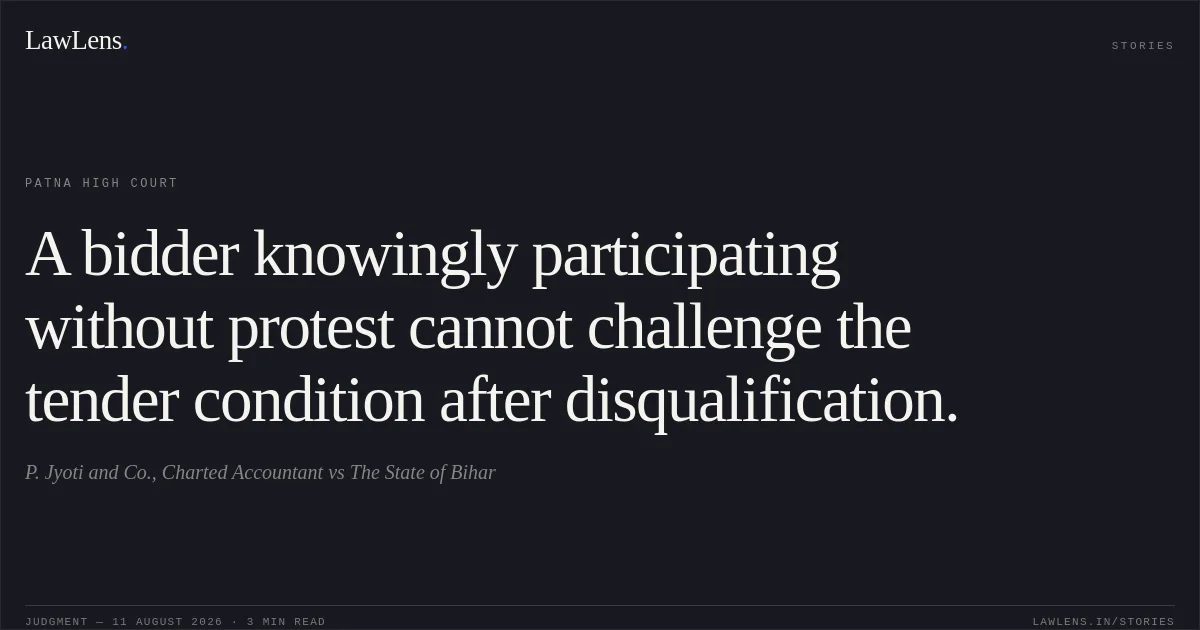
The petitioner, a Chartered Accountant partnership firm, challenged Clause 9 of the Request for Proposal issued by Babasaheb Bhimrao Ambedkar Bihar University under Tender Notice No. BU/2026/02 dated 18 April 2026 for appointment of Chartered Accountant firms to provide financial management and technical support services to the University and its constituent and affiliated colleges.
Source reference: pp. 3–4Clause 9 disqualified any bidder that had previously been associated with the University, its constituent colleges, or its affiliated colleges. The petitioner had earlier provided professional services to affiliated institutions and had participated in a previous tender for similar services, in which it was declared the lowest bidder, although no work order was issued. Despite knowing of Clause 9, the petitioner submitted its bid and Earnest Money Deposit, but was technically disqualified solely because of its prior association with the University’s affiliated colleges.
Source reference: p. 4It then sought quashing of Clause 9, a declaration that its disqualification was illegal and arbitrary, and a direction permitting it to participate in the financial bid.
Source reference: pp. 2–3Issues
Whether the petitioner, having participated in the tender process with full knowledge of Clause 9, could subsequently challenge the validity of that condition after being technically disqualified under it?
Source reference: pp. 6–9; paras. 10–16Whether Clause 9, which disqualified bidders having prior association with the University, its constituent colleges, or affiliated colleges, was arbitrary, irrational, discriminatory, or violative of Article 14 of the Constitution?
Source reference: pp. 9–10; paras. 10, 17–25Law Applied
The Court applied the doctrine of approbation and reprobation, under which a bidder who knowingly participates in a selection or tender process cannot challenge the same conditions merely after suffering an adverse result. Relying on Madan Lal v. State of J&K, (1995) 3 SCC 486, and the principle stated in Om Prakash Shukla v. Akhilesh Kumar Shukla, the Court held that a candidate who takes a calculated chance in a process cannot subsequently question its fairness after an unfavourable outcome.
Source reference: pp. 7–9; para. 13On tender review, the Court relied on Michigan Rubber (India) Ltd. v. State of Karnataka, (2012) 8 SCC 216, holding that the tendering authority is ordinarily the best judge of eligibility conditions and that judicial interference is limited to cases of mala fides, arbitrariness, irrationality, or favouritism.
Source reference: pp. 10–12; para. 20It also relied on N.G. Projects Ltd. v. Vinod Kumar Jain, (2022) 6 SCC 127, and BLT EPC Ltd. v. Macawber Beekay Pvt. Ltd., (2024) 12 SCC 614, for the principle that courts should exercise restraint in contractual and commercial matters and should not substitute their own view for the procuring authority’s commercial judgment.
Source reference: pp. 12–14; paras. 21–22Article 14 requires fairness and non-arbitrariness in State action, but does not confer a fundamental right to secure a government contract.
Source reference: pp. 10–12; para. 20Reasoning
The Court held that the petitioner was fully aware of Clause 9 before submitting its bid, yet participated in the process without seeking pre-bid clarification or challenging the condition at that stage. Having taken a calculated chance of selection, it could not challenge the clause only after being disqualified under it; such conduct was barred by the principle of approbation and reprobation.
Source reference: pp. 6–9; paras. 11–16On the constitutional challenge, the Court found that Clause 9 applied uniformly to all prospective bidders and was not shown to have been framed to favour or exclude any particular firm.
Source reference: p. 15; para. 23The condition had a discernible rationale: ensuring institutional independence and avoiding actual or perceived conflicts of interest in the provision of financial and technical support services.
Source reference: p. 15; para. 23Whether a less restrictive or commercially preferable condition could have been adopted was a matter of policy for the University, not a ground for judicial substitution of opinion under Article 226.
Source reference: pp. 15–16; paras. 23–24The petitioner therefore failed to establish manifest arbitrariness, mala fides, irrationality, or violation of Article 14.
Source reference: no citationHolding
The Court answered both issues against the petitioner. It held that the petitioner, having knowingly participated in the tender, could not subsequently challenge Clause 9 after its technical disqualification.
It further upheld Clause 9 as a uniform and rational eligibility condition, not shown to be arbitrary, discriminatory, mala fide, or violative of Article 14.
Source reference: pp. 15–16; para. 25The writ petition was dismissed for lack of merit, and any pending interlocutory applications were also disposed of.
Source reference: p. 16; paras. 26–28Original Court PDF
P. Jyoti and Co., Charted AccountantvsThe State of Bihar
Click to open original judgment
Original judgment, available to read, download and summarize on LawLens.in