Facts
The petitioner, a Sub-Inspector in the Special Armed Force (SAF), was sent on deputation to the Special Task Force (STF) by order dated 21 August 2019 and repatriated to SAF on 13 February 2020.
Source reference: pp. 1–2, 8–9On 2 May 2025, about five years after his repatriation, STF issued him a charge-sheet concerning alleged interference in an STF investigation; STF appointed an Enquiry Officer on 1 June 2026.
Source reference: pp. 2, 6The petitioner challenged both orders, contending that STF lacked authority to proceed against him after repatriation. The State argued that STF and SAF were units of the same Police Department and that the petitioner had remained in the same employment.
Source reference: pp. 3–5Issues
Whether the borrowing department may initiate or continue disciplinary proceedings under Rule 20 of the Madhya Pradesh Civil Services (Classification, Control and Appeal) Rules, 1966, after an employee’s deputation has ended and the employee has been repatriated to the parent department.
Source reference: para. 23; pp. 9–13Whether STF could proceed against the petitioner after repatriation on the ground that STF and SAF are units of the same Police Department.
Source reference: paras. 24–26; pp. 13–15Law Applied
Rule 20 of the Madhya Pradesh Civil Services (Classification, Control and Appeal) Rules, 1966 empowers a borrowing department to take disciplinary action against a government servant while the deputation-related master–servant relationship subsists; that authority ends when the employee is repatriated to the parent department.
Source reference: para. 23; pp. 9–13The Court applied the Division Bench ruling in B.L. Satyarthi v. State of M.P., 2015(1) MPLJ, which interpreted Rule 20 to limit the borrowing department’s disciplinary powers to the period of deputation.
Source reference: para. 23; pp. 9–13The Court also considered GOP No. 129/08, which provides for deputation to specialised police units, as supporting the treatment of such units as distinct for deputation purposes.
Source reference: para. 25; p. 14Reasoning
The Court found it admitted that the petitioner had been sent on deputation from SAF to STF and later repatriated to SAF, and that STF issued the charge-sheet years after repatriation.
Source reference: para. 26; pp. 14–15Applying B.L. Satyarthi, the Court held that Rule 20’s authority depends on the borrowing department’s service relationship with the deputed employee and ceases when that relationship ends upon repatriation.
Source reference: paras. 23–24; pp. 9–13It rejected the State’s argument that STF’s place within the Police Department meant there had been no deputation: GOP No. 129/08 recognised deputation to specialised units, and the petitioner’s orders expressly described deputation and repatriation.
Source reference: paras. 21–22, 25–26; pp. 7–9, 14–15STF therefore lacked authority to issue the charge-sheet after the petitioner’s repatriation.
Source reference: para. 26; p. 15Holding
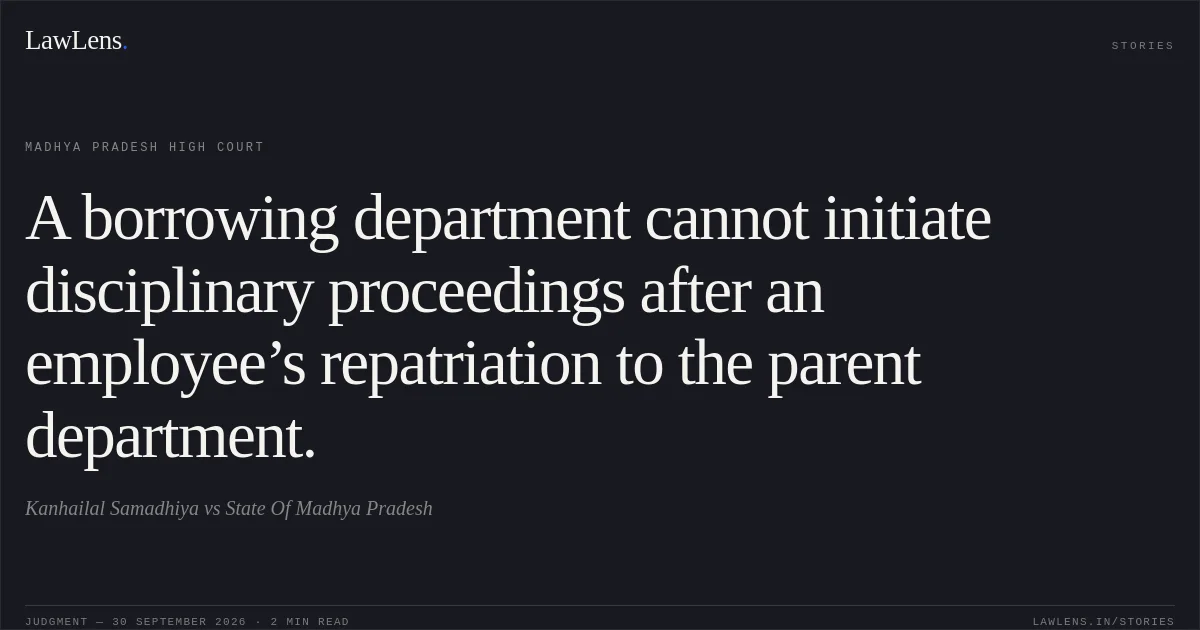
The Court held that STF could not initiate disciplinary proceedings against the petitioner after his repatriation to SAF.
It set aside the charge-sheet dated 2 May 2025 and the order dated 1 June 2026 appointing the Enquiry Officer, while granting the respondents liberty to take appropriate action in accordance with law.
Source reference: paras. 26–29; p. 15Original Court PDF
Kanhailal SamadhiyavsState Of Madhya Pradesh
Click to open original judgment
Original judgment, available to read, download and summarize on LawLens.in
![Casual presenters who hold no civil post fall outside the Tribunal’s jurisdiction.. DR NARESH KUMAR SRIVASTAV vs I & B. CAT - ['Patna']. LawLens](/stories/thumbnails/casual-presenters-who-hold-no-civil-post-fall-outside-the-tribunals-jurisdiction-8d95966512e7495fabb22f22ef31dbda.webp)
![Comparative-merit decisions on compassionate appointment warrant no interference absent demonstrated illegality.. MUKESH KUMAR vs POST HARYANA CIRCLE. CAT - ['Chandigarh']. LawLens](/stories/thumbnails/comparative-merit-decisions-on-compassionate-appointment-warrant-no-interference-absent-de-4e99f9f1109d47c7879847495a413d0c.webp)
![Departmental delay cannot deny an applicant fair consideration for compassionate appointment.. RACHPAL SINGH vs POSTS. CAT - ['Chandigarh']. LawLens](/stories/thumbnails/departmental-delay-cannot-deny-an-applicant-fair-consideration-for-compassionate-appointme-4321754285c84db18b35adb6ac872075.webp)