Facts
During evening patrol on 9 October 2017, police received information that a person was creating a nuisance while intoxicated.
Source reference: pp. 2–4The police found the appellant, who allegedly fled and was apprehended.
Source reference: pp. 2–4A breath-analyser test recorded alcohol content of 74 mg/100 ml, and a case was registered under Section 37(b) of the Bihar Prohibition and Excise Act, 2016.
Source reference: pp. 2–4The trial court convicted the appellant and sentenced him to five years’ rigorous imprisonment and a fine of ₹6,00,000.
Source reference: pp. 2–4He appealed, challenging the sufficiency and reliability of the prosecution evidence.
Source reference: pp. 2–4Issues
1. Whether the prosecution proved beyond reasonable doubt that the appellant committed an offence under Section 37(b) of the Bihar Prohibition and Excise Act, 2016
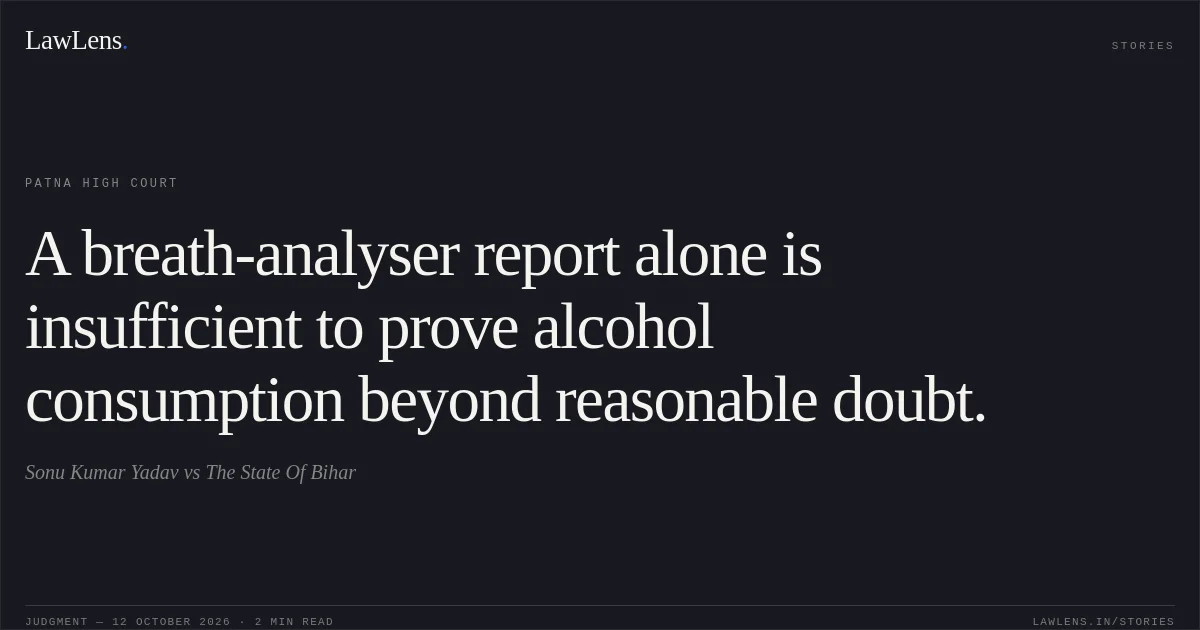
Source reference: pp. 3–52. Whether the breath-analyser report, without medical or other corroborative evidence and without evidence establishing the machine’s reliability, was sufficient to sustain the conviction
Source reference: pp. 4–5Law Applied
The Court considered Section 37(b) of the Bihar Prohibition and Excise Act, 2016, under which the appellant had been convicted.
Source reference: p. 2Relying on Manju Devi v. State of Bihar (citation not provided) and Bachubhai Hassanalli Karyani v. State of Maharashtra, (1971) 3 SCC 930, it treated a breath-analyser report as not conclusive proof of alcohol consumption and referred to blood or urine testing as a means of ascertaining consumption.
Source reference: p. 5The prosecution was required to prove the charge beyond reasonable doubt.
Source reference: p. 5Reasoning
Although police witnesses supported the appellant’s apprehension and the generation of the breath-analyser report, the prosecution presented no independent public witness or medical examination, obtained no blood or urine samples, and produced no evidence concerning the machine’s calibration, accuracy, or technical verification.
Source reference: pp. 4–5In those circumstances, the report was not conclusive proof of the offence, and the appellant’s signatures on documents did not establish the truth of their contents or substitute for substantive proof.
Source reference: p. 5The Court therefore found the prosecution had not proved the charge beyond reasonable doubt.
Source reference: p. 5Holding
The Court allowed the appeal, set aside the conviction and sentence, and acquitted Sonu Kumar Yadav of the charge on the benefit of doubt.
As he was on bail, he was discharged from the liability of his bail bond.
Source reference: p. 6Acts & Sections Cited
1 provisions across 1 statute referred to in this judgment. Each provision opens on LawLens.
BIHAR PROHIBITION AND EXCISE ACT, 20161
Original Court PDF
Sonu Kumar YadavvsThe State Of Bihar
Click to open original judgment
Original judgment, available to read, download and summarize on LawLens.in
![Competent authority must reconsider transfer-waiting-list priority through a reasoned order.. Prabhat Kumar Srivastwa vs NORTH CENTRAL RAILWAY. CAT - ['Allahabad']. LawLens](/stories/thumbnails/competent-authority-must-reconsider-transfer-waiting-list-priority-through-a-reasoned-orde-e23ccd4eaf154e82b09ea183b25e32fb.webp)
![Excess-pay recovery from retired Group C employees is impermissible absent fraud or misrepresentation.. SATYA NAND YADAV vs NORTH EASTERN RAILWAY. CAT - ['Allahabad']. LawLens](/stories/thumbnails/excess-pay-recovery-from-retired-group-c-employees-is-impermissible-absent-fraud-or-misrep-c357cbdd195c44d68331385eea2a3c9a.webp)