Facts
The applicant invoked Section 482 of the Code of Criminal Procedure, 1973, seeking quashing of FIR C.R. No. II-3005 of 2010 registered at DCB Police Station, Ahmedabad, for offences under Sections 3, 5, 7 and 9 of the Immoral Traffic Act, 1956, and Section 188 of the Indian Penal Code.
Source reference: p.1The FIR alleged that a raid was conducted at Hotel Dev Palace, where the hotel manager, customers and other persons were found; the prosecution alleged that the hotel was being used as a brothel and that girls had been brought from outside the State.
Source reference: pp.1–2The applicant was arrested and charge-sheeted as a customer, and the charge-sheet was registered as Criminal Case No. 330 of 2010.
Source reference: p.2Issues
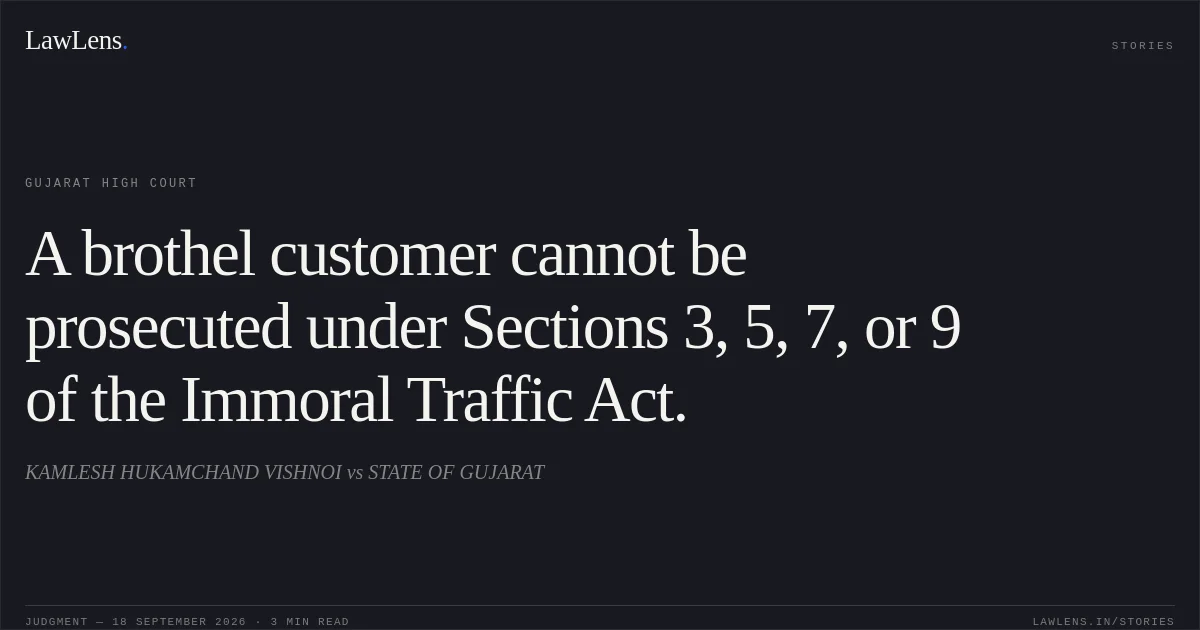
Whether an individual arraigned and apprehended merely as a customer during a raid at an alleged brothel can be prosecuted under Sections 3, 5, 7 and 9 of the Immoral Traffic Act, 1956?
Source reference: pp.3–5Whether the proceedings under Section 188 of the Indian Penal Code could continue against the applicant in the absence of a specific role attributed to him and in view of the bar under Section 195 of the Code of Criminal Procedure?
Source reference: p.3Law Applied
The Court applied Section 482 of the Code of Criminal Procedure, 1973, permitting the High Court to quash criminal proceedings to prevent abuse of process and secure the ends of justice.
Source reference: p.1Section 3 of the Immoral Traffic Act, 1956, penalises keeping a brothel or allowing premises to be used as a brothel; Section 5 concerns procuring or attempting to procure a person for prostitution; Section 7 addresses prostitution in or near public places; and Section 9 concerns seduction for prostitution by a person having authority or influence over the woman or girl.
Source reference: pp.4–5The Court held that these provisions, on the facts alleged, target persons such as brothel-keepers, procurers, agents, pimps or persons exercising authority, and do not ordinarily apply to a person merely present as a customer.
Source reference: pp.4–5It relied on the coordinate Bench decisions in Vishal Bhikhabhai Chavda v. State of Gujarat, 2025(0) AIJEL-HC 252088, and Sajjan Kalikant Zha v. State of Gujarat, 2026(0) AIJEL-HC 253939.
Source reference: p.3The Court also considered Section 195 of the Code of Criminal Procedure in relation to prosecution for Section 188 of the Indian Penal Code.
Source reference: p.3Reasoning
The prosecution and the charge-sheet described the applicant as a customer apprehended during the raid, not as the hotel owner, manager, brothel-keeper, procurer or person exercising authority over any woman.
Source reference: pp.2–4Consequently, Section 3 could not apply because the applicant was not alleged to have kept or permitted the use of premises as a brothel.
Source reference: p.4Section 5 was inapplicable because there was no allegation that he procured or attempted to procure any person for prostitution; the statutory concept of “procuring” was directed towards an agent or pimp rather than the customer himself.
Source reference: p.4The Court further held that Section 7 could not be invoked against the applicant merely because prostitution was allegedly occurring at a public place, particularly when the foundational ingredients connecting him with the prohibited activity were absent.
Source reference: pp.4–5Section 9 was also not attracted because there was no allegation or evidence that the applicant occupied a position of authority over the woman or girl or caused, aided or abetted her seduction for prostitution.
Source reference: p.5The learned APP did not dispute that the applicant had been charge-sheeted as a customer and accepted that the statutory offences under Sections 3, 5, 7 and 9 could not be attributed to him.
Source reference: p.3The Court also noted the absence of any specific role against the applicant concerning Section 188 IPC and accepted the challenge based on Section 195 CrPC.
Source reference: p.3Holding
The High Court allowed the application and quashed FIR C.R. No. II-3005 of 2010 registered at DCB Police Station, Ahmedabad, for offences under Sections 3, 5, 7 and 9 of the Immoral Traffic Act, 1956, and Section 188 of the Indian Penal Code, together with all consequential proceedings arising from it, insofar as they related to the applicant.
Rule was made absolute to that extent.
Source reference: p.5Acts & Sections Cited
9 provisions across 3 statutes referred to in this judgment. Each provision opens on LawLens.
Code of Criminal Procedure, 19732
Indian Penal Code, 18601
Original Court PDF
KAMLESH HUKAMCHAND VISHNOIvsSTATE OF GUJARAT
Click to open original judgment
Original judgment, available to read, download and summarize on LawLens.in