01Facts
The petitioner, an aspirant for the Second SLST, 2025, intended to claim reservation under the Economically Weaker Section (EWS) category but did not possess a valid EWS certificate when submitting the application.
¶ 3–7Accordingly, the petitioner applied under the general category.
¶ 3–7The Central School Service Commission subsequently prescribed a cut-off date permitting candidates to switch their candidature from the general category to the EWS category.
¶ 3–7The petitioner did not seek such conversion within the prescribed period because the EWS certificate was not then available.
¶ 3–7Although the certificate was subsequently issued, the petitioner sought permission to alter the candidature from general to EWS category, relying on a communication dated 10 August 2026 and the decision in Sonali Paul & Anr. v. The State of West Bengal & Ors.
¶ 9–10, 1502Issues
i.1. Whether a candidate who applied and participated in the Second SLST, 2025 under the general category, without possessing a valid EWS certificate, could subsequently convert the candidature to the EWS category after the prescribed cut-off date.
¶ 8–12ii.2. Whether permitting such post-cut-off conversion would violate the equality guarantees under Articles 14 and 16 of the Constitution by altering the prescribed rules of the selection process and affecting the earmarked EWS vacancies.
¶ 11–1303Law Applied
The Court applied the principle that the rules governing a recruitment or selection process cannot be altered after the process has commenced, particularly where such alteration would prejudice other candidates or compromise equality under Articles 14 and 16 of the Constitution.
¶ 11It further held that category eligibility must be determined in accordance with the applicable recruitment rules and the conditions prescribed by the recruiting authority; a candidate who did not satisfy the EWS criteria at the relevant stage could not claim conversion unless the rules expressly permitted it.
¶ 12The Court also relied on the principle of equal treatment of similarly situated candidates and recognised that candidates who participated within the earmarked EWS category had a legitimate expectation that the reserved zone would not subsequently be expanded by permitting ineligible or general-category candidates to enter it.
¶ 13The decision in Sonali Paul was distinguished on the ground that the candidates there possessed EWS certificates within the prescribed cut-off date.
¶ 1504Reasoning
The Court found that the petitioner admittedly lacked a valid EWS certificate when applying for the selection process and also failed to exercise the Commission’s limited opportunity for category conversion within the prescribed cut-off period.
¶ 8–10The subsequent issuance of the certificate did not retrospectively cure the petitioner’s failure to satisfy the applicable conditions within the relevant timeframe.
¶ 11–13Permitting conversion after the cut-off date would effectively alter the rules of the selection process and allow the petitioner to enter the earmarked EWS pool after other candidates had participated on the basis of the notified conditions.
¶ 11–13This would prejudice eligible EWS candidates, compromise the fairness of the selection process, and potentially violate Articles 14 and 16.
¶ 11–13The reasoning in Sonali Paul was held inapplicable because, unlike the present petitioner, the candidates in that case had obtained their EWS certificates within the prescribed cut-off date.
¶ 1505Holding
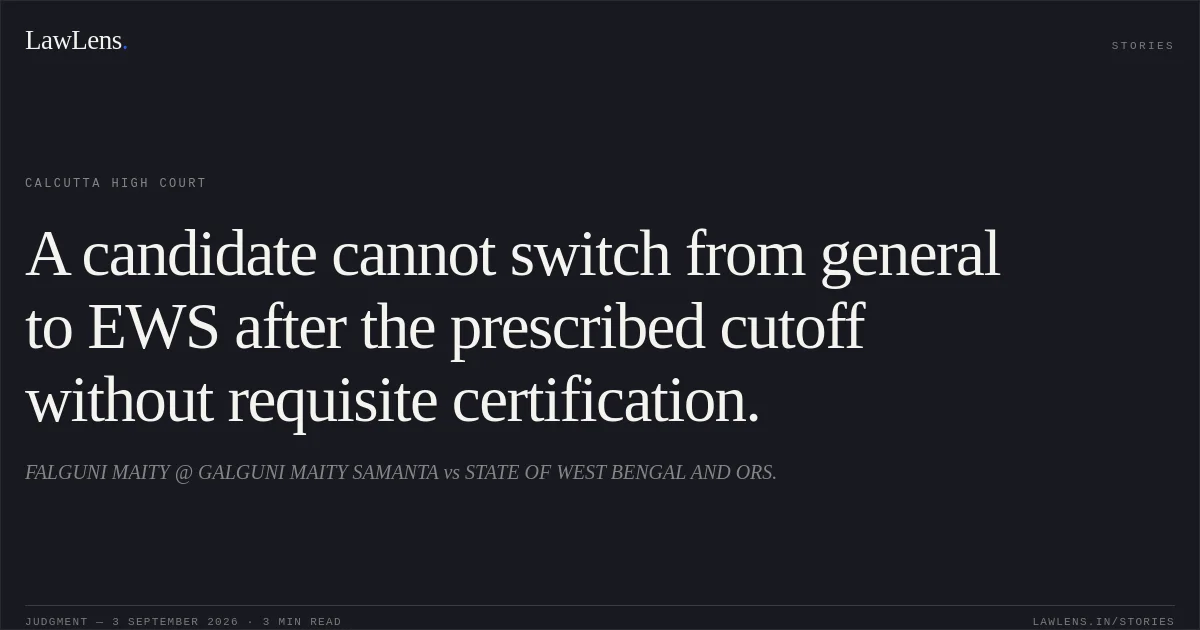
The Court held that the petitioner had no right to change the candidature from the general category to the EWS category after having participated under the general category and failed to seek conversion within the prescribed period.
¶ 14The writ petition was dismissed as devoid of merit, without any order as to costs.
¶ 16–18Since affidavits had not been called for, the allegations in the petition were not treated as admitted by the respondents.
¶ 16–18Parties were permitted to act on the basis of the server copy of the order obtained from the official website.
¶ 19Original Court PDF
FALGUNI MAITY @ GALGUNI MAITY SAMANTAvsSTATE OF WEST BENGAL AND ORS.
Click to open original judgment
Original judgment, available to read, download and summarize on LawLens.in