Facts
The appellant, an Assistant Registrar, Firms & Societies, Jabalpur, was arrayed as an accused in Crime No. 80 of 2022 concerning alleged misappropriation of funds, diversion of funds, and transactions involving immovable property of a society/trust affiliated with the Church of North India, Jabalpur Diocese.
Source reference: p.1A chargesheet was filed alleging offences under Sections 406, 420, 468, 471, 120-B, 109, 409 and 467 IPC, and Sections 7, 13(1)(b) and 13(2) of the Prevention of Corruption Act, 1988.
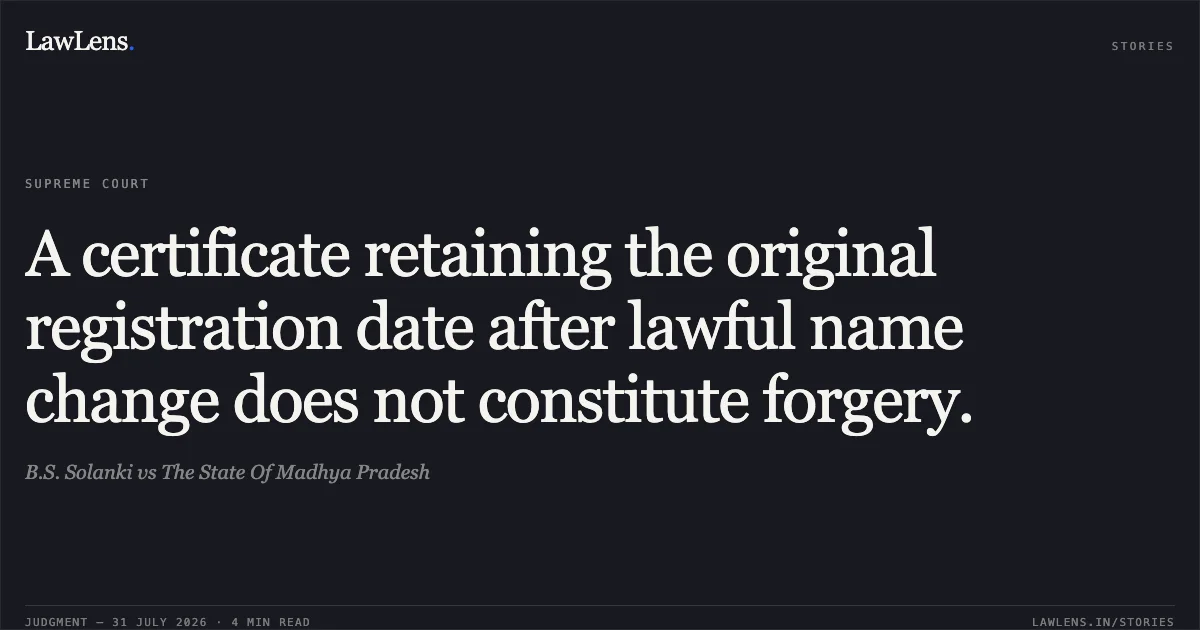
Source reference: p.1The specific allegation against the appellant was that he forged or improperly issued a certificate recording the change of name of the Nagpur Diocesan Board of Education, Jabalpur, to the Board of Education, Church of North India, Jabalpur Diocese.
Source reference: p.2The certificate bore the original registration date of 11 July 1959, although the change-of-name certificate was issued on 19 February 2003.
Source reference: pp.2–4The High Court declined to quash the chargesheet under Section 482 CrPC, leading to the present appeal.
Source reference: p.2Issues
1. Whether the certificate recording the society’s change of name, bearing the original registration date of 11 July 1959, constituted forgery or a criminal act on the part of the appellant.
Source reference: pp.2–4, paras. 4–92. Whether the allegations and materials disclosed a prima facie case connecting the appellant with the alleged misappropriation, illegal transactions, or conspiracy, so as to justify continuation of Crime No. 80 of 2022 against him.
Source reference: p.2, 5, paras. 10–123. Whether the High Court ought to have exercised its jurisdiction under Section 482 CrPC to quash the chargesheet against the appellant.
Source reference: p.2; para. 12Law Applied
The Court applied Section 482 of the Code of Criminal Procedure, 1973, which empowers the High Court to quash criminal proceedings where the allegations and accompanying materials do not disclose a sustainable criminal case.
Source reference: no citationIt applied Section 10 of the Madhya Pradesh/Chhattisgarh Societies Registrikaran Adhiniyam, 1973 and Rules, under which a Registrar is required to register a validly proposed amendment to a society’s name and issue a certificate upon payment of the prescribed fee.
Source reference: pp.3–4, paras. 5, 8Section 10(1) treats the registered amendment as valid, while Section 10(2) prescribes the procedure for forwarding and registering the amendment and Section 10(3) requires issuance of the certificate.
Source reference: p.4, para. 8The Court also relied on Section 3-A of the 1973 Act, which deemed societies registered under the repealed 1959 enactment to have been registered under the 1973 Act.
Source reference: pp.4–5, para. 9The alleged offences under the IPC and the Prevention of Corruption Act could not be sustained without material showing that the appellant had committed a cognisable criminal act or that the alleged misappropriation resulted from his conduct.
Source reference: pp.5–6, paras. 11–12Reasoning
The Court examined the society’s resolutions and the correspondence exchanged with the appellant regarding the proposed change of name.
Source reference: p.3, para. 7The Executive Council recommended the change, the General Council approved it, and defects identified by the appellant in the original application were subsequently cured through a fresh application.
Source reference: p.3, para. 7The certificate was therefore issued pursuant to the statutory procedure under Section 10 of the 1973 Act.
Source reference: no citationThe date of 11 July 1959 was not the date of the name change but the society’s original registration date; the society continued under that original registration when its name was altered in 2003.
Source reference: pp.3–5, paras. 7–9The Court further noted that the principal accused, P.C. Singh, was not a member of either the Executive Council or the General Council, had not signed their minutes, and assumed charge only after the change of name.
Source reference: p.5, para. 10Consequently, the materials did not establish collusion between him and the appellant or connect the appellant’s official act with the alleged misappropriation or property transactions.
Source reference: no citationThe Court characterised the prosecution as arising from a factional dispute and held that the allegations and records showed that the appellant was not culpable.
Source reference: p.5, para. 11Holding
The Supreme Court held that the certificate was lawfully issued in 2003 and that the 1959 date merely reflected the society’s original registration; it did not make the certificate forged or fraudulent.
The allegations did not disclose the appellant’s involvement in the alleged misappropriation, illegal transactions, or conspiracy, and the criminal case against him was unsustainable.
Source reference: pp.5–6, paras. 11–12The appeal was allowed, the High Court’s order was reversed, and Chargesheet No. 01A/2023 dated 20 July 2023, filed before the Special Judge under the Prevention of Corruption Act, Jabalpur, was quashed insofar as it concerned the appellant.
Source reference: p.6, para. 12Crime No. 80 of 2022 was directed not to proceed against him, and any bail bonds furnished by him were cancelled.
Source reference: p.6, para. 12Original Court PDF
B.S. SolankivsThe State Of Madhya Pradesh
Click to open original judgment
Original judgment, available to read, download and summarize on LawLens.in