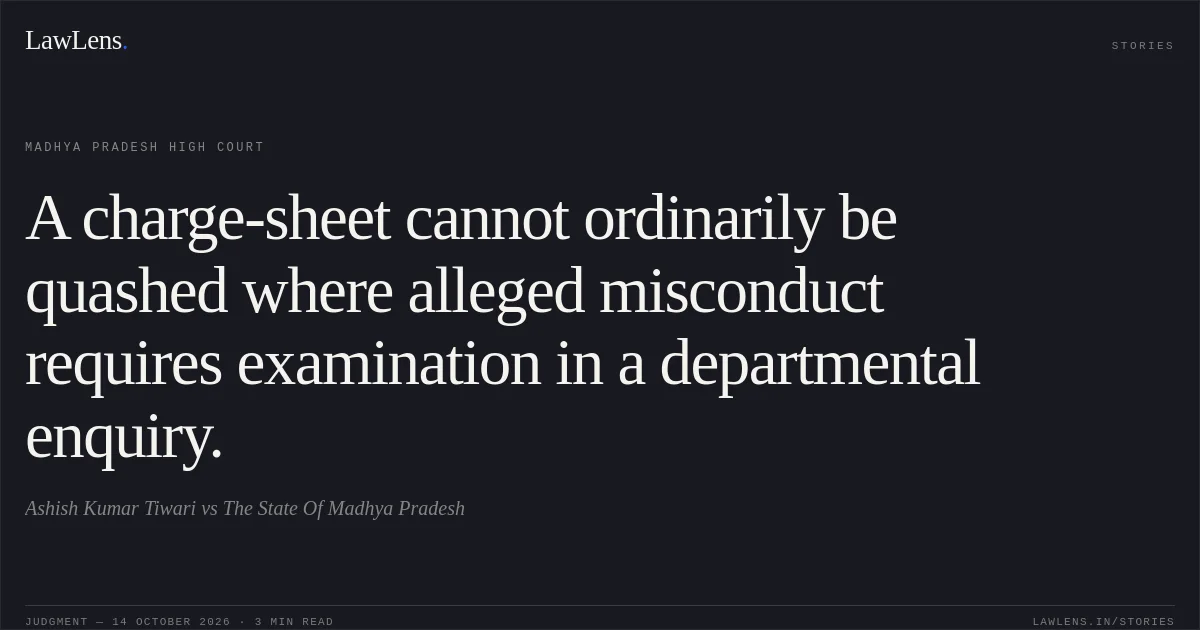
Facts
The petitioner, appointed as a Patwari on 21 July 2005, challenged the Collector’s order dated 24 August 2026 directing a departmental enquiry and the consequential charge-sheet dated 1 September 2026.
Source reference: para. 2He argued that the disputed revenue entries concerned periods before his appointment, that he had not been posted at the relevant Patwari Halka, and that the Collector’s order did not adequately address his reply.
Source reference: para. 2The State submitted that the proceedings followed a complaint and an enquiry report, and that the petitioner could raise his defences during the departmental enquiry.
Source reference: para. 3The Court noted that the Collector’s order referred to relevant revenue records and a Sub-Divisional Officer’s report, and that the allegations also concerned subsequent transactions and entries.
Source reference: paras. 7–8Issues
1. Whether the departmental proceedings and charge-sheet could be quashed under Article 226 on the grounds that the disputed entries predated the petitioner’s appointment or were unrelated to his posting.
Source reference: paras. 8–11, 14–152. Whether the Collector’s order was liable to be quashed for failing to give a separate, detailed response to each objection raised by the petitioner.
Source reference: para. 12Law Applied
Under Article 226, a charge-sheet or show-cause notice ordinarily is not amenable to challenge because the proceedings may not yet have resulted in an adverse order; intervention may be warranted where the issuing authority lacks jurisdiction or the charge-sheet otherwise discloses a reviewable defect (Union of India v. Kunisetty Satyanarayana, (2006) 12 SCC 28).
Source reference: para. 6At the charge-sheet stage, judicial review is limited: the Court may consider whether the charges and imputations disclose misconduct, but ordinarily may not decide their truth before the enquiry (Union of India v. Upendra Singh, (1994) 3 SCC 357).
Source reference: para. 9Disciplinary action may be justified where allegations concern breach of prescribed procedure or dereliction of duty, rather than merely an allegedly erroneous revenue decision (Bhupendra Singh Kushwah v. State of Madhya Pradesh, W.P. No. 3878/2013, decided 27 October 2015).
Source reference: para. 10Although reasoned orders are required, the absence of a separate response to every objection does not by itself establish illegality where the order discusses relevant material; the authority must nevertheless have material connecting the employee to the alleged misconduct (Kranti Associates Pvt. Ltd. v. Masood Ahmed Khan, (2010) 9 SCC 496).
Source reference: para. 12A dispute over revenue entries does not automatically establish misconduct, but it does not bar disciplinary action where specific negligence, manipulation or breach of official duty is alleged.
Source reference: para. 13Reasoning
The Court declined to determine the petitioner’s defences concerning age, appointment date and posting at the charge-sheet stage, holding that they required assessment against the specific charges and supporting material during the enquiry.
Source reference: paras. 8, 11, 14Because the Collector’s order referred to revenue records and the Sub-Divisional Officer’s report, the Court found that the lack of a separate, detailed response to every objection did not, by itself, invalidate the order.
Source reference: paras. 7, 12The petitioner had not established that the charge-sheet was wholly without jurisdiction or that its allegations disclosed no misconduct attributable to him; the truth of the allegations therefore remained for the disciplinary authority.
Source reference: paras. 9, 15Holding
The Court dismissed the writ petition and refused to quash the Collector’s order or the consequential charge-sheet.
It directed the competent authority to conduct the enquiry independently, in accordance with the applicable service rules and principles of natural justice, and to consider the petitioner’s defence and documents without being influenced by observations in the Collector’s order.
Source reference: paras. 17–18The Court expressed no finding on guilt and made no order as to costs.
Source reference: paras. 17–18Original Court PDF
Ashish Kumar TiwarivsThe State Of Madhya Pradesh
Click to open original judgment
Original judgment, available to read, download and summarize on LawLens.in
![A police constable cannot be removed for unauthorized absence without a Rule 359-compliant inquiry.. Mohammad Sidiq Khan vs D/o Home Ut Of Jammu & Kashmir. CAT - ['Srinagar']. LawLens](/stories/thumbnails/a-police-constable-cannot-be-removed-for-unauthorized-absence-without-a-rule-359-compliant-7b43fc316bd94f22a62676153bbc9d54.webp)
![A Review DPC lacks authority to determine or alter inter se seniority.. SAURABH KUMAR vs REVENUE. CAT - ['Patna']. LawLens](/stories/thumbnails/a-review-dpc-lacks-authority-to-determine-or-alter-inter-se-seniority-4b21640f20af46fcabdfc8273d2ce959.webp)