Facts
The prosecution alleged that the appellant sexually assaulted the victim repeatedly over approximately six months, beginning when she was under 18 years of age.
Source reference: pp. 6–10, paras. 10–18The victim testified that the appellant had penetrative intercourse with her; medical evidence recorded that her hymen was not intact, although no semen or spermatozoa was detected.
Source reference: pp. 6–10, paras. 10–18The Mahila Court (FTC), Thanjavur, convicted the appellant under Section 6 read with Section 5(l) of the POCSO Act and sentenced him to ten years’ rigorous imprisonment and a fine.
Source reference: pp. 4–5, 7, paras. 6–9, 19He appealed under Section 374(2) Cr.P.C., arguing, among other things, that the relationship was consensual.
Source reference: pp. 4–5, 7, paras. 6–9, 19Issues
Whether the appellant’s conviction and sentence under Section 6 read with Section 5(l) of the POCSO Act were sustainable, including in light of the contention that the relationship was consensual.
Source reference: p. 5, para. 9; pp. 11–13, paras. 19–21Law Applied
Section 5(l), read with Section 6, of the Protection of Children from Sexual Offences Act, 2012, criminalises aggravated penetrative sexual assault; for penetrative sexual assault, penetration is sufficient and ejaculation is not required.
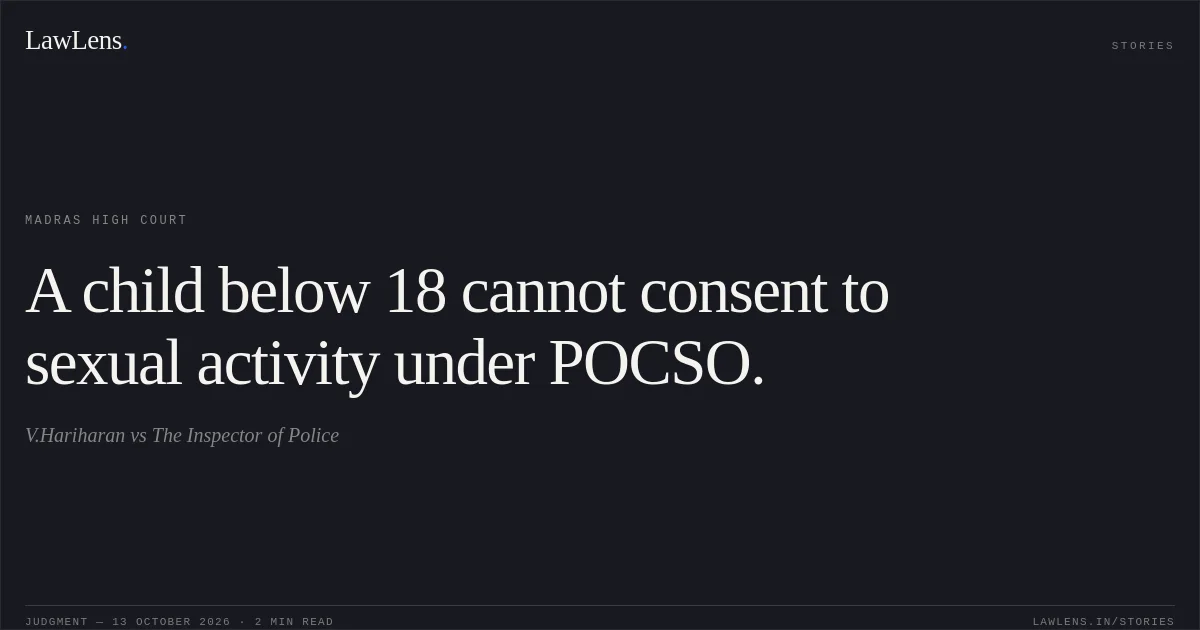
Source reference: p. 10, para. 18The court applied the principle that a person below 18 years is a child for purposes of the Act and cannot give legally effective consent to sexual activity; it relied on the Madras High Court Division Bench decision in Arumugam v. Deputy Superintendent of Police, Thiruchuli Utkottam, 2026:MHC:2112, which held that consent or a consensual romantic relationship does not exempt conduct involving a child from the POCSO Act.
Source reference: pp. 12–13, para. 20Reasoning
The court accepted the victim’s testimony describing repeated penetrative sexual assault and found it corroborated by the medical evidence that her hymen was not intact. The absence of semen or spermatozoa did not undermine the prosecution case because ejaculation was not necessary to establish penetration.
Source reference: p. 10, para. 18It rejected the appellant’s consensual-relationship argument, holding that, as the victim was under 18, any purported consent could not defeat liability under the POCSO Act; the Division Bench’s decision in Arumugam bound the court.
Source reference: pp. 11–13, paras. 19–20Holding
The court answered the issue in the affirmative.
The court dismissed the appeal, and upheld the conviction under Section 6 read with Section 5(l) of the POCSO Act and the sentence imposed by the Trial Court.
Source reference: p. 13, para. 21Acts & Sections Cited
7 provisions across 3 statutes referred to in this judgment. Each provision opens on LawLens.
Code of Criminal Procedure, 19734
Indian Penal Code, 18601
Original Court PDF
V.HariharanvsThe Inspector of Police
Click to open original judgment
Original judgment, available to read, download and summarize on LawLens.in