Facts
The appellant-father and respondent-mother were married on 20 September 2018, and their son, Vivaan, was born on 2 April 2022.
Source reference: paras. 1–3Following marital discord, the mother alleged that the appellants forcibly took the child on 15 March 2025 when she had gone to visit a doctor and thereafter denied her access to him.
Source reference: paras. 1–3The father’s case was that the child had been residing with him in a comfortable and adequately provided environment for more than a year, and that the mother’s remedy was before the competent Civil Court.
Source reference: paras. 1–3The mother filed a habeas corpus petition seeking custody of the child.
Source reference: paras. 1–3The learned Single Judge allowed the petition, directed the appellants to hand over custody to the mother, granted visitation/access to the appellants, and reserved liberty to the father to approach the Civil Court for permanent custody.
Source reference: paras. 1–3The father and his family members challenged that order through the present Letters Patent Appeal.
Source reference: paras. 1–3, 8Issues
Whether a petition for habeas corpus is maintainable for seeking custody of a minor in a dispute between the parents.
Source reference: para. 5Whether, considering the child’s age, welfare, and the statutory preference under Section 6(a) of the Hindu Minority and Guardianship Act, 1956, custody ought to be restored to the mother.
Source reference: paras. 6–8Whether the judgment of the learned Single Judge disclosed any illegality, perversity, or jurisdictional error warranting interference in the Letters Patent Appeal.
Source reference: para. 8Law Applied
The Court held that a habeas corpus petition seeking custody of a minor is maintainable, although the extraordinary jurisdiction may be declined where determination requires a detailed factual inquiry and the parties may then be directed to approach the Civil Court.
Source reference: para. 5This principle was drawn from Yashita Sahu v. State of Rajasthan, (2020) 3 SCC 67, Manju Tiwari v. Dr. Rajendra Tiwari, 1990 AIR SC 1156, Nil Ratan Kundu v. Abhijit Kundu, (2008) 9 SCC 413, and Roxann Sharma v. Arun Sharma, (2015) 8 SCC 318.
Source reference: para. 5In custody matters, the welfare and best interests of the child are paramount, and the competing rights of the parents must yield to that consideration.
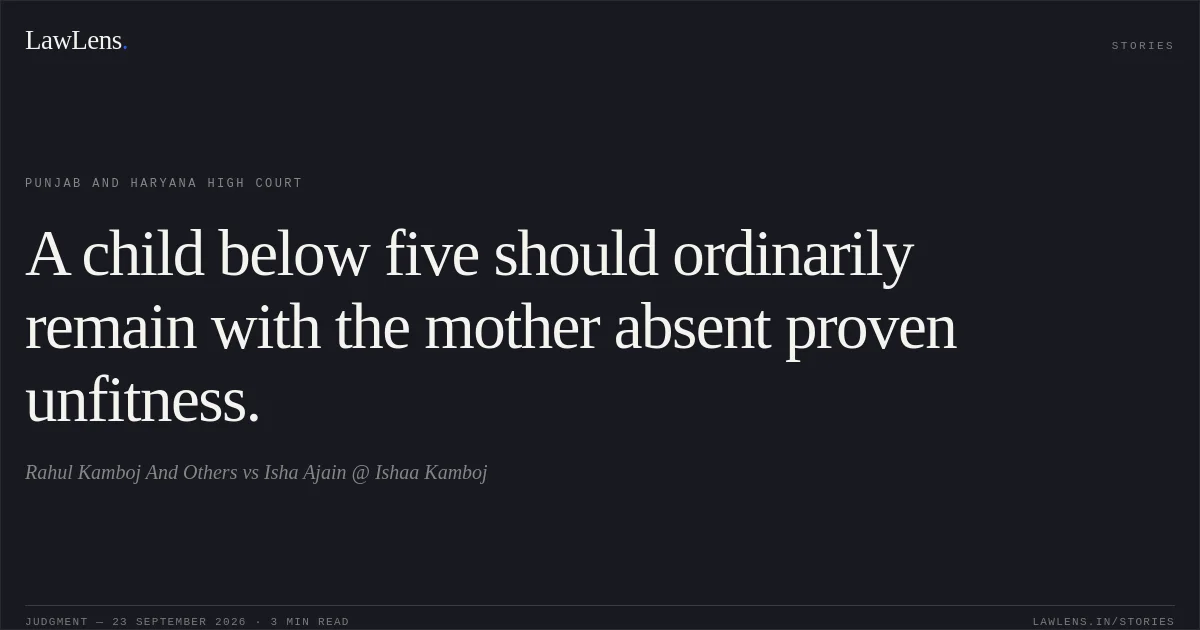
Source reference: para. 6Under the proviso to Section 6(a) of the Hindu Minority and Guardianship Act, 1956, custody of a minor below five years ordinarily lies with the mother.
Source reference: para. 6Departure from that rule requires circumstances showing that the mother is unfit, incapable, immoral, or that her custody would be detrimental to the child’s welfare.
Source reference: para. 6Reasoning
The Court rejected the appellants’ objection that habeas corpus was unavailable merely because the dispute concerned parental custody, holding that such a petition is maintainable in an appropriate case.
Source reference: para. 5The child was approximately four years and five months old and therefore fell within the statutory preference favouring maternal custody under Section 6(a).
Source reference: para. 7Although allegations had been made that the mother had voluntarily left the matrimonial home and had not met the child despite opportunities, the appellants produced no material demonstrating that she was incapable, unsuitable, or unfit to care for him.
Source reference: para. 7The fact that the child had remained with the father or his family for some time did not, by itself, create a superior custodial right, particularly when the circumstances of separation were disputed.
Source reference: para. 7The Court also held that the father’s superior financial position or expenditure on the child could not replace the biological and emotional care required by a young child.
Source reference: para. 7The visitation rights granted to the appellants and the liberty to seek permanent custody before the Civil Court appropriately balanced the interests of both parents.
Source reference: para. 8Holding
The Court answered the maintainability issue in the affirmative and held that the mother was ordinarily entitled to custody of the approximately four-year-old child in the absence of proof of unfitness or detriment to the child’s welfare.
Finding no illegality, perversity, or jurisdictional error in the learned Single Judge’s order, the Court dismissed the Letters Patent Appeal without an order as to costs.
Source reference: paras. 8–10The direction to hand over custody to the mother, the appellants’ visitation/access rights, and the father’s liberty to approach the competent Civil Court for permanent custody were consequently maintained.
Source reference: paras. 8–10Acts & Sections Cited
1 provisions across 1 statute referred to in this judgment. Each provision opens on LawLens.
Hindu Minority and Guardianship Act, 19561
Original Court PDF
Rahul Kamboj And OthersvsIsha Ajain @ Ishaa Kamboj
Click to open original judgment
Original judgment, available to read, download and summarize on LawLens.in