Facts
The petitioner, a juvenile, was implicated in Ghorasahan P.S. Case No. 88 of 2025, registered under Sections 103, 328(a) and 61(2)(a) of the Bharatiya Nyaya Sanhita, 2023, concerning the alleged murder of the informant’s son.
Source reference: para. 3The petitioner was not named in the FIR and his name emerged during investigation through the alleged confessional statement of co-accused Sikandar Rai.
Source reference: para. 3He was taken into custody on 22 March 2025 and was subsequently declared a child in conflict with law after the Juvenile Justice Board determined that he was 17 years and 23 days old on the date of the alleged offence.
Source reference: para. 4The Juvenile Justice Board rejected his bail application on 27 August 2025, and the appellate court dismissed his appeal on 5 January 2026.
Source reference: paras. 5–6The petitioner thereafter approached the High Court in revision, contending that his clean antecedents, the absence of direct evidence, and the Social Investigation Report showing good behaviour justified his release under Section 12 of the Juvenile Justice (Care and Protection of Children) Act, 2015.
Source reference: para. 8Issues
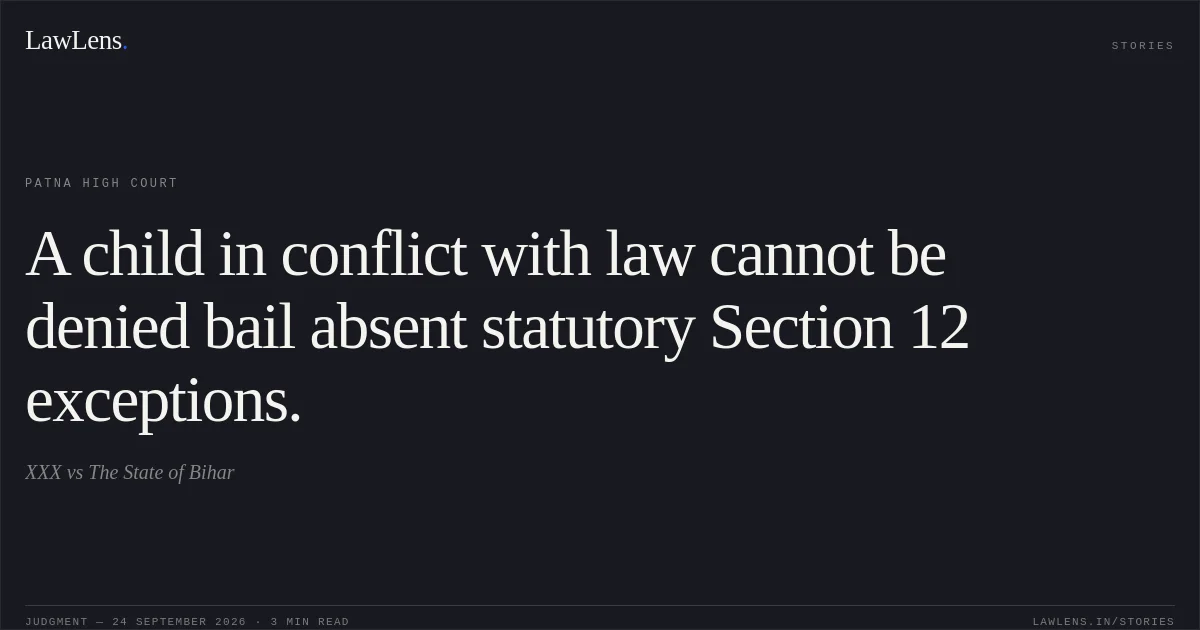
Whether the petitioner, being a child in conflict with law, was entitled to bail under Section 12 of the Juvenile Justice (Care and Protection of Children) Act, 2015, in the absence of the statutory grounds for refusal of bail?
Source reference: paras. 11–14Whether the courts below erred in refusing bail on the basis of conjectures regarding the petitioner’s possible association with criminal elements or danger to his moral, physical or psychological well-being?
Source reference: paras. 8, 14Whether the seriousness of the alleged offence could, by itself, justify denial of bail to a child in conflict with law?
Source reference: para. 14Law Applied
The Court primarily applied Section 12 of the Juvenile Justice (Care and Protection of Children) Act, 2015, under which a child alleged to be in conflict with law is ordinarily entitled to bail unless release would bring the child into association with known criminals, expose the child to moral, physical or psychological danger, or defeat the ends of justice.
Source reference: para. 11It further relied on the child-friendly and welfare-oriented scheme of the Act, particularly Section 3(iv), embodying the best-interest principle; Section 3(xii), treating institutional care as a measure of last resort; and Section 3(xiii), recognizing the child’s right to repatriation, restoration and reunion with the family.
Source reference: para. 12The governing principle is that bail to a child cannot be refused merely because of the gravity or seriousness of the alleged offence; refusal must be supported by cogent material demonstrating one of the statutory exceptions under Section 12.
Source reference: paras. 13–14Reasoning
The Court found that the petitioner had clean antecedents, was not named in the FIR, and had been implicated primarily on the basis of the alleged confession of a co-accused.
Source reference: para. 14The Social Investigation Report recorded his good behaviour and conduct and did not indicate any prior misconduct or circumstance showing that his release would expose him to moral, physical or psychological danger.
Source reference: paras. 8, 14The findings of the Juvenile Justice Board and the appellate court that release might bring him into contact with known criminals were unsupported by cogent material and rested on conjecture.
Source reference: para. 14Applying the best-interest, rehabilitation and non-institutionalization principles under Section 3 of the Act, the Court held that continued institutional custody was not justified and that the gravity of the allegation could not independently defeat the statutory entitlement to bail under Section 12.
Source reference: paras. 11–14Holding
The High Court allowed the revision petition and set aside the appellate order dated 5 January 2026 as well as the Juvenile Justice Board’s order dated 27 August 2025 rejecting bail.
The petitioner was directed to be released on bail on furnishing a bond of Rs. 10,000 with two sureties of the like amount to the satisfaction of the Juvenile Justice Board, subject to the conditions that one surety be a parent, the other be a relative without criminal antecedents who undertakes proper care and upkeep of the petitioner, and that the petitioner appear before the Board on every date fixed in the case.
Source reference: para. 16Acts & Sections Cited
5 provisions across 2 statutes referred to in this judgment. Each provision opens on LawLens.
Bharatiya Nyaya Sanhita, 20233
Juvenile Justice (Care and Protection of Children) Act, 2015.2
Original Court PDF
XXXvsThe State of Bihar
Click to open original judgment
Original judgment, available to read, download and summarize on LawLens.in