Facts
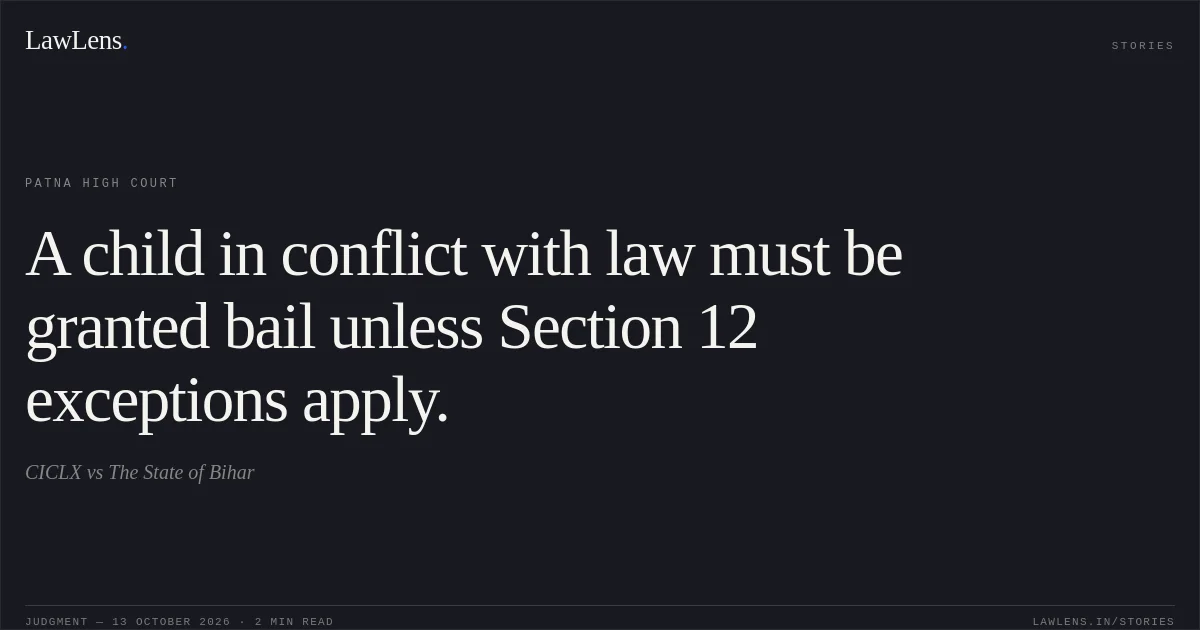
The petitioner, a child in conflict with law (CICL), was accused of offences under Section 65(2) of the Bharatiya Nyaya Sanhita, 2023, and Sections 4 and 8 of the POCSO Act, arising from an allegation concerning the informant’s three-year-old daughter
Source reference: p. 2, paras. 2–3The Juvenile Justice Board assessed the petitioner’s age at the time of the alleged offence as fourteen years, six months and five days; he had been in custody since 10 July 2025
Source reference: p. 2, para. 4The Board refused bail, and the Sessions Court dismissed his appeal
Source reference: pp. 2–3, paras. 4–5The petitioner challenged both orders in revision, submitting that the statutory grounds for denying bail under Section 12 of the Juvenile Justice (Care and Protection of Children) Act, 2015 (“JJ Act”) were not established
Source reference: pp. 3–4, para. 7Issues
1. Whether the petitioner’s bail could be denied under Section 12 of the JJ Act in the absence of material establishing one of its statutory exceptions
Source reference: pp. 5–7, paras. 10–132. Whether the Board and the appellate court erred in refusing bail and whether their orders should be set aside
Source reference: pp. 6–8, paras. 13–16Law Applied
Section 12 of the JJ Act establishes bail as the general rule for a child alleged to be in conflict with law, whether the alleged offence is bailable or non-bailable; bail may be denied only where reasonable grounds indicate that release would bring the child into association with a known criminal, expose the child to moral, physical or psychological danger, or defeat the ends of justice
Source reference: p. 5, para. 10; p. 7, para. 13Section 3(iv) requires decisions concerning a child to be guided by the child’s best interests and development; Section 3(xii) treats institutional care as a last resort following reasonable inquiry; and Section 3(xiii) recognizes the principle of repatriation and restoration, subject to the child’s best interests
Source reference: pp. 5–6, paras. 11–12Reasoning
The Court applied Section 12’s limited grounds for refusing bail and found that the record did not establish that the petitioner would associate with known criminals, face danger to his well-being, or that his release would defeat the ends of justice
Source reference: pp. 6–7, paras. 12–13It considered his clean antecedents, age at the time of the alleged offence, and the purpose of rehabilitation under the JJ Act.
Source reference: no citationAlthough the State relied on allegations of serious offending and the petitioner’s reported exposure to pornography and bad company, the Court concluded that these circumstances did not establish the statutory grounds for denying bail
Source reference: pp. 4–5, paras. 7–8; p. 7, para. 13It also emphasized that institutionalization should be a last resort and that reformation may be better served in a home environment
Source reference: p. 7, para. 13Holding
The Court held that the statutory conditions for denying bail were not present and that the subordinate courts had erred in refusing it
It set aside the appellate court’s order and, consequentially, the Board’s order, and allowed the revision
Source reference: p. 8, paras. 14, 16The petitioner was ordered released on a bond of ₹10,000 with two sureties of the like amount, subject to conditions including that one bailor be a parent, the other be a relative without criminal antecedents who undertakes to care for the petitioner, and that the petitioner attend every date fixed by the Board
Source reference: pp. 7–8, para. 15Acts & Sections Cited
6 provisions across 3 statutes referred to in this judgment. Each provision opens on LawLens.
Bharatiya Nyaya Sanhita, 20231
Juvenile Justice (Care and Protection of Children) Act, 2015.3
Original Court PDF
CICLXvsThe State of Bihar
Click to open original judgment
Original judgment, available to read, download and summarize on LawLens.in