Facts
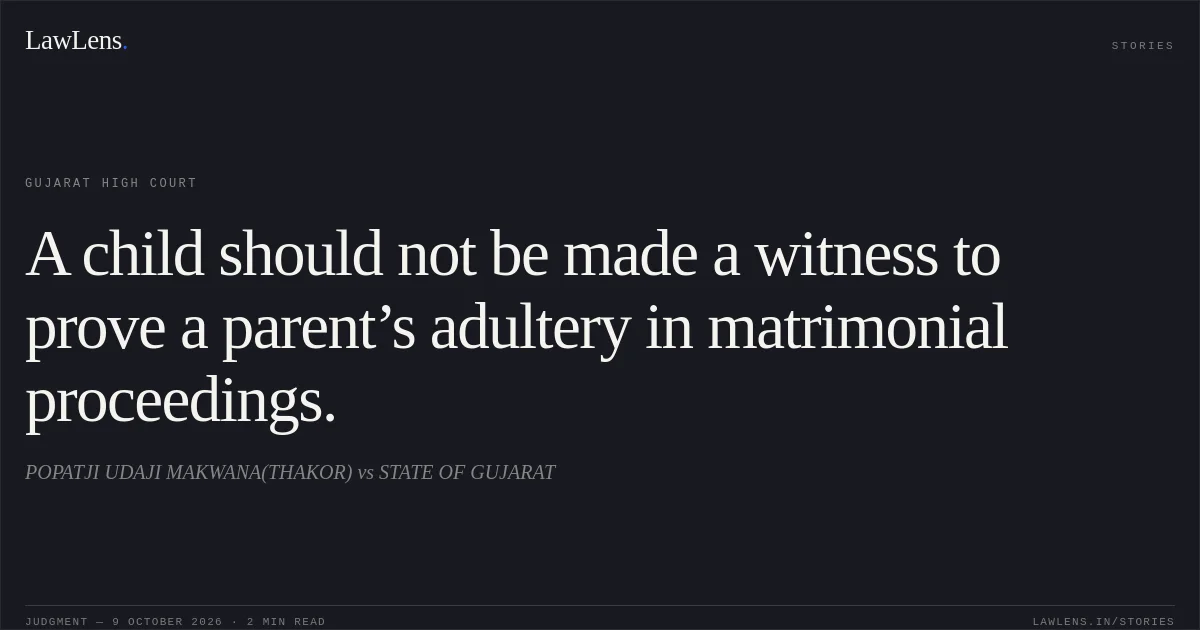
In pending proceedings before the Family Court, Gandhinagar, the petitioner sought permission to examine his 16-year-old child as a witness to support his allegation that his wife had an illicit relationship with another man.
Source reference: pp. 1–3The child was living with the petitioner and studying in Standard IX.
Source reference: pp. 1–3The Family Court rejected the application at Exh. 24, considering the likely effect of the child’s testimony on the child’s personal and educational future.
Source reference: pp. 1–3The petitioner challenged that order before the High Court.
Source reference: pp. 1–3The petitioner also relied on an agreement executed in the presence of village members concerning the alleged relationship.
Source reference: p. 4Issues
1. Whether the Family Court erred in refusing to permit the petitioner to examine his 16-year-old child as a witness in support of his adultery defence.
Source reference: pp. 2–42. Whether the challenged order warranted interference by the High Court.
Source reference: p. 4Law Applied
The judgment cites no specific statute or precedent. It applies the principle that a child’s interests should receive primary consideration in disputes between parents, and that a child should not be made a pawn in their litigation.
Source reference: pp. 3–4It also recognises that a party alleging adultery may seek to prove that allegation through evidence other than the child’s testimony, while the mother’s reputation and dignity should be protected.
Source reference: pp. 3–4Reasoning
The Court accepted that the child was alleged to be an eyewitness but considered the child’s age, schooling and position in the parental dispute.
Source reference: pp. 3–4It agreed with the Family Court that involving the child in the dispute could gravely affect the child’s mind and future.
Source reference: pp. 3–4Because the petitioner could seek to establish the adultery allegation through other evidence—and had placed an agreement executed before village members on record—the Court found no error warranting interference with the refusal to summon the child.
Source reference: pp. 3–4Holding
The High Court held that the Family Court had committed no error in disallowing the application to examine the child and declined to interfere with its order.
The petition was dismissed and the Rule discharged.
Source reference: p. 4Original Court PDF
POPATJI UDAJI MAKWANA(THAKOR)vsSTATE OF GUJARAT
Click to open original judgment
Original judgment, available to read, download and summarize on LawLens.in