Facts
On 19 August 2005, Mehulkumar was travelling as a pillion rider on a scooter driven by Gauravbhai Pandya when the scooter collided with a jeep. Mehulkumar sustained fatal injuries.
Source reference: p.2His heirs brought a claim against the scooter’s driver, owner and insurer.
Source reference: p.2The Tribunal found the jeep driver solely negligent and dismissed the claim against the scooter parties, reasoning that the jeep’s driver, owner and insurer had not been joined.
Source reference: p.2; p.3The deceased’s heirs appealed under Section 173 of the Motor Vehicles Act.
Source reference: p.1Issues
Whether the Tribunal could dismiss the claim against the scooter parties after finding the jeep driver solely negligent, when the jeep’s driver, owner and insurer were not parties to the claim.
Source reference: p.2; p.3; p.6Whether, in a claim involving composite negligence, the claimants may proceed against one alleged tortfeasor without joining the other, and whether negligence may be apportioned in the latter’s absence.
Source reference: p.3; p.4Law Applied
Section 173 of the Motor Vehicles Act provides the appellate basis for challenging the Tribunal’s award.
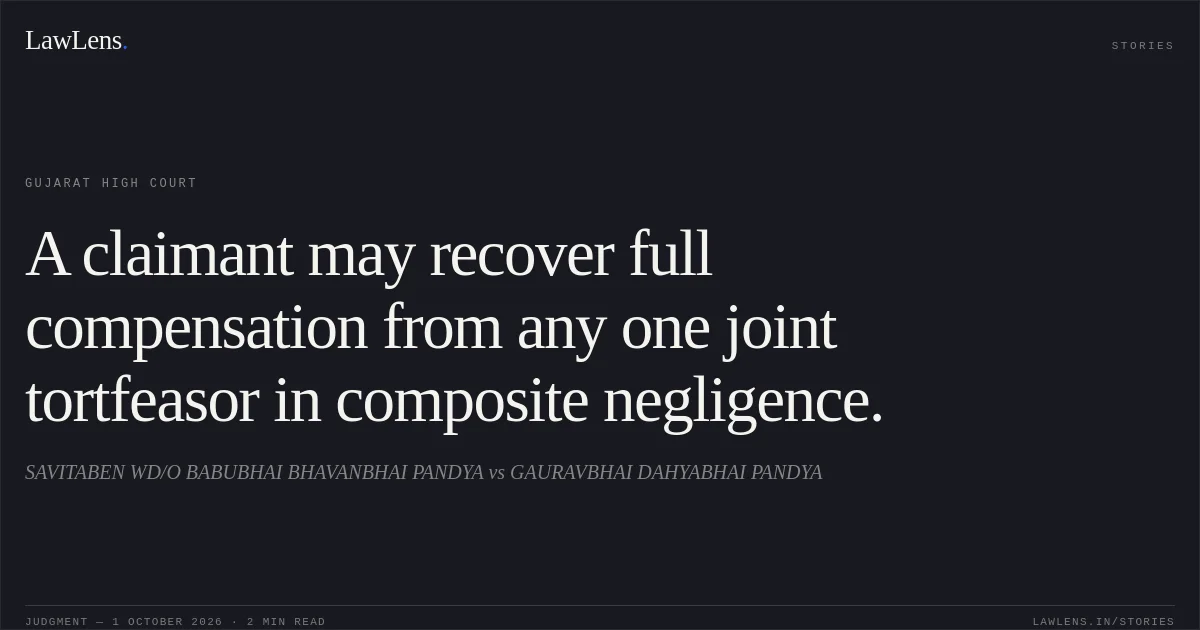
Source reference: p.1In Khenyei v. New India Assurance Company Limited, (2015) 9 SCC 273, the Supreme Court held that a claimant affected by composite negligence may sue either or both joint tortfeasors and recover the entire compensation from any one of them; apportionment is not permissible as between the claimant and the tortfeasors.
Source reference: p.3; p.4; p.5A court should not determine the respective shares of absent joint tortfeasors, though an impleaded tortfeasor may pursue an independent remedy for contribution.
Source reference: p.3; p.4; p.5Sushma v. Nitin Ganapati Rangole, AIR 2024 SC 4627, was cited for the principle that a passenger’s contributory negligence cannot be presumed or imputed merely from the negligence of the vehicle’s driver.
Source reference: p.4; p.5; p.6Reasoning
The High Court held that the Tribunal had failed to distinguish composite negligence from contributory negligence.
Source reference: p.3; p.6The claimants were heirs of a pillion passenger, and the driver’s negligence could not be imputed to the deceased passenger.
Source reference: p.3; p.6Further, under Khenyei, the absence of the jeep parties did not by itself bar a claim against an impleaded tortfeasor; nor was it appropriate to determine the absent parties’ respective negligence in their absence.
Source reference: p.3; p.6The Tribunal therefore erred in dismissing the claim solely because it found the jeep driver negligent and the jeep parties had not been joined.
Source reference: p.6Holding
The appeal was allowed, and the Tribunal’s judgment and award were set aside.
The claim petition was remanded for fresh consideration, with liberty for both parties to lead further evidence.
Source reference: p.7The parties were directed to appear before the Tribunal on 12 October 2026, and the Tribunal was directed to decide the claim in accordance with law, preferably within three months of receiving the order.
Source reference: p.7Acts & Sections Cited
1 provisions across 1 statute referred to in this judgment. Each provision opens on LawLens.
Motor Vehicles Act, 19881
Original Court PDF
SAVITABEN WD/O BABUBHAI BHAVANBHAI PANDYAvsGAURAVBHAI DAHYABHAI PANDYA
Click to open original judgment
Original judgment, available to read, download and summarize on LawLens.in