Facts
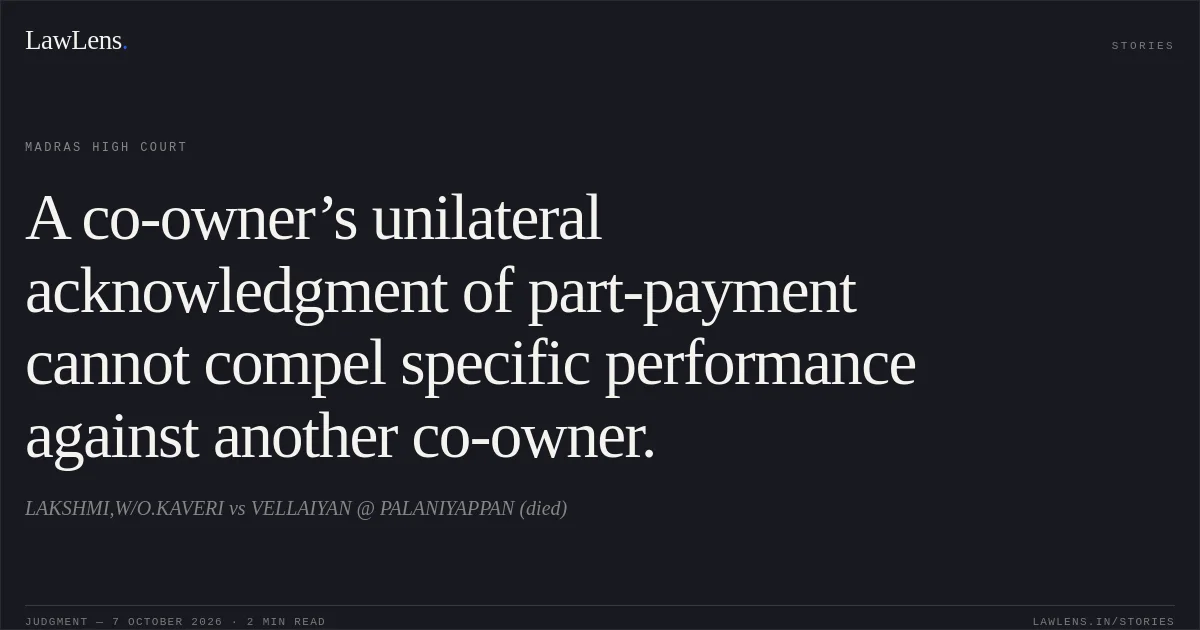
The plaintiff and defendants 1 to 3 entered into a registered agreement on 22 November 2000 for the sale of the suit property for Rs. 40,000, with a six-month period for completion.
Source reference: p. 4The defendants admitted the agreement and receipt of Rs. 20,000 as advance. The plaintiff alleged later payments, acknowledged by defendants 1 and 2, but the appellant, defendant 3 and a joint owner, denied receiving those payments or endorsing them
Source reference: pp. 4–6, 12The trial court refused specific performance but awarded recovery of the advance with interest; the first appellate court reversed that decision and decreed specific performance for the entire property. Defendant 3 brought this second appeal
Source reference: pp. 7–8Issues
Whether acknowledgments of further payments made by defendant 1 alone could support specific performance against defendant 3, a joint owner who did not sign the endorsements
Source reference: pp. 8, 14–15Whether the suit was barred by limitation, or whether defendant 1’s acknowledgments were necessary to save it
Source reference: pp. 8, 15Whether the plaintiff proved readiness and willingness to perform the contract so as to obtain specific performance of defendant 3’s share
Source reference: pp. 12–14Law Applied
In a claim for specific performance, the plaintiff must plead and prove readiness and willingness to perform the plaintiff’s contractual obligations
Source reference: p. 13The Court also considered the agreement’s stipulation that the agreement would be cancelled and the advance forfeited if the balance was not paid within six months.
Source reference: pp. 6, 12, 14In a second appeal under Section 100 of the Code of Civil Procedure, the Court addressed the substantial questions of law framed at admission.
Source reference: p. 8No precedent is cited in the judgment; the Court held that the suit, filed on 27 February 2002 following the agreement of 22 November 2000, was within the limitation period, so the acknowledgment-based limitation question did not arise.
Source reference: p. 15Reasoning
The Court found that defendant 3 did not sign the endorsements for the later payments and that the plaintiff had not paid the balance or otherwise demonstrated readiness and willingness to complete the sale within the stipulated six months.
Source reference: pp. 12–15The plaintiff’s conduct therefore did not justify compelling defendant 3 to convey her share; defendant 1’s acknowledgments could not bind defendant 3 for that purpose
Source reference: pp. 12–15The Court rejected the limitation issue because the suit was filed within the applicable period.
Source reference: p. 15It also held that the first appellate court had erred in granting specific performance over the entire property, including defendant 3’s share, while leaving its decree otherwise undisturbed.
Source reference: pp. 14–16Holding
The High Court partly allowed the second appeal, answered the first substantial question of law in favour of defendant 3, and set aside the first appellate decree insofar as it related to her share.
The decree for specific performance was left intact in all other respects; the connected miscellaneous petitions were closed, with no order as to costs
Source reference: pp. 15–16Acts & Sections Cited
1 provisions across 1 statute referred to in this judgment. Each provision opens on LawLens.
Code of Civil Procedure, 19081
Original Court PDF
LAKSHMI,W/O.KAVERIvsVELLAIYAN @ PALANIYAPPAN (died)
Click to open original judgment
Original judgment, available to read, download and summarize on LawLens.in