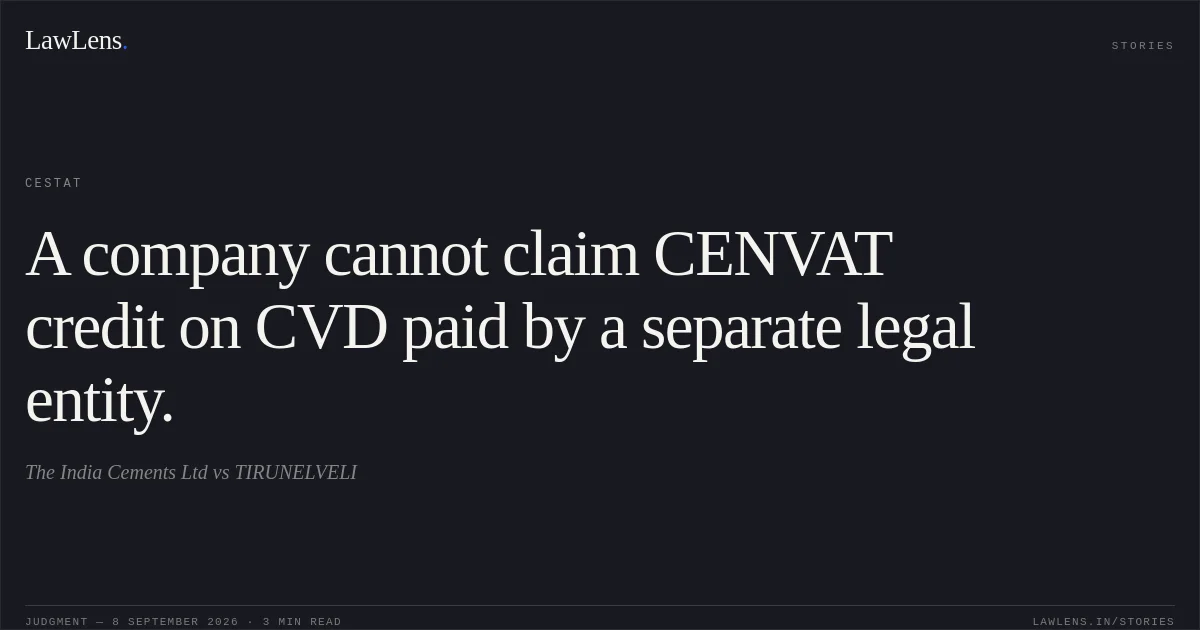
Facts
The appellant, M/s The India Cements Ltd., manufactured dutiable cement and availed CENVAT credit under the CENVAT Credit Rules, 2004.
Source reference: pp. 1–3The disputed credit, amounting to ₹8,13,91,044, represented CVD paid on capital goods imported during 2004, 2005 and 2012 for establishing a captive power plant at Valantharavai, Ramanathapuram District.
Source reference: pp. 1–3The capital goods were imported by Coromandel Electric Company Ltd. (CECL), a separately incorporated special purpose vehicle formed to generate electricity for captive consumption by the appellant.
Source reference: p. 3The appellant initially held 25% of CECL’s shares and subsequently acquired more than 51% shareholding.
Source reference: p. 3The Commissioner confirmed recovery of ₹8,13,91,044, along with applicable interest and equal penalty under Rule 15(2) of the CENVAT Credit Rules, 2004 read with Sections 11A and 11AC of the Central Excise Act, 1944.
Source reference: pp. 1–3Issues
1. Whether the appellant was entitled to avail CENVAT credit of the CVD paid on capital goods imported by CECL, a separate legal entity?
Source reference: p. 7 / para. 5(i)2. Whether the demand of ₹8,13,91,044, together with applicable interest and penalty, was legally sustainable?
Source reference: p. 7 / para. 5(ii)Law Applied
The Tribunal applied Rules 2(a)(1A), 3(1), 4(3), 14 and 15(2) of the CENVAT Credit Rules, 2004, holding that CENVAT credit is a statutory entitlement available only in accordance with the prescribed conditions and to the legally entitled manufacturer or service provider; credit cannot ordinarily be claimed by one corporate entity for duty paid on goods imported by another independent entity.
Source reference: pp. 10–11, 18–19Recovery of inadmissible credit follows under Rule 14, while interest is compensatory and penalty may be imposed under Rule 15(2) read with Section 11AC of the Central Excise Act, 1944.
Source reference: pp. 18–20The Tribunal relied on the principle of separate corporate personality, holding that majority or controlling shareholding does not extinguish the separate legal identity of a subsidiary.
Source reference: p. 16It distinguished Vikram Cement v. Commissioner of Central Excise, 2006 (197) E.L.T. 145 (S.C.), and Birla Corporation Ltd. v. Commissioner of Central Excise, 2005 (186) E.L.T. 266 (S.C.), because those cases concerned capital goods used within the integrated operations of the same assessee.
Source reference: pp. 11–13It also relied on TVS Motor Company Ltd. v. State of Tamil Nadu, 2019 (13) SCC 403, for the principle that tax credit is a statutory concession governed by legislative conditions and cannot be founded merely on equity, economic integration or business convenience.
Source reference: p. 17Reasoning
The Tribunal held that the decisive question was not whether the capital goods were functionally connected with the appellant’s cement manufacturing operations, but whether the appellant could claim credit for duty paid by a different legal entity.
Source reference: pp. 7–10The Bills of Entry were in CECL’s name, CECL paid the customs duty and CVD, and the machinery remained installed in the power plant owned by CECL.
Source reference: p. 10Although the appellant controlled CECL and consumed the electricity generated by it, those circumstances did not eliminate CECL’s independent corporate personality or create a statutory right in the appellant to claim CECL’s credit.
Source reference: pp. 10–12, 16–17The Tribunal found that the specific statutory modes permitting credit where capital goods are acquired through lease, hire-purchase or loan arrangements did not apply because the appellant had neither imported the goods nor acquired them under a recognized arrangement under Rule 4(3).
Source reference: pp. 10–11The authorities cited by the appellant concerning captive mines, integrated manufacturing operations and liberal interpretation of credit provisions were distinguished as cases involving the same assessee, not cross-entity transfer of credit.
Source reference: pp. 11–13The earlier customs proceedings concerning CECL’s eligibility for concessional duty were also held irrelevant because they arose under a different notification and statutory scheme and did not determine entitlement under the CENVAT Credit Rules.
Source reference: pp. 13–15Since the credit was substantively inadmissible, the plea of revenue neutrality could not validate it; recovery, interest and penalty were consequently held sustainable.
Source reference: pp. 18–20Holding
The Tribunal answered both issues against the appellant.
It held that India Cements Ltd. was not entitled to avail CENVAT credit of the CVD paid on capital goods imported by CECL, notwithstanding the captive-power arrangement, controlling shareholding and economic integration between the companies.
Source reference: pp. 17–18The demand of ₹8,13,91,044, together with applicable interest and equal penalty under Rule 15(2) of the CENVAT Credit Rules, 2004 read with Section 11AC of the Central Excise Act, 1944, was upheld.
Source reference: pp. 19–20The appeal was dismissed and the Commissioner’s Order-in-Original dated 5 December 2014 was affirmed.
Source reference: p. 20 / para. 32Acts & Sections Cited
1 provisions across 1 statute referred to in this judgment. Each provision opens on LawLens.
Central Excise Act, 19441
Original Court PDF
The India Cements LtdvsTIRUNELVELI
Click to open original judgment
Original judgment, available to read, download and summarize on LawLens.in
![Pay fixation under Rule 11, not Rule 7, applies to employees promoted before revised-pay adoption who opted from promotion date.. ANIL KUMAR & ORS vs General Manager N C Rly. CAT - ['Allahabad']. LawLens](/stories/thumbnails/pay-fixation-under-rule-11-not-rule-7-applies-to-employees-promoted-before-revised-pay-ado-ff90b7d9eeba468e8f873872fd10d767.webp)
![Post-acquittal representation against dismissal must be considered under Rule 12 by the competent authority.. VINIT YADAV vs HOME AFFAIRS. CAT - ['Delhi']. LawLens](/stories/thumbnails/post-acquittal-representation-against-dismissal-must-be-considered-under-rule-12-by-the-co-c979b525ee9a4311a0f3bf3d9621b50c.webp)