01Facts
The complainant, a director of Kamadhenu Ventures Cambodia Limited, alleged financial irregularities involving the petitioner, a former employee, including mishandling or deletion of company records and removal of company funds.
¶ 2–4, 3.1–3.3, 9He further alleged that the petitioner demanded ₹50 lakh or a flat and threatened to disclose confidential information, and that threats were made concerning his son’s wedding and to others.
¶ 2–4, 3.1–3.3, 9The complainant lodged a complaint on 10 July 2022, leading Sanjay Nagar Police to register Crime No. 0172/2022 under Sections 406, 420 and 384 of the IPC.
¶ 2–4, 3.1–3.3, 9The petitioner sought to quash the complaint and proceedings under Articles 226 and 227 of the Constitution and Section 482 CrPC.
¶ 2–4, 3.1–3.3, 9The complainant died while the petition was pending.
¶ 2–4, 3.1–3.3, 902Issues
i.Whether the complaint and FIR disclosed a cognizable offence warranting investigation, or whether the proceedings should be quashed as an abuse of process.
¶ 5–14, 19–32ii.Whether the petitioner’s material satisfied the Rajiv Thapar test for quashing criminal proceedings at the threshold.
¶ 15–2003Law Applied
The Court considered the High Court’s inherent and supervisory powers under Section 482 CrPC and Articles 226 and 227 of the Constitution, alongside the alleged offences under Sections 406, 420 and 384 IPC.
¶ 15–18Applying Rajiv Thapar v. Madan Lal Kapoor, it stated that quashing on the basis of material produced by an accused requires that the material be sterling and impeccable, rule out the complaint’s factual assertions, remain unrefuted or incapable of refutation, and show that continuing the proceedings would abuse the process of court or defeat justice; all four conditions must be met.
¶ 15–18The Court also referred to Isaac Isanga Musumba v. State of Maharashtra on the elements of extortion, and Vijay Kumar Ghai v. State of West Bengal on the need for dishonest intention at the time of the promise to establish cheating.
¶ 7, 13Provisions in the judgment · 7 · Linked ones open on LawLens
Code of Criminal Procedure, 1973 Section 482Section 152
Indian Penal Code, 1860 Section 406Section 420Section 384Section 383Section 405
04Reasoning
The Court held that the complaint contained allegations—including alleged theft of cheque books and tampering with accounts—that warranted investigation, and that the petitioner’s material was not of the sterling, impeccable quality required by Rajiv Thapar.
¶ 19–20, 27–32It therefore found the quashing test unsatisfied and considered it premature to decide whether the evidence would ultimately establish the ingredients of Sections 406, 420 or 384 IPC.
¶ 19–20, 27–32The Court stated that a complaint need not set out every relevant fact and that the truth of the complainant’s allegations could not be decided through a mini-trial at the FIR stage.
¶ 19–20, 27–3205Holding
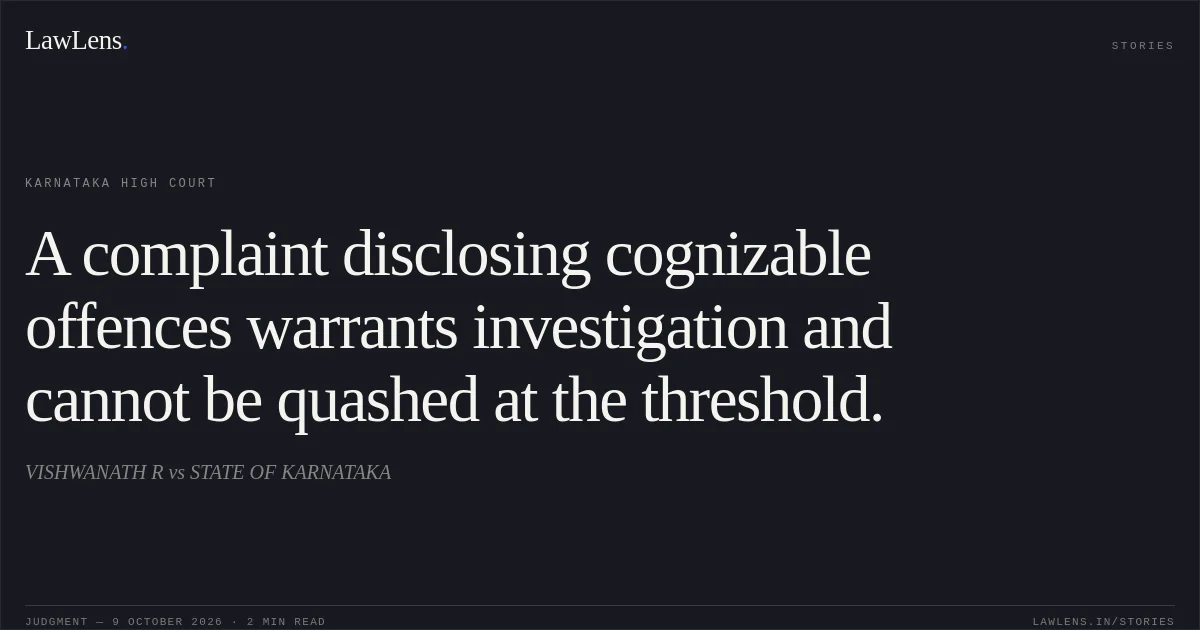
The Court held that the complaint disclosed a prima facie cognizable case and that mere registration of the FIR did not amount to an abuse of process.
¶ 22, 25–26, 33–35Finding no merit in the petitioner’s grounds, it dismissed the writ petition, while observing that the petitioner could approach the Court after an adverse investigation report.
¶ 22, 25–26, 33–35Original Court PDF
VISHWANATH RvsSTATE OF KARNATAKA
Click to open original judgment
Original judgment, available to read, download and summarize on LawLens.in



