Facts
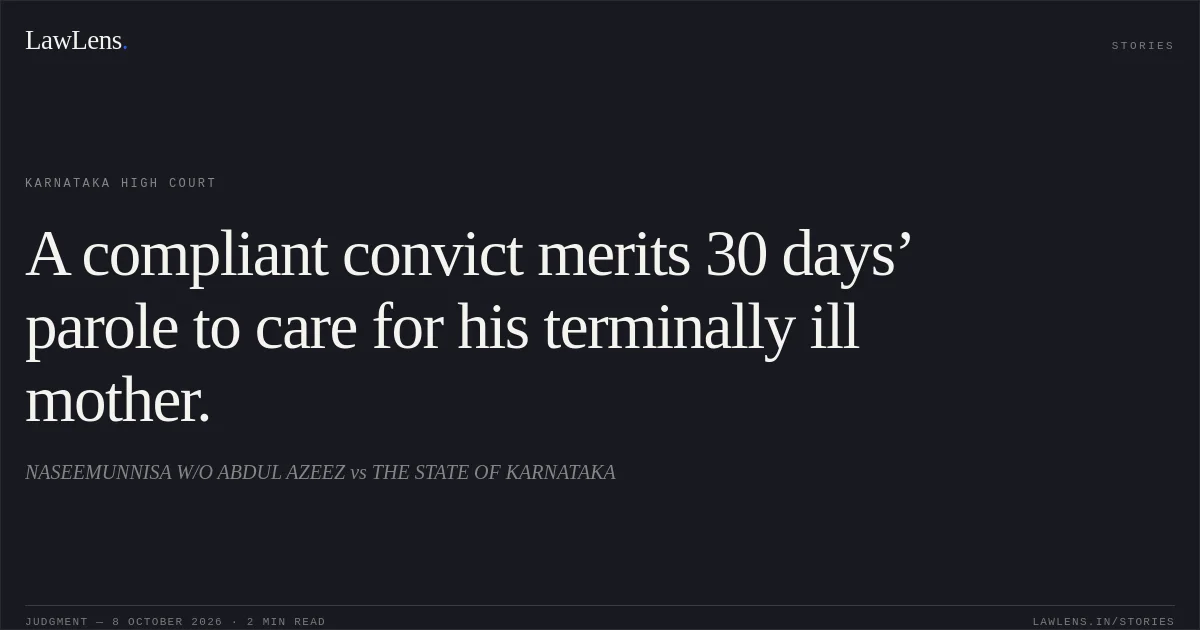
The petitioner, the mother of convict Abdul Wahid (CTP No. 3391), sought his release on general parole to care for her.
Source reference: para. 1He was serving a sentence imposed for offences under Sections 302 and 120B of the Indian Penal Code and had undergone 10 years and 1 month of incarceration.
Source reference: paras. 1–2, 9The petitioner relied on a medical certificate stating that she was critically ill, at a terminal stage, and required constant supervision and care.
Source reference: para. 2The convict had previously been released on parole for 60 days, from 15 December 2025 to 12 February 2026, and had complied with its conditions. A subsequent application was rejected on 29 May 2026 on the ground that six months had to elapse between paroles; a fresh application was filed on 17 September 2026.
Source reference: para. 4The petitioner sought a 90-day parole period.
Source reference: pp. 1–2Issues
1. Whether the convict should be granted parole to care for his critically ill, terminally ill mother.
Source reference: paras. 2, 5, 8–92. Whether the earlier rejection based on the six-month interval between paroles remained a bar to considering the fresh application.
Source reference: para. 4Law Applied
The Court exercised its jurisdiction under Articles 226 and 227 of the Constitution of India, under which it may issue appropriate writs, orders or directions.
Source reference: p. 1The judgment cited no specific parole statute or rule and relied on no precedent.
Source reference: no citationSections 302 and 120B of the Indian Penal Code were identified as the provisions underlying the convict’s sentence, but were not the basis of the parole decision.
Source reference: para. 1The Court’s stated approach was to grant time-limited parole in light of the urgency of a family member’s terminal illness, the prisoner’s prior compliance with parole conditions, and his custody record.
Source reference: paras. 9–11Reasoning
The medical certificate described the petitioner’s condition as critical and terminal and indicated the need for constant care.
Source reference: paras. 2, 8The Court also took into account that the convict had previously complied with parole conditions, had served 10 years and 1 month without blemish, and was said to be the only family member available to care for his mother.
Source reference: para. 9In view of the urgency, the Court considered parole warranted notwithstanding the earlier rejection based on the six-month interval; it ordered a shorter period than the 90 days requested.
Source reference: paras. 4, 9–11Holding
The Court allowed the petition and directed Respondent No. 2 to act on the convict’s application dated 17 September 2026 and grant parole for 30 days.
During parole, the convict was required to report weekly to the jurisdictional police, avoid illegal or criminal activity, and return to prison by the end of the period; the police were directed to ensure his return, with breach requiring his immediate return to prison.
Source reference: para. 12(ii), (iv)–(vi)The Registry was directed to communicate the order to the concerned authorities.
Source reference: para. 12(vii)Acts & Sections Cited
1 provisions across 1 statute referred to in this judgment. Each provision opens on LawLens.
Indian Penal Code, 18601
Original Court PDF
NASEEMUNNISA W/O ABDUL AZEEZvsTHE STATE OF KARNATAKA
Click to open original judgment
Original judgment, available to read, download and summarize on LawLens.in