Facts
The Petitioner joined TCIL in December 2006 on the basis of an MCM qualification awarded by Savitribai Phule Pune University. TCIL’s advertisement expressly prescribed “Master of Computer Management” or equivalent from a recognised university as an eligible qualification.
Source reference: pp. 2–3, paras. 2–4Her appointment letter contained Clause 10, permitting termination if her qualification was later found to be unrecognised, false, misleading, inconsistent with the advertisement, or suppressed.
Source reference: p. 3, para. 4She completed probation, was confirmed, received successive promotions, and became Joint General Manager.
Source reference: pp. 3–4, paras. 5–6TCIL’s Vigilance Division examined the validity of her qualification in 2015 and corresponded with the UGC, AICTE and Pune University. Pune University stated that AICTE had approved the MCM course and that, following the 2014 UGC notification, its nomenclature was changed prospectively to MBA (Information Technology) from 2015–16.
Source reference: pp. 3–4, paras. 7–9Despite the inquiry, TCIL continued her employment and granted further promotions.
Source reference: p. 4, para. 10In December 2023, TCIL required her to explain why her MCM qualification should not be treated as unrecognised. After considering her response, TCIL declared her original appointment and subsequent promotions void ab initio and terminated her services with immediate effect under Clause 10 on 2 January 2024.
Source reference: pp. 5–6, paras. 11–13The Board rejected her review, additionally criticising her alleged failure to disclose relevant facts and her pursuit of promotions despite knowledge of the qualification issue.
Source reference: p. 6, para. 14She challenged both orders before the High Court.
Source reference: no citationIssues
1. Whether TCIL could invoke Clause 10 of the appointment letter to summarily terminate a confirmed employee after approximately seventeen years of regular service, without following the Conduct, Discipline and Appeal Rules?
Source reference: pp. 7–10, paras. 19–322. Whether the disputed status of the Petitioner’s MCM qualification under Section 22(3) of the University Grants Commission Act, 1956 could be conclusively determined through a show-cause notice and response, without a disciplinary inquiry?
Source reference: pp. 13–16, paras. 44–573. Whether the Petitioner’s long service, confirmations and promotions cured any foundational illegality in her appointment?
Source reference: pp. 13–14, paras. 44–47Law Applied
Section 22(3) of the UGC Act restricts the conferment of degrees to qualifications specified or recognised under the statutory framework; an appointment lacking an essential qualification is not rendered lawful merely by long service or subsequent promotions, as recognised in Prof. Yashpal v. State of Chhattisgarh, Pramod Kumar v. U.P. Secondary Education Services Commission and State of Orissa v. Mamata Mohanty.
Source reference: pp. 13–14, paras. 44–46Under TCIL’s Conduct, Discipline and Appeal Rules, furnishing false information concerning qualifications constitutes misconduct under Rule 5(4); removal and dismissal are major penalties under Rule 23; and Rule 25 requires a disciplinary inquiry before imposing such penalties.
Source reference: pp. 8–9, paras. 22–26Clause 10 could preserve TCIL’s power to revisit an appointment tainted by an unrecognised qualification, but it could not operate as an independent, summary code displacing the service rules after confirmation.
Source reference: pp. 9–10, paras. 27–32The principles in Uptron India Ltd. v. Shammi Bhan, Delhi Transport Corporation v. DTC Mazdoor Congress, Kamal Nayan Mishra v. State of M.P. and Avtar Singh v. Union of India require procedural safeguards before termination of a confirmed employee, particularly where allegations of suppression, falsehood or blameworthy conduct are involved.
Source reference: pp. 9–11, paras. 29–35Cases involving forged or fabricated credentials, such as Union of India v. M. Bhaskaran, R. Vishwanatha Pillai v. State of Kerala, Indian Oil Corporation Ltd. v. Rajendra D. Harmalkar and Commissioner of Police v. Ex Ct. Vinod Kumar, are distinguishable where fraud or forgery has been established after appropriate verification or inquiry.
Source reference: pp. 14–16, paras. 48–57Reasoning
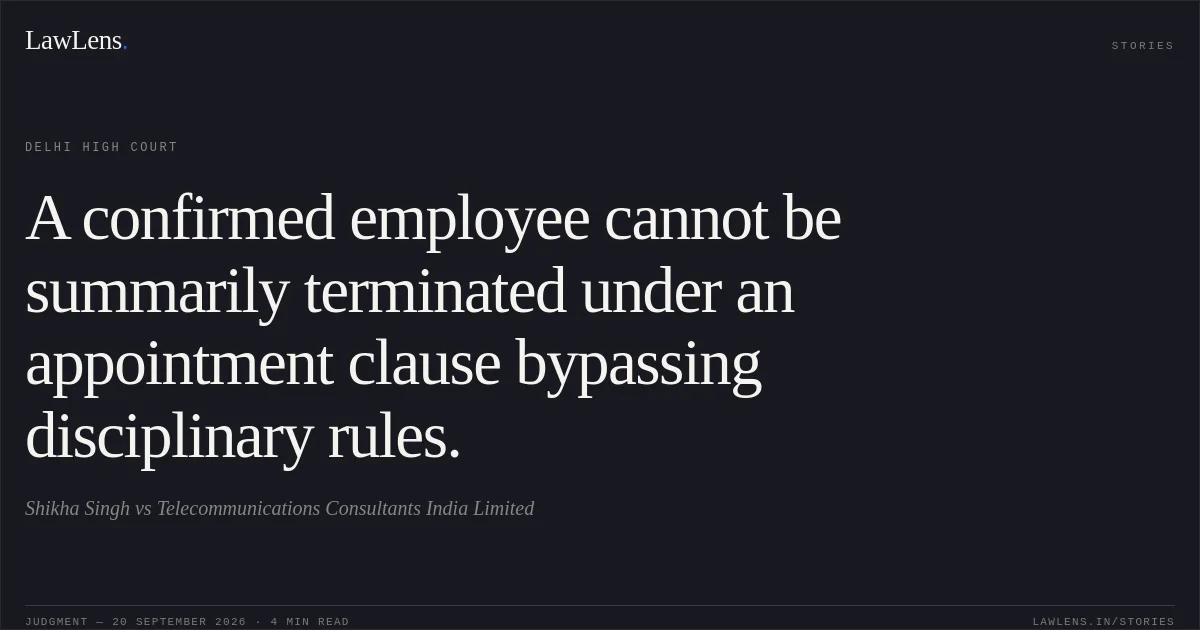
The Court held that confirmation did not permanently prevent TCIL from examining whether the Petitioner possessed the requisite qualification; nor could long service cure an otherwise illegal appointment.
Source reference: pp. 7, 13–14, paras. 19–20, 44–47Nevertheless, by January 2024 the Petitioner was a confirmed regular employee governed by TCIL’s CDA Rules. TCIL’s action was not a simple termination based solely on an objective qualification defect: the orders also attributed to her knowledge, non-disclosure, breach of an undertaking and blameworthy conduct in pursuing promotions.
Source reference: pp. 11–12, paras. 36–39Those allegations fell within the disciplinary framework and required an inquiry under Rule 25.
Source reference: p. 12, para. 42–43The 2023 communication and written response did not constitute such an inquiry because TCIL had not framed formal imputations, supplied the relied-upon material, or conducted the fact-finding process prescribed by the Rules.
Source reference: p. 12, para. 42–43The matter was also not one involving a forged or fabricated certificate: the Petitioner had actually undertaken the course, the qualification was issued by a statutory university, and no issuing authority had disowned the certificate.
Source reference: pp. 15–16, paras. 53–57The Court therefore left the substantive question of recognition under Section 22 open, while holding that TCIL could not conclusively determine it and terminate her through Clause 10 without following the applicable disciplinary procedure.
Source reference: no citationHolding
The High Court allowed the writ petition and quashed TCIL’s termination order dated 2 January 2024 and the consequential order rejecting the Petitioner’s review.
It directed TCIL to reinstate her within four weeks with continuity of service for seniority and retiral benefits, but declined to award back wages because the substantive validity of the MCM qualification remained undecided.
Source reference: p. 19, paras. 65–68TCIL was left at liberty to initiate proceedings under its CDA Rules concerning the qualification and alleged conduct, provided it supplied the relied-upon material and afforded the Petitioner the inquiry contemplated by the Rules.
Source reference: no citationThe Court expressly clarified that it had not decided whether the MCM qualification was legally recognised under Section 22 of the UGC Act.
Source reference: pp. 18–19, paras. 59, 66–68Acts & Sections Cited
1 provisions across 1 statute referred to in this judgment. Each provision opens on LawLens.
University Grants Commission Act, 19561
Original Court PDF
Shikha SinghvsTelecommunications Consultants India Limited
Click to open original judgment
Original judgment, available to read, download and summarize on LawLens.in