Facts
Respondent No. 3 (complainant) filed an FIR on 25.09.2018 alleging that she and the applicant were in a romantic relationship for over four years.
Source reference: para. 5She claimed the applicant compelled her to have physical relations under the pretext of marriage.
Source reference: para. 5Despite a written compromise executed on 05.06.2018 where both parties agreed to marry, the applicant allegedly failed to honor the terms.
Source reference: para. 5, 6At the time of the incident, both parties were approximately 20 years old and were students.
Source reference: para. 6Consequently, a chargesheet was filed, and the court of Additional Chief Judicial Magistrate, Khatima, took cognizance in Criminal Case No. 1215 of 2020. The applicant moved the High Court under Section 482 Cr.P.C. to quash the proceedings.
Source reference: para. 4Issues
1. Whether the consensual physical relationship between two adults, following a breakdown of a promise to marry, qualifies as rape under Section 376 of the IPC.
Source reference: para. 9, 102. Whether the continuation of the criminal proceedings in the absence of evidence showing a "false promise" from the inception of the relationship constitutes an abuse of the process of law.
Source reference: para. 11Law Applied
The Court primarily applied Section 376 (Rape), Section 506 (Criminal Intimidation), and Section 120-B (Criminal Conspiracy) of the Indian Penal Code.
Source reference: para. 4It relied on the inherent powers of the High Court under Section 482 of the Code of Criminal Procedure to prevent the abuse of the process of law.
Source reference: para. 11The court extensively cited the Supreme Court precedents in Pramod Kumar Navratna v. State of Chattisgarh [para. 7], Prashant v. State of NCT of Delhi [(2025) 5 SCC 764], and Samadhan v. State of Maharashtra [2025 SCC OnLine SC 2528], which establish that a breach of promise to marry is not rape unless the promise was made solely to obtain consent with no intention of fulfillment from the very beginning.
Source reference: para. 7, 22, 25Reasoning
The Court observed that the FIR and the material on record indicated a long-standing consensual relationship of over four years between two consenting adults.
Source reference: para. 5, 9The Court highlighted that the existence of a written compromise to marry in June 2018 suggested that the applicant’s intention was not fraudulent from the inception; rather, the marriage failed to fructify due to subsequent "misunderstandings".
Source reference: para. 6Applying the principles from Pramod Kumar Navratna, the Court reasoned that the prosecution failed to show that the applicant "coaxed or duped" the complainant through fraud or misrepresentation.
Source reference: para. 7, 22The Court emphasized the "disquieting tendency" of giving failed relationships a "color of criminality," noting that a mere break-up between consenting adults does not satisfy the essential ingredients of Section 376 IPC.
Source reference: para. 7, 25, 9Holding
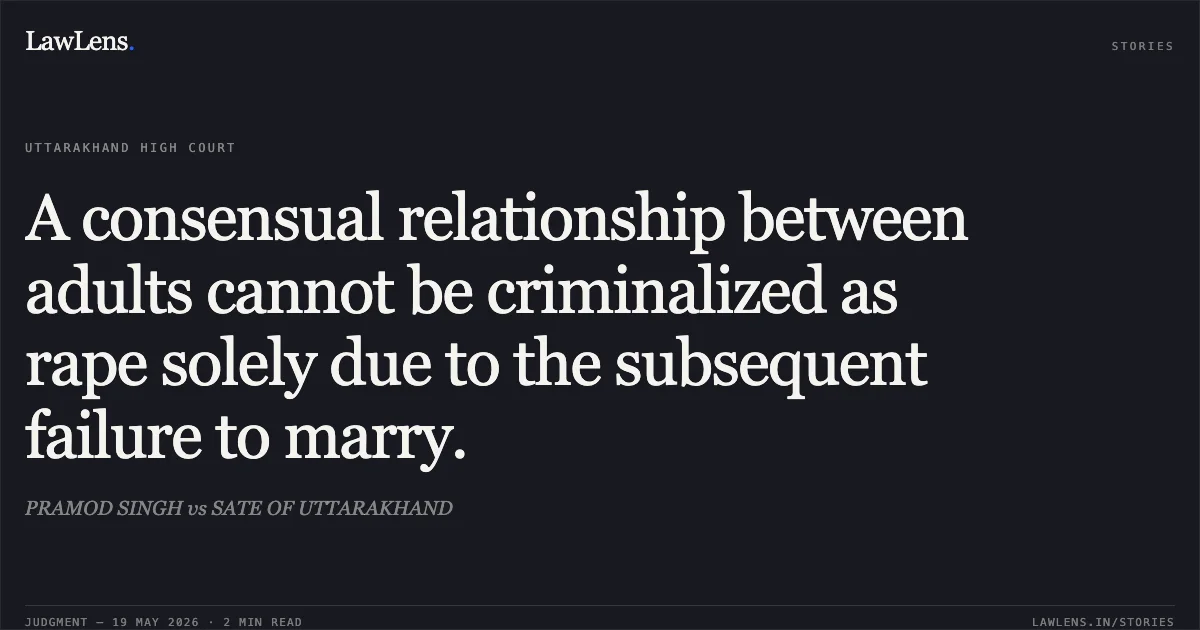
The Court held that the prosecution failed to make out an offence under Section 376 IPC, as the relationship was consensual and lacked the element of "false promise" from the outset.
The Court concluded that allowing the proceedings to continue would be an abuse of the process of law. Accordingly, the application under Section 482 Cr.P.C. was allowed, and the entire proceedings of Criminal Case No. 1215 of 2020 (State vs. Pramod Singh) pending before the Additional Chief Judicial Magistrate, Khatima, were quashed.
Source reference: para. 11, 12Acts & Sections Cited
3 provisions across 2 statutes referred to in this judgment. Each provision opens on LawLens.
Indian Penal Code, 18602
Code of Criminal Procedure, 19731
Original Court PDF
PRAMOD SINGHvsSATE OF UTTARAKHAND
Click to open original judgment
Original judgment, available to read, download and summarize on LawLens.in


![Subsequent exoneration does not retrospectively invalidate a finalized promotion select list.. UNNIKRISHNAN M vs M/o Environment And Forests. CAT - ['Ernakulam']. LawLens](/stories/thumbnails/subsequent-exoneration-does-not-retrospectively-invalidate-a-finalized-promotion-select-li-ce80a0e84f2f4887857271e8b4341c42.webp)