Facts
The petitioners, described as partners of M/s Arulmurugan Promoters, entered into an MOU dated 17 December 2021 with the second respondent concerning development and sale of plots at Ramamurthy Nagar Phase I and II.
Source reference: p.2The second respondent was authorised to market and sell plots and paid amounts towards advance sale consideration. He alleged that the petitioners breached the MOU and sold plots, and the police registered an FIR.
Source reference: p.2The dispute over sale proceeds, developer charges and performance of the MOU was also before a sole arbitrator. The arbitrator dismissed the second respondent’s application for security, granted a limited injunction over 40,000 sq. ft., and permitted dealings with the remaining 95,453 sq. ft.; a Division Bench dismissed the second respondent’s appeal.
Source reference: p.3–4The petitioners sought quashing of the FIR under Section 528 of the BNSS.
Source reference: p.2Issues
Whether the allegations in the FIR disclosed criminal offences, or were essentially a civil-commercial dispute arising from the parties’ MOU and accounting obligations.
Source reference: p.4, p.9Whether continuation of the criminal proceedings, in light of the pending arbitration and the absence of the necessary criminal intent, would amount to an abuse of process.
Source reference: p.4, p.9Law Applied
The Court considered its quashing jurisdiction under Section 528 of the BNSS.
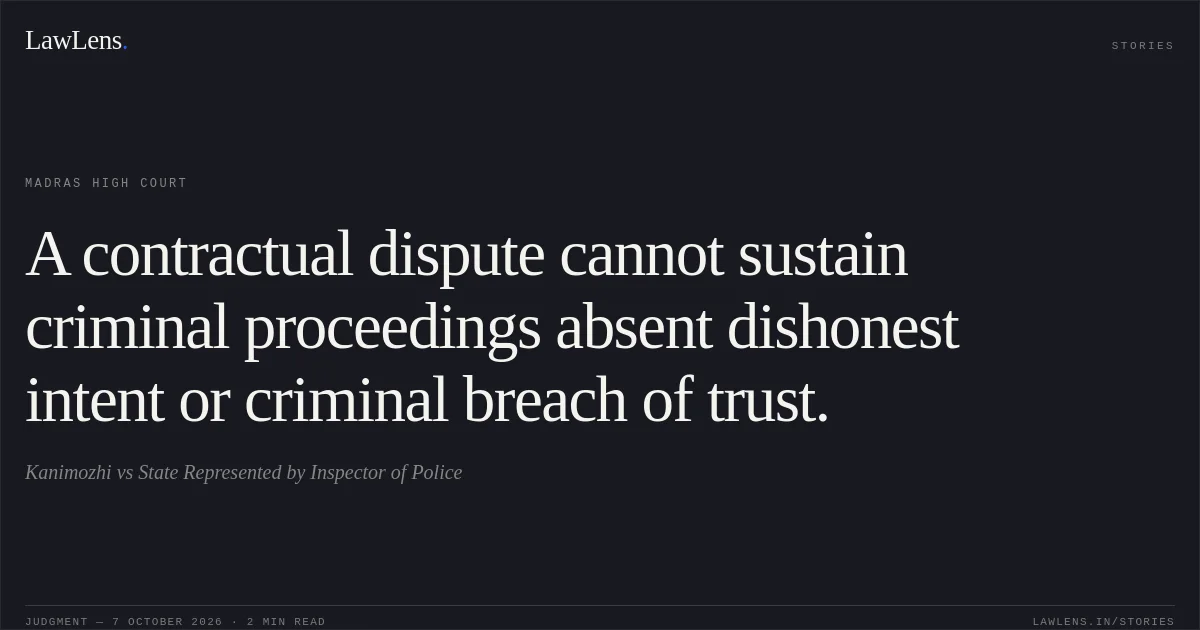
Source reference: p.2In assessing the alleged conduct, it relied on the principles concerning cheating and criminal breach of trust under Sections 420 and 405–406 of the IPC, respectively: cheating requires fraudulent or dishonest intention when the promise or representation is made, and a contractual breach alone does not establish that intention; criminal breach of trust requires dishonest misappropriation or conversion of entrusted property, and not every breach of trust gives rise to criminal liability.
Source reference: p.5–9The Court relied on Inder Chand Bagri v. Jagadish Prasad Bagri, 2025 SCC OnLine SC 2529, for these principles.
Source reference: p.5–9The Court referred to Tejas Shah v. State of Maharashtra for the concern that criminal proceedings should not be used to exert pressure in a commercial dispute.
Source reference: p.9Reasoning
The Court viewed the substance of the complaint as a disagreement over accounting, developer charges and performance of the MOU, matters already pursued through arbitration.
Source reference: p.3–4It noted that the arbitrator had refused the requested security and that the limited injunction had been upheld on appeal.
Source reference: p.3–4Applying the cited principles, the Court concluded that the alleged sale of plots and contractual non-performance, without material showing dishonest intent at the time of the agreement or dishonest misappropriation of entrusted property, did not disclose the criminal conduct discussed in relation to cheating and breach of trust.
Source reference: p.7–9It therefore characterised the dispute as civil and found that continuing the prosecution would amount to abuse of process.
Source reference: p.9Holding
The Court allowed the petition and ordered the FIR to be quashed as against the petitioners; it also closed the connected miscellaneous petition.
The operative paragraph identifies the FIR as Crime No. 17 of 2022, although the petition and earlier portions of the judgment concern Crime No. 93 of 2026. This is an apparent inconsistency in the judgment’s text.
Source reference: p.1–2, p.10Acts & Sections Cited
11 provisions across 4 statutes referred to in this judgment. Each provision opens on LawLens.
Bharatiya Nagarik Suraksha Sanhita, 20231
Bharatiya Nyaya Sanhita, 20236
Arbitration and Conciliation Act, 19961
Indian Penal Code, 18603
Original Court PDF
KanimozhivsState Represented by Inspector of Police
Click to open original judgment
Original judgment, available to read, download and summarize on LawLens.in