Facts
The complainant alleged that she had orally agreed to purchase 2.6 acres of land from the petitioner for ₹9,13,000 for expanding her private school.
Source reference: paras. 2–5Although the petitioner executed a registered sale deed dated 26 March 2010 for 15 katthas/60 decimals of land, he allegedly refused to execute a further sale deed despite having received the entire consideration.
Source reference: paras. 2–5The complainant further alleged that, on 17 May 2015, the petitioner and other persons assaulted and restrained her, abused and threatened her, and forcibly took away a suitcase containing documents and clothes.
Source reference: paras. 2–5After recording the complainant’s solemn affirmation and the statements of two enquiry witnesses, the Sub-Divisional Judicial Magistrate found a prima facie case under Sections 341, 323, 504 and 406 of the Indian Penal Code and issued process against the petitioner on 3 February 2016.
Source reference: paras. 6–7The petitioner invoked the High Court’s inherent jurisdiction under Section 482 of the Code of Criminal Procedure, contending that the dispute was civil in nature and that a title suit concerning the land was already pending.
Source reference: paras. 8–15Issues
1. Whether the allegations in the complaint, taken at face value, disclosed the essential ingredients of criminal breach of trust under Sections 405 and 406 of the Indian Penal Code?
Source reference: paras. 18–252. Whether the allegations under Sections 341, 323 and 504 of the Indian Penal Code were sufficiently specific to justify issuance of process?
Source reference: paras. 17, 283. Whether continuation of the criminal proceedings constituted an abuse of process where the underlying dispute concerned performance of an alleged land-sale transaction and was substantially civil in nature?
Source reference: paras. 24–31Law Applied
The Court applied Section 405 of the Indian Penal Code, which requires entrustment of property or dominion over property, dishonest misappropriation or conversion, and such misuse in violation of law or an express or implied legal contract; Section 406 prescribes the punishment for criminal breach of trust.
Source reference: paras. 18–20It held that mere non-performance of an agreement to sell does not constitute criminal breach of trust in the absence of entrustment and dishonest misappropriation.
Source reference: paras. 18–20The Court relied on Anand Kumar Mohatta v. State (NCT of Delhi), (2019) 11 SCC 706, regarding quashing where the complaint does not disclose the ingredients of Section 406.
Source reference: para. 21Rashmi Kumar v. Mahesh Kumar Bhada, (1997) 2 SCC 397, and Radheyshyam v. State of Rajasthan, 2024 SCC OnLine SC 2311, on the meaning and requirements of “entrustment”.
Source reference: para. 23It further applied the principles in State of Haryana v. Bhajan Lal, 1992 Supp. (1) SCC 335, particularly the categories where the allegations do not constitute an offence, are inherently improbable, or where the proceedings are manifestly mala fide and instituted for an ulterior motive.
Source reference: para. 30The High Court exercised its inherent jurisdiction under Section 482 CrPC to prevent abuse of the process of court.
Source reference: para. 30Reasoning
The Court examined the complaint, the complainant’s statements, the legal notices and the pleadings in the pending title suit.
Source reference: no citationIt found that the complainant admitted payment of ₹2,13,000, against which the petitioner had already executed the registered sale deed for 15 katthas/60 decimals.
Source reference: para. 25(ii)There was no written agreement, no material showing payment of any further consideration, and no allegation that the petitioner had been entrusted with property or money for a specific purpose and had thereafter dishonestly misappropriated it.
Source reference: paras. 25(iii)–(vi), 28The alleged conduct therefore amounted, at most, to a dispute regarding the execution of a further sale deed and enforcement of an alleged land-sale arrangement, for which civil proceedings were already pending.
Source reference: paras. 25(vii), 26–27The allegations of restraint, assault and abuse were also treated as bald and unsupported, while the alleged criminal acts appeared to have been added to exert pressure upon the petitioner to execute another sale deed without further consideration.
Source reference: paras. 17, 28–29Applying the Bhajan Lal categories, the Court concluded that the prosecution lacked the foundational ingredients of the alleged offences and was attended by mala fide intent.
Source reference: para. 30Holding
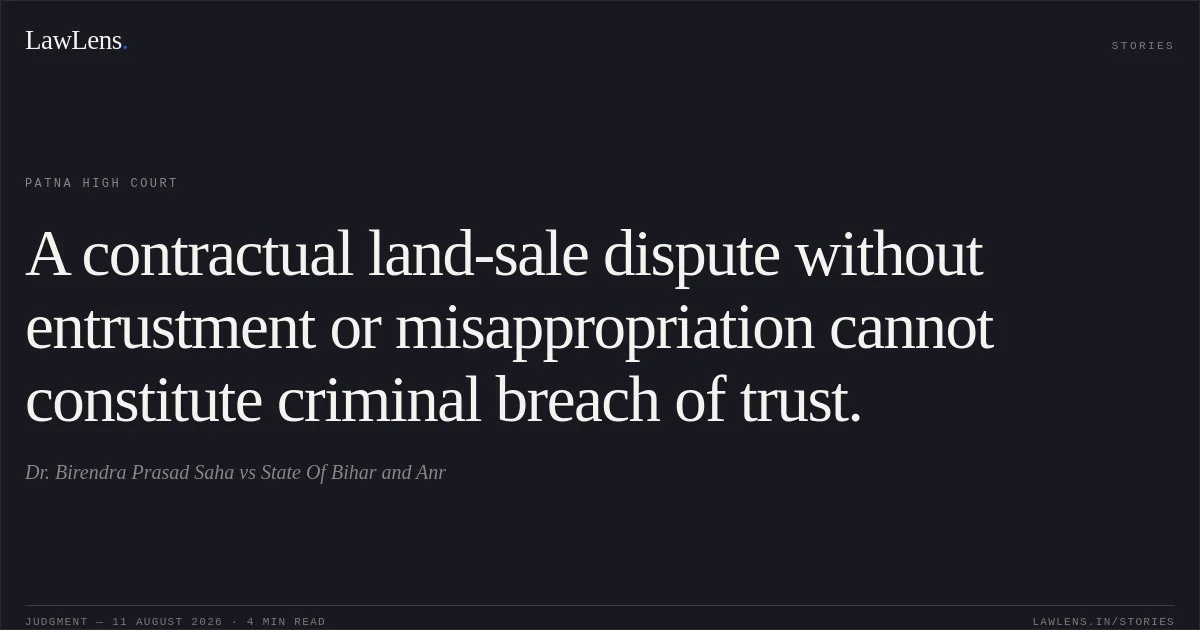
The High Court held that the complaint did not prima facie establish criminal breach of trust under Sections 405/406 IPC, nor did the general allegations substantiate offences under Sections 341, 323 or 504 IPC.
The criminal proceedings were found to be a mala fide attempt to convert a civil land-sale dispute into a criminal prosecution and to coerce the petitioner into executing a further sale deed.
Source reference: paras. 28–31Accordingly, the summoning order dated 3 February 2016 in Complaint Case No. 187(C) of 2015 and the criminal proceedings against the petitioner were quashed and set aside.
Source reference: paras. 31–33No order as to costs was made, and all pending interlocutory applications were disposed of.
Source reference: paras. 31–33Acts & Sections Cited
6 provisions across 2 statutes referred to in this judgment. Each provision opens on LawLens.
Indian Penal Code, 18605
Code of Criminal Procedure, 19731
Original Court PDF
Dr. Birendra Prasad SahavsState Of Bihar and Anr
Click to open original judgment
Original judgment, available to read, download and summarize on LawLens.in