Facts
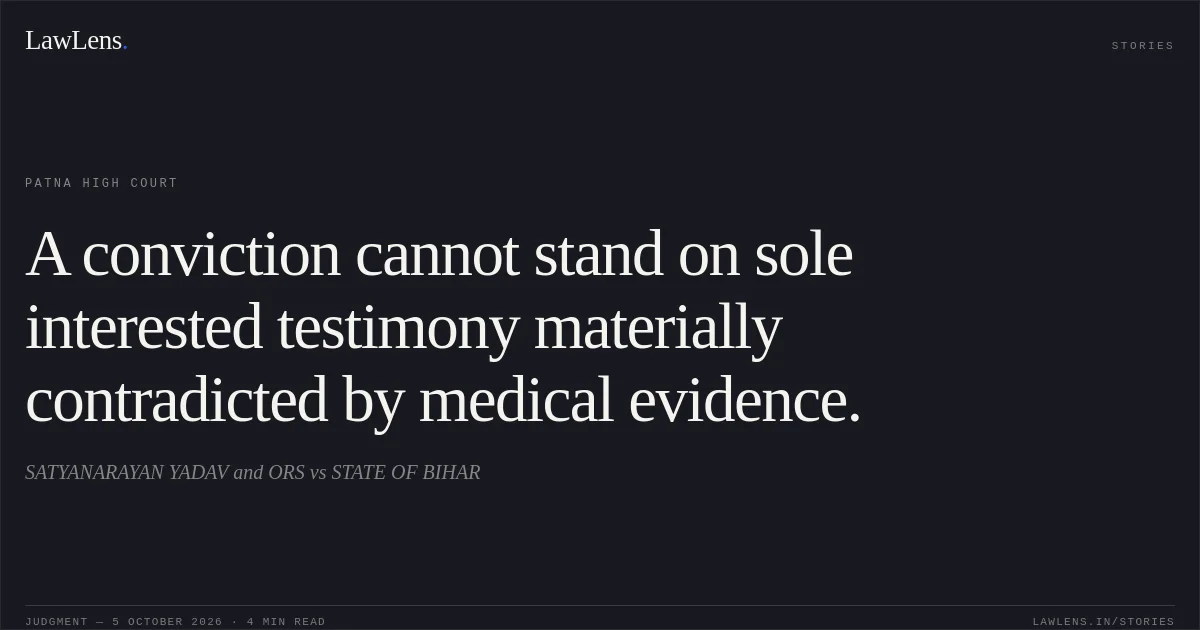
The appellants were convicted under Sections 302/34 IPC and sentenced to life imprisonment for the death of Govind Yadav, who was allegedly assaulted during a land dispute on 14 May 2005.
Source reference: pp. 2–6, paras. 2–14The prosecution case principally rested on the testimony of the deceased’s brother, Prayag Yadav (P.W. 11), while the other examined occurrence witnesses did not support the prosecution. The fardbeyan, formal FIR and inquest report were not exhibited; the postmortem report was the only exhibit. The doctor recorded two incised wounds on the deceased’s forehead and cheek, whereas the account attributed blows with the blunt side of a Tangi and did not locate the injuries on those parts of the body. The trial court convicted the appellants on 24 December 2007; they appealed against the conviction and sentence.
Source reference: pp. 2–6, paras. 2–14Issues
1. Whether the unproved fardbeyan, FIR and inquest report could be considered, including for their contents.
Source reference: pp. 7–10, paras. 15–202. Whether the alleged improvement in P.W. 11’s account was proved as a contradiction in accordance with Sections 145 and 155 of the Evidence Act.
Source reference: pp. 10–12, paras. 21–243. Whether the conviction could rest on the sole testimony of P.W. 11, and whether that testimony met the required standard of reliability.
Source reference: pp. 12–15, paras. 25–314. Whether P.W. 11’s relationship to the deceased and admitted land dispute affected the reliability of his evidence.
Source reference: pp. 15–17, paras. 32–365. Whether the oral account of assault with the blunt side of a Tangi was reconcilable with the incised wounds recorded at autopsy.
Source reference: pp. 17–21, paras. 37–416. Whether deficiencies in the investigation—including the absence of blood at the alleged scene, a site plan and recovered weapons—undermined the prosecution case.
Source reference: pp. 21–23, paras. 42–46Law Applied
The Court applied Sections 302/34 IPC, concerning murder committed with common intention, and Sections 145, 155 and 157 of the Evidence Act, together with Sections 162 and 174 CrPC.
Source reference: paras. 17–20An FIR is not substantive evidence; it may be used to corroborate or contradict its maker only through legally admissible proof, while an inquest report is not substantive evidence of the manner of assault or identity of assailants.
Source reference: paras. 17–20Under Tahsildar Singh v. State of U.P., an omission in a prior statement must be put to the witness and, where denied, proved through the investigating officer.
Source reference: paras. 22–24Section 134 of the Evidence Act does not require a particular number of witnesses, but a conviction on sole testimony requires the witness to be wholly reliable; testimony that is neither wholly reliable nor wholly unreliable ordinarily requires corroboration in material particulars, as explained in Vadivelu Thevar v. State of Madras and subsequent authorities.
Source reference: paras. 26–30Relationship alone does not disqualify a witness, but evidence from a related witness who also has an independent motive for enmity requires careful scrutiny.
Source reference: paras. 32–35Under Hallu v. State of M.P. and Khambam Raja Reddy v. Public Prosecutor, medical evidence may justify rejecting ocular evidence where the injuries cannot be related to the alleged manner of assault; the Court also relied on Ram Narain Singh v. State of Punjab on material inconsistency between direct and medical evidence.
Source reference: paras. 38–41Reasoning
The Court held that the fardbeyan, FIR and inquest report could not be considered for their contents because they were not proved, and noted that the inquest began before the fardbeyan was recorded, undermining the claim that the latter represented the earliest spontaneous account.
Source reference: paras. 16–20P.W. 11’s trial account assigned the Tangi to one appellant and lathis to the others, unlike the account attributed to him in the FIR; the investigating officer denied that P.W. 11 had made the trial version in his police statement. The Court treated the discrepancy as a proved material contradiction that impeached the witness’s credit.
Source reference: paras. 21–24As the remaining witnesses supplied no meaningful corroboration, P.W. 11’s testimony—already affected by the contradiction, his relationship to the deceased and the admitted land dispute—was not sufficiently reliable to sustain conviction alone.
Source reference: paras. 25–36The alleged blunt-side blows to the neck were also irreconcilable with the doctor’s finding of incised wounds on the forehead and cheek.
Source reference: paras. 37–41Finally, the absence of blood at the alleged place of occurrence, a site plan and weapon recovery further weakened the prosecution case.
Source reference: paras. 42–46Holding
The Court answered the issues against the prosecution and held that the evidence did not establish the appellants’ guilt beyond reasonable doubt.
It allowed the appeal, set aside the conviction and sentence under Section 302/34 IPC, and acquitted all three appellants by giving them the benefit of doubt. As they were on bail, they were discharged from their bail-bond liabilities.
Source reference: paras. 48–49Acts & Sections Cited
4 provisions across 2 statutes referred to in this judgment. Each provision opens on LawLens.
Indian Penal Code, 18602
Code of Criminal Procedure, 19732
Original Court PDF
SATYANARAYAN YADAV and ORSvsSTATE OF BIHAR
Click to open original judgment
Original judgment, available to read, download and summarize on LawLens.in