Facts
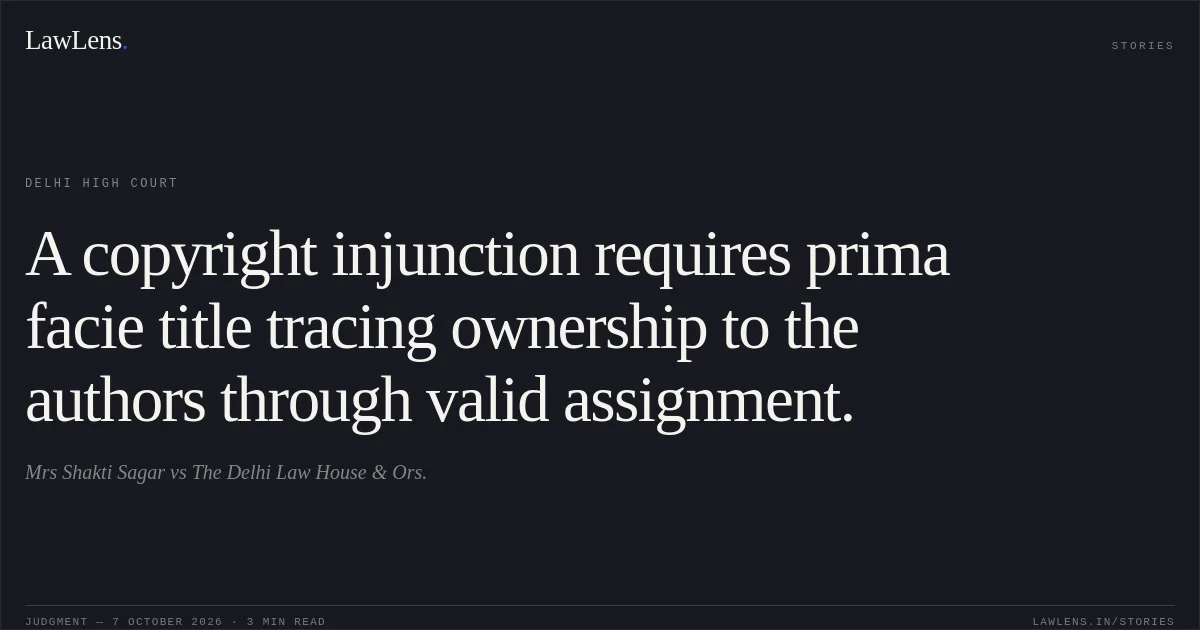
The plaintiff sought an interim injunction under Order XXXIX Rules 1 and 2 CPC restraining defendants 1–4 from using or dealing in 47 literary works in which she claimed copyright through two Wills: one executed by her father-in-law, R.G. Sagar, in 1995, and another by her husband, Subhash Sagar, in 2021.
Source reference: pp. 2, 5–6, 10Her asserted chain of title also relied on a 1962 certificate said to record the transfer of copyrights from M/s Law Book Company to R.G. Sagar.
Source reference: pp. 4–5, 12The defendants disputed her title, including the absence of assignments from the works’ named authors and the validity and effect of the Wills.
Source reference: pp. 7–9The Court considered only the plaintiff’s application for interim relief, not the merits of the suit.
Source reference: pp. 10, 17–18Issues
Whether the plaintiff established a prima facie copyright right sufficient to restrain defendants 1–4 from dealing in the works pending trial.
Source reference: pp. 10–11, 14–15Whether the plaintiff satisfied the requirements of balance of convenience and irreparable injury for interim injunction.
Source reference: pp. 15–17Whether the plaintiff made out a prima facie case for passing off.
Source reference: p. 16Law Applied
Under Order XXXIX Rules 1 and 2 CPC, an interim injunction requires the applicant to establish a prima facie case, balance of convenience in their favour, and irreparable injury; the requirements are cumulative, and the Court should avoid conducting a mini-trial at the interlocutory stage (Dalpat Kumar v. Prahlad Singh; Wander Ltd. v. Antox India (P) Ltd.; Shruti Manav Sharma v. Sunanina Singh).
Source reference: pp. 10–11Under Sections 17–19 of the Copyright Act, 1957, the author is ordinarily the first owner of copyright, and an assignment must be in writing and signed by the assignor or authorised agent.
Source reference: pp. 11–12Section 55(2) provides a rebuttable presumption of authorship in favour of the person named as author on a literary work.
Source reference: p. 13An injunction for copyright infringement presupposes that the plaintiff has prima facie established ownership (Midas Hygiene Industries (P) Ltd. v. Sudhir Bhatia).
Source reference: p. 15Passing off protects the plaintiff’s goodwill and reputation.
Source reference: p. 16Reasoning
The works named different authors, but the plaintiff produced no assignment from those authors to M/s Law Book Company or to R.G. Sagar; the 1962 certificate could not, by itself, show that the company had acquired the copyrights it purportedly transferred.
Source reference: pp. 12–14The Wills could transmit only rights held by their testators, and both Wills were disputed; accordingly, they did not cure the gap in the asserted chain of title at the interim stage.
Source reference: pp. 13–15The Court therefore found no prima facie copyright right and held that the infringement question could not be reached on the material then available.
Source reference: p. 15The plaintiff had also failed to show personal goodwill for her passing-off claim, while the alleged loss of sales revenue was quantifiable and could be addressed through accounts or damages; the balance of convenience likewise did not favour restraining publication of titles sold for decades.
Source reference: pp. 16–17Holding
The Court held that the plaintiff had not established a prima facie case, a favourable balance of convenience, or irreparable injury, and had not made out a prima facie case of passing off.
It dismissed I.A. 31143/2024.
Source reference: p. 18The Court clarified that its observations were preliminary and would not determine the merits of the suit or the disputed questions of title, authorship, assignment, and the Wills.
Source reference: p. 18Acts & Sections Cited
7 provisions across 1 statute referred to in this judgment. Each provision opens on LawLens.
Copyright Act, 19577
Original Court PDF
Mrs Shakti SagarvsThe Delhi Law House & Ors.
Click to open original judgment
Original judgment, available to read, download and summarize on LawLens.in