Facts
The respondents filed O.S. No. 237 of 2022 seeking declaration of title, a declaration that a sale deed was null and not binding on them, and an injunction.
Source reference: p. 3–5The petitioner-defendant applied under Order VII Rule 11(a) and (d) of the Code of Civil Procedure, contending, among other things, that the plaint disclosed no cause of action and that the suit was barred by law. The trial court rejected the application on 7 January 2026.
Source reference: p. 3–5In revision, the petitioner argued that the trial court’s order included reasoning concerning an unrelated suit, O.S. No. 128 of 2017, and did not give reasons based on the facts of this case.
Source reference: p. 3–5Issues
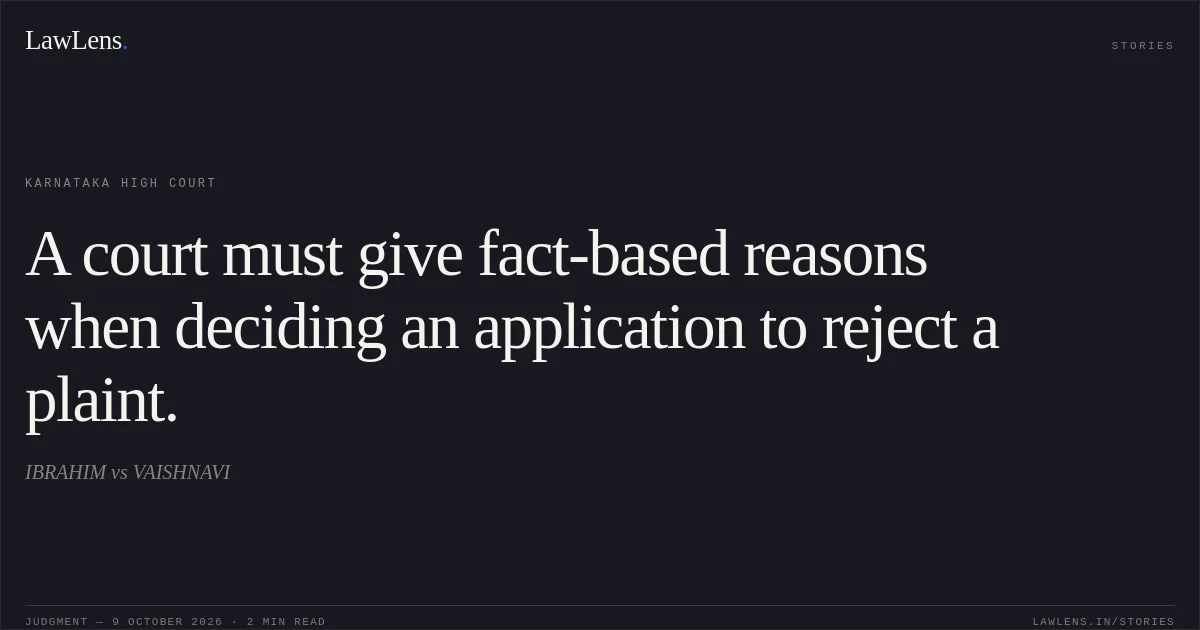
1. Whether the trial court’s order rejecting the application under Order VII Rule 11 was liable to be set aside for failing to give reasons based on the facts of the case
Source reference: p. 5–62. Whether the application for rejection of the plaint should be determined afresh by the trial court on the grounds raised and the parties’ arguments
Source reference: p. 8Law Applied
Order VII Rule 11(a) CPC permits rejection of a plaint that does not disclose a cause of action, while Rule 11(d) applies where a suit appears from the statements in the plaint to be barred by law.
Source reference: p. 6–7The High Court also exercised its revisional jurisdiction under Section 115 CPC, as invoked in the petition.
Source reference: p. 2The judgment states that a reasoned decision must address the application on the relevant facts; merely citing authorities is not sufficient.
Source reference: p. 6Although the petitioner raised limitation, Section 34 of the Specific Relief Act, and other objections, the High Court did not decide those questions on their merits.
Source reference: p. 3–4, 8Reasoning
The High Court found that the trial court’s order referred to the presentation of a plaint in 2021 and to O.S. No. 128 of 2017, rather than setting out reasons grounded in the facts of O.S. No. 237 of 2022.
Source reference: p. 5–7It held that the trial court had not adequately explained its rejection of the Order VII Rule 11 application; referring to legal authorities without reasons addressing the case was insufficient.
Source reference: p. 5–7Because the application’s grounds had not been properly considered, the High Court directed the trial court to reconsider them and hear both sides, without itself deciding whether the plaint was liable to be rejected.
Source reference: p. 8Holding
The revision petition was allowed, and the trial court’s order dated 7 January 2026 was set aside.
The matter was remanded with a direction to reconsider the petitioner’s grounds for rejection of the plaint and the arguments of both parties under Order VII Rule 11 CPC.
Source reference: p. 8Acts & Sections Cited
4 provisions across 3 statutes referred to in this judgment. Each provision opens on LawLens.
Code of Civil Procedure, 19082
Hindu Succession Act, 19561
Specific Relief Act, 19631
Original Court PDF
IBRAHIMvsVAISHNAVI
Click to open original judgment
Original judgment, available to read, download and summarize on LawLens.in