Facts
The appellant was prosecuted for allegedly taking a 10-year-old girl, his neighbour, into a bamboo grove on 19 August 2021 and committing penetrative sexual assault upon her.
Source reference: pp. 2–3, paras. 3–5The victim’s father lodged the FIR on 20 August 2021, leading to registration of Bihubor P.S. Case No. 39/2021 under Section 376(3) IPC and Section 4 of the POCSO Act.
Source reference: pp. 2–3, paras. 3–5The Trial Court framed charges under Sections 448 and 376(AB) IPC and Section 6 of the POCSO Act. The appellant pleaded not guilty.
Source reference: p. 3, para. 6The Trial Court acquitted the appellant of the charge under Section 448 IPC but convicted him under Section 6 of the POCSO Act and sentenced him to 20 years’ rigorous imprisonment and a fine of ₹10,000, with six months’ further rigorous imprisonment in default.
Source reference: pp. 3, 6–7, paras. 7, 14Issues
Whether the prosecution proved beyond reasonable doubt that the victim was below 12 years of age at the time of the occurrence.
Source reference: p. 6, para. 12; pp. 20–21, para. 34Whether the testimony of the victim, despite the absence of an eyewitness and medical evidence showing no recent intercourse or bodily injury, was reliable and sufficient to establish penetrative sexual assault by the appellant.
Source reference: pp. 6–7, para. 12; pp. 18–23, paras. 30–37Whether the surrounding evidence, including the appellant and victim being seen together emerging from the bamboo grove and the appellant’s subsequent attempt to flee, corroborated the victim’s testimony.
Source reference: pp. 19–20, paras. 32–33Whether the ingredients of aggravated penetrative sexual assault under Section 6 of the POCSO Act were established, including the allegation of repeated assault.
Source reference: p. 35, para. 40Whether the conviction and sentence imposed by the Trial Court required interference in appeal.
Source reference: pp. 4–6, paras. 9–11; p. 36, para. 41Law Applied
The Court applied Section 374 CrPC governing appeals against conviction, Sections 376(AB) and 448 IPC, and Sections 6, 29 and 30 of the POCSO Act.
Source reference: pp. 2–3, paras. 2–6; p. 35, para. 39Under the POCSO Act, penetrative sexual assault on a child below the prescribed age, when aggravated by the circumstances contemplated by the statute, attracts Section 6; Sections 29 and 30 create statutory presumptions regarding culpable mental state and commission of the offence, subject to the statutory scheme.
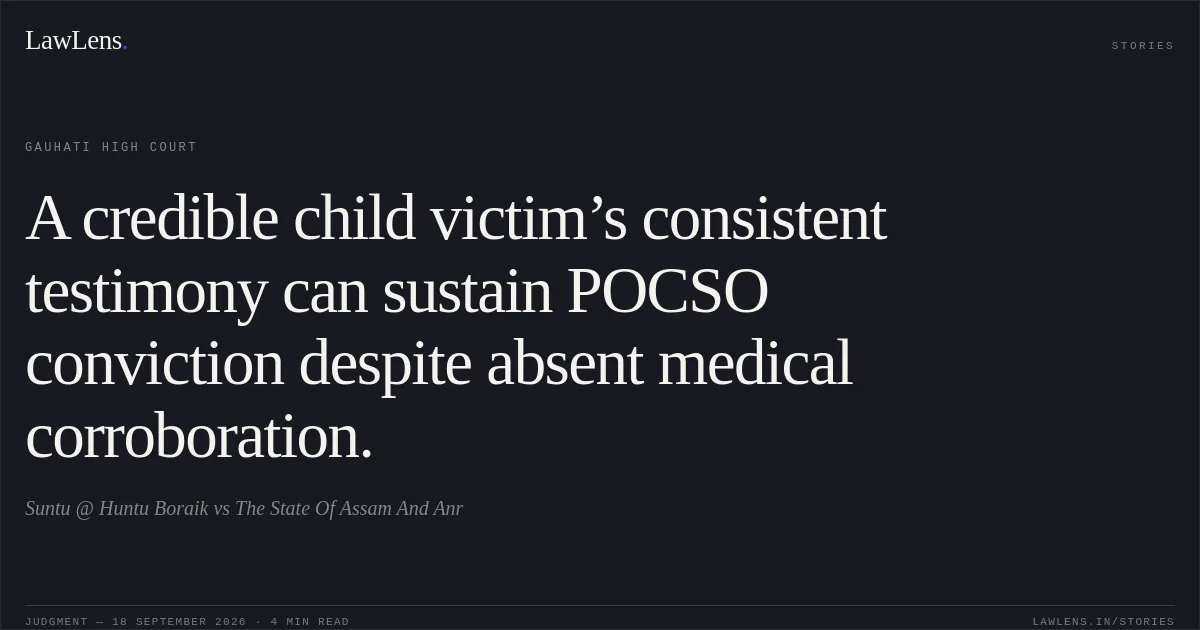
Source reference: p. 35, para. 39The Court reiterated that the credible and trustworthy testimony of a prosecutrix can, by itself, sustain a conviction and that corroboration is not a legal requirement, though surrounding evidence may provide assurance.
Source reference: pp. 23–25, para. 37Relying on Rai Sandeep @ Deepu v. State (NCT of Delhi), (2012) 8 SCC 21, it stated that a “sterling witness” must give a consistent, natural and unshaken account on the core facts of the offence.
Source reference: pp. 23–25, para. 37It also relied on Ganesan v. State, (2020) 10 SCC 573, and the principles discussed therein that conviction may rest on the sole testimony of a reliable victim of sexual assault, and that absence of injuries or corroboration is not necessarily fatal.
Source reference: pp. 25–35, para. 38Reasoning
The Court found the victim competent to testify after the Trial Court conducted a preliminary assessment of her understanding and capacity to answer questions.
Source reference: p. 8, para. 17Her account consistently identified the appellant, described the act of penetration, and placed the occurrence in the bamboo grove.
Source reference: no citationThe Court treated the variations concerning pain, injury and earlier incidents as non-fatal, particularly because the victim stated that the appellant had subjected her to sexual intercourse on earlier occasions, which the Court considered capable of explaining the absence of fresh injury or pain.
Source reference: pp. 21–23, para. 36The absence of medical evidence of recent intercourse did not discredit the victim’s testimony, since the medical evidence did not exclude penetration and the hymen was recorded as absent.
Source reference: p. 14, para. 25; pp. 19–23, paras. 33 and 36The victim’s testimony received assurance from the evidence of PW-6, who saw the appellant and the victim emerge from the grove and stated that the appellant fled when questioned, and PW-4, to whom the victim immediately disclosed the assault.
Source reference: pp. 12–13, paras. 23–24; pp. 19–22, paras. 32 and 35The Court also considered the appellant’s attempt to flee upon the police arriving as a relevant surrounding circumstance.
Source reference: p. 20, para. 33The birth certificate and official birth records established that the victim was 10 years, 4 months and 9 days old, thereby satisfying the age requirement.
Source reference: pp. 20–21, para. 34On the totality of the evidence, the Court held that the victim was a trustworthy witness and that the evidence established penetrative sexual assault committed repeatedly, attracting Section 6 of the POCSO Act.
Source reference: pp. 22–25, paras. 36–39; p. 35, para. 40Holding
The Gauhati High Court held that the victim’s testimony was reliable, consistent and adequately supported by the surrounding evidence.
The prosecution proved that she was below 12 years of age and that the appellant had committed repeated penetrative sexual assault upon her.
Source reference: p. 36, paras. 41–43The conviction under Section 6 of the POCSO Act and the sentence of 20 years’ rigorous imprisonment with a fine of ₹10,000, in default of which six months’ further rigorous imprisonment was imposed, were upheld.
Source reference: p. 36, paras. 41–43The appeal was dismissed, the Trial Court Record was directed to be returned, and the Legal Aid Counsel’s fees were ordered to be paid by the Gauhati High Court Legal Services Committee.
Source reference: p. 36, paras. 41–43Acts & Sections Cited
12 provisions across 3 statutes referred to in this judgment. Each provision opens on LawLens.
Code of Criminal Procedure, 19734
Indian Penal Code, 18602
Protection of Children from Sexual Offences Act, 20126
Original Court PDF
Suntu @ Huntu BoraikvsThe State Of Assam And Anr
Click to open original judgment
Original judgment, available to read, download and summarize on LawLens.in