Facts
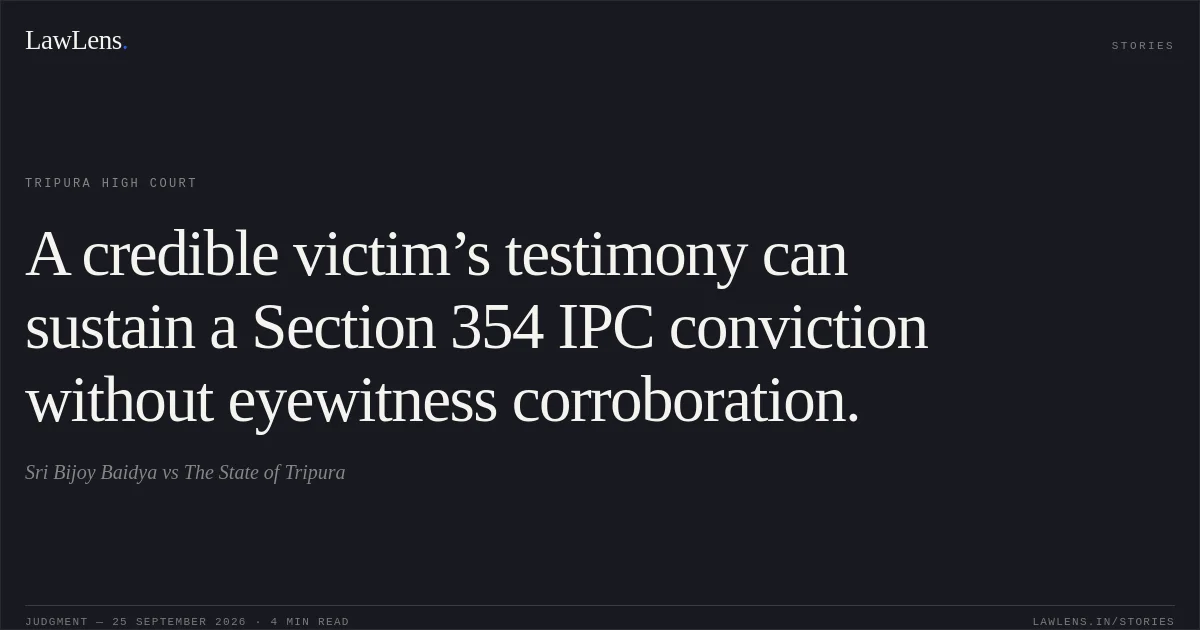
The petitioner, a Mathematics tutor and Headmaster, was prosecuted under Section 354 of the Indian Penal Code on the basis of an FIR lodged by a Class XII student alleging that, during a private tuition session at his residence on 11 February 2020, he pulled her cheeks and touched her thigh and breast with the requisite intention or knowledge.
Source reference: p.6, para. 13She stated that she immediately returned home and informed her mother, following which the matter was reported to the police.
Source reference: p.6, para. 13The Trial Court examined seven prosecution witnesses, including the victim, her parents, relatives, the father’s friend, and the Investigating Officer, and convicted the petitioner under Section 354 IPC.
Source reference: p.6, para. 14The Additional Sessions Judge, Gomati District, affirmed the conviction and sentence on 4 July 2025.
Source reference: no citationIn revision under Sections 397 and 401 CrPC, the petitioner challenged the conviction primarily on the grounds that no other tuition student was examined, no study material was seized, and the prosecution evidence contained contradictions.
Source reference: pp.2–4, paras. 3–7Issues
Whether the evidence of the victim, corroborated by the surrounding and subsequent conduct proved by other witnesses, was sufficient to establish the petitioner’s guilt under Section 354 IPC despite the absence of independent eyewitnesses and other tuition students.
Source reference: pp.13–19, paras. 22–32Whether the alleged investigative deficiencies—such as non-examination of other students, non-seizure of study materials, and alleged contradictions in the prosecution evidence—created a reasonable doubt warranting interference in revision under Sections 397 and 401 CrPC.
Source reference: pp.2–4, 13–16, paras. 3–7, 22–28Whether the concurrent findings of conviction by the Trial Court and the Appellate Court suffered from perversity, illegality, or material infirmity requiring revisional interference.
Source reference: p.19, paras. 33–36Law Applied
The Court applied Section 354 IPC, under which the prosecution must establish that the victim was a woman, that the accused assaulted or used criminal force against her, and that such force was used with the intention of outraging, or with knowledge of the likelihood of outraging, her modesty.
Source reference: pp.16–18, para. 29Intention is not the sole criterion; knowledge that the act is likely to affect the woman’s modesty may suffice, and intention or knowledge may be inferred from the circumstances of the occurrence.
Source reference: pp.17–18, para. 29Relying on Vidyadharan v. State of Kerala, the Court held that the testimony of a victim of molestation is to be accorded the weight of an injured witness, while allegations under Section 354 IPC require careful scrutiny but do not ordinarily fail merely because the incident occurred without independent eyewitnesses.
Source reference: pp.16–18, paras. 29–31The Court also applied the revisional standard under Sections 397 and 401 CrPC, under which interference is warranted only where the concurrent findings disclose perversity, illegality, or material infirmity.
Source reference: p.19, paras. 33–36The prosecution was required to prove its case independently; the petitioner’s failure to lead defence evidence could not, by itself, establish guilt.
Source reference: p.19, para. 34Reasoning
The Court found the victim’s account consistent on the material particulars: she attended tuition alone, the petitioner touched her cheeks, thigh, and breast, and she immediately disclosed the incident to her mother.
Source reference: pp.6–7, para. 15Her immediate disclosure was supported in material respects by her parents and other witnesses, and the Court held that the absence of other students or independent eyewitnesses was not significant because the alleged act occurred in a private setting.
Source reference: pp.13–15, paras. 22–25The non-examination of other tuition students and non-seizure of study materials were treated as investigative omissions that did not discredit the victim’s direct testimony, particularly since she had stated that no other student was present during the occurrence.
Source reference: pp.15–16, paras. 25–27The Court also held that the contradictions elicited in cross-examination were not material enough to create reasonable doubt.
Source reference: no citationApplying Section 354 IPC and Vidyadharan, the petitioner’s acts of touching the victim’s intimate body parts in the circumstances proved were sufficient to establish the requisite criminal force and the knowledge or intention necessary to outrage her modesty.
Source reference: pp.16–19, paras. 29–32No perversity or illegality was found in the concurrent factual findings of the courts below.
Source reference: p.19, paras. 33–36Holding
The High Court answered the issues against the petitioner and held that the prosecution had proved the charge under Section 354 IPC beyond reasonable doubt.
It found no perversity, illegality, or infirmity in the judgments of conviction and sentence passed by the Trial Court and affirmed by the Appellate Court.
Source reference: pp.19–20, paras. 33–36The criminal revision petition was dismissed as devoid of merit, and the petitioner was directed to surrender before the Trial Court on 12 October 2026.
Source reference: p.20, para. 37The record was ordered to be returned to the Trial Court, and any pending applications were disposed of.
Source reference: p.20, para. 37Acts & Sections Cited
9 provisions across 3 statutes referred to in this judgment. Each provision opens on LawLens.
Code of Criminal Procedure, 19735
Indian Penal Code, 18603
Scheduled Castes and the Scheduled Tribes (Prevention of Atrocities) Act, 19891
Original Court PDF
Sri Bijoy BaidyavsThe State of Tripura
Click to open original judgment
Original judgment, available to read, download and summarize on LawLens.in