Facts
Kangra Central Co-operative Bank instituted a recovery suit for ₹10,99,287, with interest, against Akhil Steel Traders as the principal borrower and Vinod Kumar and Naresh Kumar as guarantors.
Source reference: para. 2–4The loan of ₹10,00,000 had been sanctioned to Akhil Steel Traders, and the petitioners had executed a guarantee undertaking joint and several liability for repayment.
Source reference: para. 2–4The petitioners admitted their status as guarantors but contended that the principal borrower possessed sufficient movable and immovable assets and that recovery should first be pursued against him.
Source reference: para. 5, 12By judgment and decree dated 26 February 2019, the Trial Court decreed the suit against all defendants jointly and severally, with contractual and future interest.
Source reference: para. 6The decree was not challenged in appeal and consequently attained finality.
Source reference: para. 6During execution, the petitioners filed objections. The learned Senior Civil Judge, Nadaun, thereafter ordered issuance of a warrant of sale to the Collector for realization of the decretal amount by order dated 28 March 2026.
Source reference: para. 7The petitioners challenged that order under Article 227 of the Constitution, arguing that the Bank was required to proceed first against the principal borrower.
Source reference: para. 8–9Issues
Whether a decree-holder creditor can execute a decree against the guarantors without first exhausting its remedies against the principal borrower?
Source reference: para. 14–16Whether the executing court’s order directing sale of the petitioners’ property suffered from jurisdictional error, illegality, perversity, or any other defect warranting interference under Article 227 of the Constitution?
Source reference: para. 23–27Law Applied
The Court applied Section 128 of the Indian Contract Act, 1872, under which the liability of a surety is co-extensive with that of the principal debtor unless the contract provides otherwise.
Source reference: para. 24Relying on State Bank of India v. Indexport Registered, (1992) 3 SCC 159, Bank of Bihar Ltd. v. Damodar Prasad, AIR 1969 SC 297, and Industrial Investment Bank of India Ltd. v. Biswanath Jhunjhunwala, (2009) 9 SCC 478, the Court held that a creditor is not required to first sue or proceed against the principal debtor, or exhaust remedies against him, before enforcing liability against the surety.
Source reference: para. 17–21The decree-holder may choose to proceed against any judgment-debtor where liability is joint and several, and the judgment-debtors cannot dictate the mode of execution.
Source reference: para. 15, 22The Court further applied the limited scope of supervisory jurisdiction under Article 227 of the Constitution, as explained in Garment Craft v. Prakash Chand Goel, (2022) 4 SCC 181, and Shri Digant v. M/s P.D.T. Trading Co. & Others, Civil Appeal No. 13801 of 2025: interference is warranted only for jurisdictional error, grave dereliction, perversity, or flagrant violation of fundamental legal principles, not for correction of every factual or legal error.
Source reference: para. 25–26Reasoning
The decree expressly imposed joint and several liability on the principal borrower and the guarantors, and the petitioners did not challenge that decree in appeal; therefore, they could not reopen the nature or extent of their liability during execution.
Source reference: para. 6, 15–16Under Section 128 of the Contract Act, the petitioners’ liability as sureties was co-extensive with that of the principal borrower. The Bank was consequently entitled, at its discretion, to execute the decree against the petitioners without first proceeding against Akhil Steel Traders or proving that the principal borrower’s assets were insufficient.
Source reference: para. 15, 18–24The executing court merely enforced a final and executable decree by directing sale of the judgment-debtors’ property.
Source reference: para. 23, 25–27Since no jurisdictional error, perversity, or illegality was demonstrated, the restrictive standards governing Article 227 intervention were not satisfied.
Source reference: para. 23, 25–27Holding
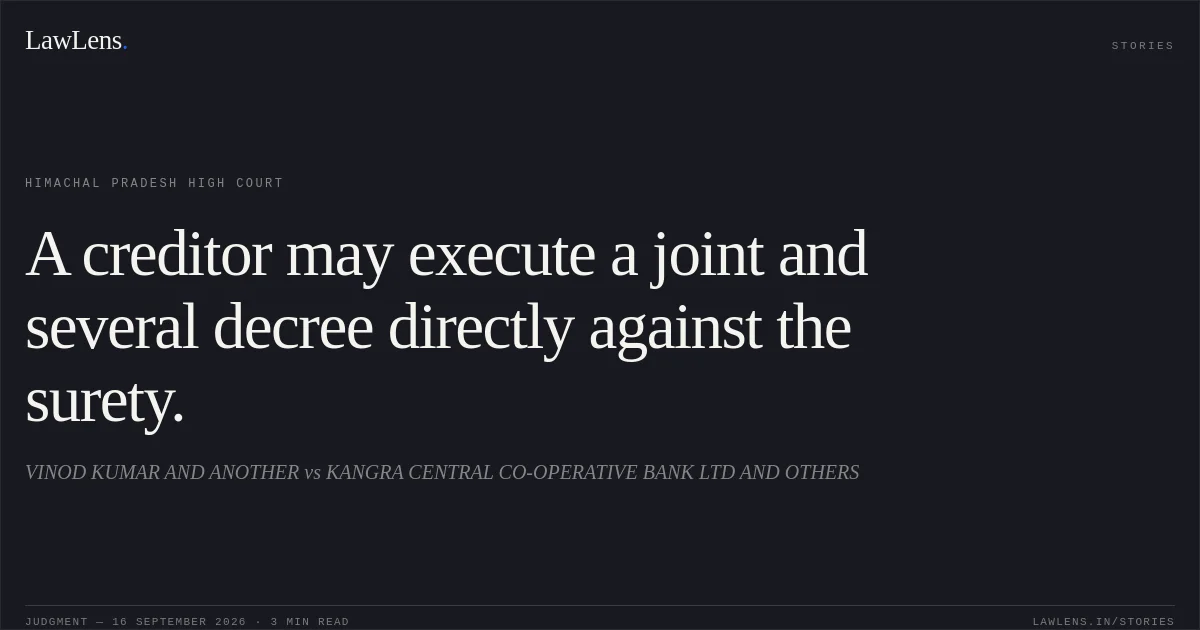
The Court held that a decree-holder is entitled to proceed directly against guarantors whose liability is joint and several with that of the principal debtor; the guarantors cannot insist that execution first be pursued against the principal borrower.
The executing court’s order dated 28 March 2026 directing issuance of a warrant of sale was upheld.
Source reference: para. 23–27The petition under Article 227 was dismissed as meritless, and all pending miscellaneous applications were disposed of.
Source reference: para. 23–27Acts & Sections Cited
1 provisions across 1 statute referred to in this judgment. Each provision opens on LawLens.
Indian Contract Act, 18721
Original Court PDF
VINOD KUMAR AND ANOTHERvsKANGRA CENTRAL CO-OPERATIVE BANK LTD AND OTHERS
Click to open original judgment
Original judgment, available to read, download and summarize on LawLens.in
![Routine transfer of a primary caregiver to a benchmark-disabled dependent is impermissible absent overriding administrative constraints.. D sam Thomas vs EMPLOYEES STATE INSURANCE CORPORATION (ESIC). CAT - ['Chennai']. LawLens](/stories/thumbnails/routine-transfer-of-a-primary-caregiver-to-a-benchmark-disabled-dependent-is-impermissible-42752681fd8348d682d4536d32bcdf56.webp)
![Inspectors and Superintendents receive notional pay revision from 1 January 1996 and monetary benefits from 21 April 2004.. K V Baskar vs REVENUE. CAT - ['Chennai']. LawLens](/stories/thumbnails/inspectors-and-superintendents-receive-notional-pay-revision-from-1-january-1996-and-monet-f9bda0cc8ca8499a8980cc80aedacef8.webp)
![Manpower shortages cannot indefinitely delay approved inter-railway transfers; employees must be relieved within six months.. Niranjan Kumar vs SOUTHERN RAILWAY. CAT - ['Ernakulam']. LawLens](/stories/thumbnails/manpower-shortages-cannot-indefinitely-delay-approved-inter-railway-transfers-employees-mu-0a7a00b8a25942b390905bcf2dd70389.webp)