Facts
Respondent No. 1 filed a 2014 suit seeking to set aside two sale deeds and obtain a permanent injunction.
Source reference: para. 2–3, 12–13The plaint was signed by her power-of-attorney holder, not by the plaintiff, and the plaintiff’s evidence was concluded in January 2023.
Source reference: para. 2–3, 12–13After the Trial Court rejected her application to amend the plaint and implead another purchaser, she sought permission under Order XXIII Rule 1(3) CPC to withdraw the suit with liberty to file afresh, citing a technical defect in the plaint.
Source reference: para. 2–3, 12–13The Trial Court allowed the application, subject to limitation.
Source reference: para. 2–3, 12–13The petitioner challenged that order under Article 227 of the Constitution.
Source reference: para. 2–3, 12–13Issues
1. Whether the Trial Court was justified in permitting withdrawal of the suit with liberty to institute a fresh suit on the ground that the plaint was not signed by the plaintiff
Source reference: para. 12–142. Whether granting that permission after the plaintiff’s evidence had concluded would prejudice the defendants by allowing the plaintiff to overcome deficiencies in her case
Source reference: para. 15Law Applied
Under Order XXIII Rule 1(3) CPC, a court may permit withdrawal with liberty to bring a fresh suit only where it is satisfied that the suit must fail because of a formal defect or that other sufficient grounds justify a fresh suit; the power is discretionary and is guided by the public-policy objective of preventing repeated suits on the same cause of action.
Source reference: para. 11Order VI Rule 14 CPC requires pleadings to be signed by the party and the pleader, if any, but Uday Shankar Triyar v. Ram Kalewar Prasad Singh, (2006) 1 SCC 75, establishes that non-signing due to bona fide error is a curable defect that may be rectified before judgment.
Source reference: para. 14The Court also relied on V. Rajendran v. Annasamy Pandian, (2017) 5 SCC 63, on the conditions governing withdrawal with liberty to sue afresh.
Source reference: para. 11Reasoning
The defect relied on by the plaintiff—the plaint’s non-compliance with Order VI Rule 14 CPC—was curable and could be corrected in the existing suit.
Source reference: para. 14–15The Court therefore found it insufficient to justify withdrawal with liberty to bring a fresh suit.
Source reference: para. 14–15Further, the plaintiff’s evidence had already concluded, and permitting withdrawal at that stage could prejudice the defendants by giving the plaintiff an opportunity to overcome deficiencies in her evidence.
Source reference: para. 14–15The Trial Court’s decision accordingly amounted to a jurisdictional error.
Source reference: para. 14–15Holding
The High Court allowed the petition, set aside the Trial Court’s order dated 6 March 2023, and dismissed the plaintiff’s application to withdraw the suit with liberty to file afresh.
The suit was restored to its original number for proceedings in accordance with law.
Source reference: para. 15–16Acts & Sections Cited
1 provisions across 1 statute referred to in this judgment. Each provision opens on LawLens.
Code of Civil Procedure, 19081
Original Court PDF
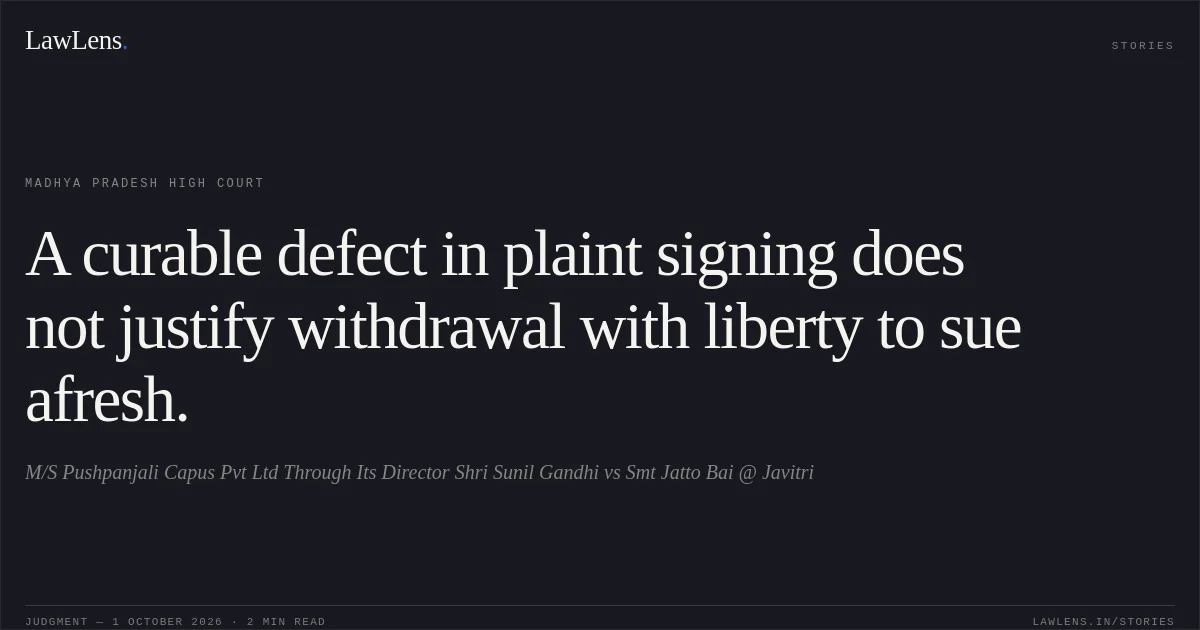
M/S Pushpanjali Capus Pvt Ltd Through Its Director Shri Sunil GandhivsSmt Jatto Bai @ Javitri
Click to open original judgment
Original judgment, available to read, download and summarize on LawLens.in