Facts
The appellant, a Customs Broker, handled Shipping Bill No. 7953846 dated 21.02.2015 filed for export of “Cotton Tufted Floor Mat” by M/s. Sam (CBE) Impex to the UAE.
Source reference: para. 2Although the container received Let Export Order and left the CFS, subsequent examination on 18.03.2015 revealed 4.030 MT of red sanders valued at approximately ₹1.81 crore, allegedly substituted for the declared goods.
Source reference: para. 2The appellant had obtained the exporter’s authorisation, verified its IEC through DGFT and ICEGATE, and examined a previous shipping bill.
Source reference: paras. 2, 3.1–3.3However, the adjudicating authority found inadequate verification of the exporter’s antecedents and KYC particulars and imposed a penalty of ₹2,00,000 under Section 114(i) read with Section 117 of the Customs Act, 1962.
Source reference: paras. 2, 3.1–3.3The Commissioner (Appeals) upheld the penalty, leading to the present appeal.
Source reference: paras. 2, 3.1–3.3Issues
Whether the alleged failure of the Customs Broker to adequately verify the exporter’s antecedents and KYC particulars constituted an act or omission that rendered the red sanders liable to confiscation under Section 113, thereby attracting penalty under Section 114(i) of the Customs Act, 1962.
Source reference: para. 5Whether, in the absence of evidence connecting the appellant with the substitution, smuggling, or preparation of false documents, the penalty could be sustained under Section 114(i) read with Section 117 of the Customs Act, 1962.
Source reference: paras. 7–10, 15Law Applied
Section 114(i) of the Customs Act, 1962 requires an identifiable act, omission, or abetment attributable to the person penalised, which rendered the goods liable to confiscation under Section 113; mere involvement in export documentation or a regulatory lapse is insufficient without the requisite statutory nexus.
Source reference: para. 7Section 117 is a residuary penalty provision and cannot independently apply unless an identifiable contravention of the Customs Act or breach of a statutory obligation is established.
Source reference: para. 15The Tribunal relied on International Cargo Services v. Commissioner of Customs (Export), 2015 (323) E.L.T. 206 (Tri.-Del.), holding that proper authorisation and verification, absent evidence of knowledge or involvement in fraudulent export, cannot sustain a Section 114 penalty.
Source reference: para. 12It distinguished S. Chandrasekaran v. Commissioner of Customs, Tuticorin, 2014 (310) E.L.T. 826 (Tri.-Chennai), where positive evidence existed of proxy arrangements, signing of blank documents, and participation in offending transactions.
Source reference: para. 11It also followed M/s. Bhavani Shipping Services (I) Pvt. Ltd. v. Commissioner of Customs, Tuticorin, 2018 (1) TMI 499 (CESTAT Chennai), which distinguished a KYC lapse from actual participation or abetment in smuggling.
Source reference: para. 13Reasoning
The Tribunal found that the show-cause notice did not allege or establish that the appellant procured, stuffed, transported, or substituted the red sanders, tampered with the container, knowingly filed false documents, or otherwise participated in the attempted export.
Source reference: para. 8The substitution occurred after the container had left the CFS, and no evidence showed that the appellant retained possession or control over it at that stage.
Source reference: paras. 8–10The appellant had obtained authorisation, verified the IEC through official systems, and examined the exporter’s previous shipping bill; the only established deficiency was inadequate verification of the exporter’s antecedents and KYC particulars.
Source reference: para. 9The absence of direct contact with the exporter did not, by itself, prove knowledge, collusion, facilitation, or abetment.
Source reference: para. 10Although mens rea was not treated as an essential requirement for Section 114, the Revenue still had to prove an act, omission, or abetment contemplated by that provision.
Source reference: paras. 14–16The alleged KYC deficiency did not establish the necessary nexus with the prohibited goods, and Section 117 could not cure the failure to prove a substantive contravention.
Source reference: paras. 14–16Holding
The Tribunal held that the Department failed to establish that the appellant committed or omitted any act which rendered the red sanders liable to confiscation or that it abetted their attempted export.
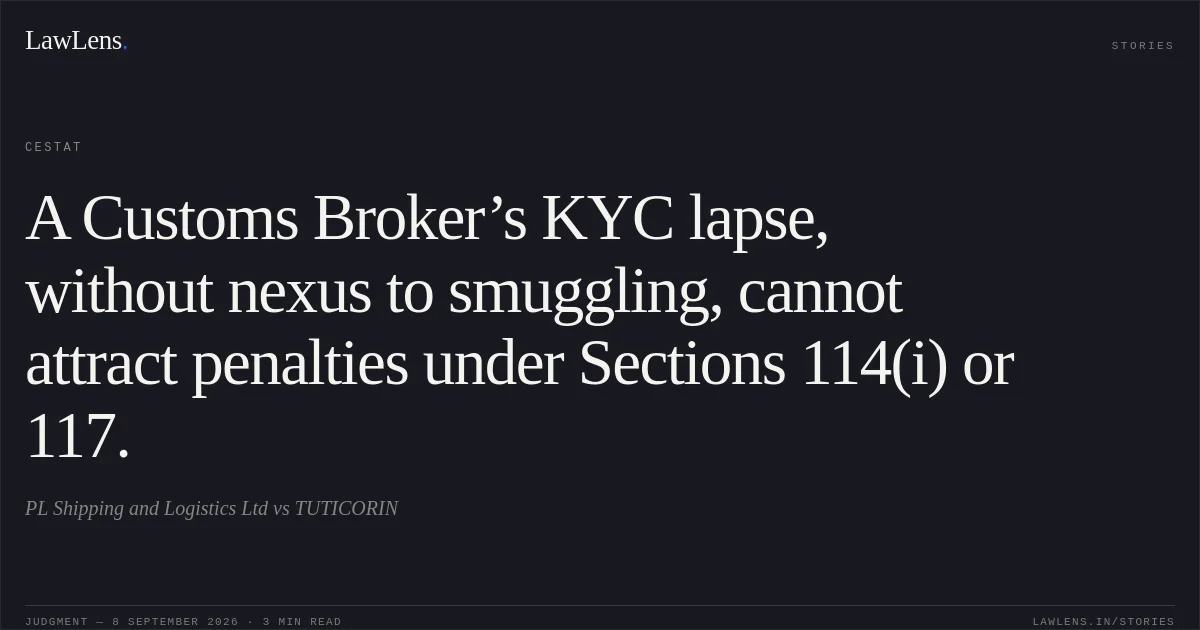
The alleged KYC or antecedent-verification deficiency, without evidence of participation in or knowledge of the substitution or smuggling operation, was insufficient to attract Section 114(i); Section 117 also could not independently sustain the penalty.
Source reference: para. 17The penalty of ₹2,00,000 was therefore set aside, the impugned Order-in-Appeal was modified accordingly, and the appeal was allowed with consequential relief in accordance with law.
Source reference: para. 18Acts & Sections Cited
3 provisions across 1 statute referred to in this judgment. Each provision opens on LawLens.
Customs Act,19623
Original Court PDF
PL Shipping and Logistics LtdvsTUTICORIN
Click to open original judgment
Original judgment, available to read, download and summarize on LawLens.in
![Pay fixation under Rule 11, not Rule 7, applies to employees promoted before revised-pay adoption who opted from promotion date.. ANIL KUMAR & ORS vs General Manager N C Rly. CAT - ['Allahabad']. LawLens](/stories/thumbnails/pay-fixation-under-rule-11-not-rule-7-applies-to-employees-promoted-before-revised-pay-ado-ff90b7d9eeba468e8f873872fd10d767.webp)
![Post-acquittal representation against dismissal must be considered under Rule 12 by the competent authority.. VINIT YADAV vs HOME AFFAIRS. CAT - ['Delhi']. LawLens](/stories/thumbnails/post-acquittal-representation-against-dismissal-must-be-considered-under-rule-12-by-the-co-c979b525ee9a4311a0f3bf3d9621b50c.webp)