Facts
The plaintiff, a former Central Health Services officer, was charged in 2012 with misconduct concerning the evaluation of sanitation-service tenders while on deputation with the GNCTD. After the plaintiff’s retirement, the Central Administrative Tribunal quashed the chargesheet on 3 January 2019; the GNCTD’s writ petition challenging that order was dismissed on 24 May 2019.
Source reference: pp. 2–8, paras. 2–10The plaintiff later sued for an apology and ₹2.5 crore in damages, alleging that the chargesheet was false, frivolous and malicious. The defendants applied under Order VII Rule 11 CPC to reject the plaint as time-barred. The plaintiff contended that Article 101 of the Limitation Act, 1963 applied; the defendants argued that the claim was for malicious prosecution and governed by Article 74.
Source reference: pp. 2–8, paras. 2–10Issues
Whether, on a reading of the plaint as a whole, the claim was one for compensation for malicious prosecution governed by Article 74 of the Limitation Act, rather than a suit upon a judgment governed by Article 101.
Source reference: pp. 12–13, 27–31, paras. 14–16, 21–24Whether the plaint was liable to be rejected under Order VII Rule 11(d) CPC as barred by limitation.
Source reference: pp. 9–12, 31–32, paras. 12–13, 25–26Law Applied
Order VII Rule 11(d) CPC permits rejection of a plaint where, on its averments read as a whole, the suit appears barred by law; for that purpose, the plaint’s averments govern, not the defendant’s pleadings, and the court must distinguish a genuine cause of action from one created by artful drafting (Popat and Kotecha Property v. State Bank of India Staff Assn., (2005) 7 SCC 510).
Source reference: pp. 9–12, para. 12Article 74 of the Limitation Act prescribes one year for a suit for compensation for malicious prosecution, running from the plaintiff’s acquittal or other termination of the prosecution; Article 101 prescribes three years for a suit upon a judgment, running from the date of judgment.
Source reference: pp. 12–13, para. 15The Court also relied on W.B. SEB v. Dilip Kumar Ray, (2007) 14 SCC 568, in considering the character of a malicious-prosecution claim, and on A. Venkata Subbarao v. State of A.P., 1964 SCC OnLine SC 141, for the principle that a claimant cannot resort to a general limitation provision where a specific provision governs the suit.
Source reference: pp. 13–26, 31, paras. 17–20, 24The Supreme Court’s limitation-exclusion directions in Cognizance for Extension of Limitation, In re, (2022) 3 SCC 117, excluded the period from 15 March 2020 to 28 February 2022.
Source reference: p. 31, para. 25Reasoning
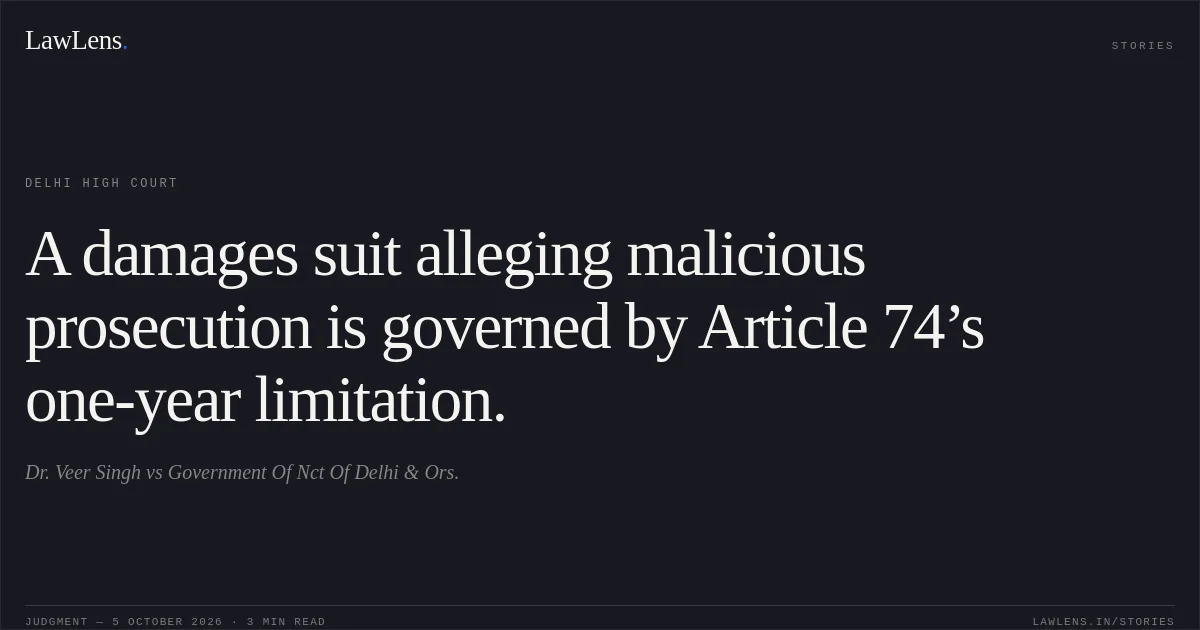
The Court considered the plaint’s allegations and reliefs, which centred on the allegedly false and malicious chargesheet and the resulting injury to the plaintiff’s reputation and dignity. It therefore characterised the suit as one for compensation for malicious prosecution, rather than a suit brought upon the Division Bench’s 2019 judgment; Article 74, not Article 101, applied.
Source reference: pp. 28–31, paras. 21–24Taking 24 May 2019—the date the writ petition was dismissed—as the relevant starting point, the ordinary one-year period would have expired on 23 May 2020. Applying the Supreme Court’s exclusion of time, the Court found that only 70 days remained from 1 March 2022, giving the plaintiff until 10 June 2022 to sue. Because the suit was filed on 19 May 2023, it was out of time.
Source reference: p. 31, para. 25Holding
The Court held that Article 74 of the Limitation Act governed the claim and that the suit was time-barred.
It allowed the defendants’ application under Order VII Rule 11(d) CPC and rejected the plaint; any pending applications were also dismissed.
Source reference: p. 32, paras. 26–27Acts & Sections Cited
5 provisions across 2 statutes referred to in this judgment. Each provision opens on LawLens.
Code of Civil Procedure, 19082
Limitation Act, 19633
Original Court PDF
Dr. Veer SinghvsGovernment Of Nct Of Delhi & Ors.
Click to open original judgment
Original judgment, available to read, download and summarize on LawLens.in