Facts
On 21 May 2002, a collision occurred between a Santro car and a truck, resulting in the death of the Santro car’s unmarried driver.
Source reference: p.1–2; paras. 1–2His parents instituted a motor accident compensation claim.
Source reference: p.1–2; paras. 1–2The Tribunal found the truck driver solely negligent, noting that a charge-sheet had been filed against him and that he had not entered the witness box to establish any negligence by the deceased’s driver.
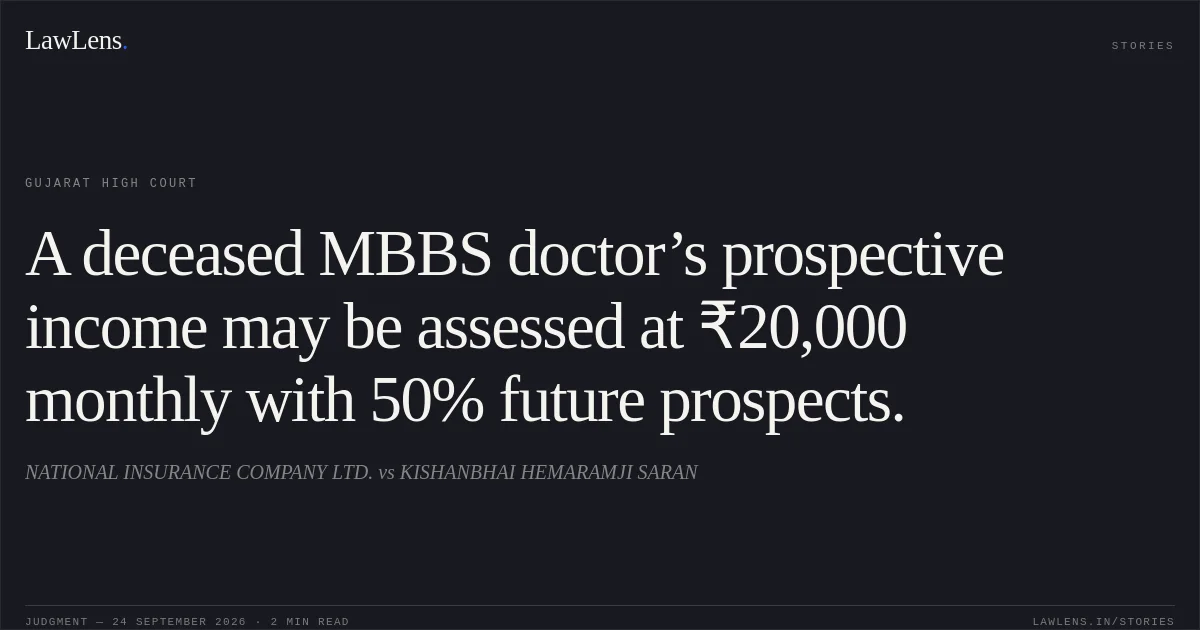
Source reference: p.1–2; paras. 1–2The Tribunal assessed the deceased’s monthly income at ₹20,000, added 50% towards future prospects, applied the appropriate multiplier, and awarded ₹30,77,500 to the parents.
Source reference: p.2–3; paras. 3, 8The insurer challenged the award, disputing both the finding of sole negligence and the quantum of income and compensation.
Source reference: p.2; para. 4Issues
1. Whether the Tribunal erred in holding that the truck driver was solely negligent for the accident, without attributing contributory negligence to the deceased’s driver.
Source reference: p.2–3; paras. 4–52. Whether the Tribunal’s assessment of the deceased’s monthly income at ₹20,000 and addition of 50% towards future prospects resulted in excessive compensation.
Source reference: p.2–4; paras. 3–8Law Applied
The Court applied the principles governing motor accident compensation under the Motor Vehicles Act, including proof of negligence, assessment of the deceased’s probable income, addition for future prospects, and application of the appropriate multiplier; no specific statutory provision or precedent was cited in the judgment.
Source reference: no citationA charge-sheet against a driver, together with the absence of evidence from that driver disputing negligence, may support a finding that the driver was responsible for the accident.
Source reference: p.2–3; paras. 2, 5Compensation may be assessed on the basis of the deceased’s qualifications, likely career, family circumstances, and prospective earning capacity, rather than only proved current earnings.
Source reference: p.3; paras. 6–8Reasoning
The Court upheld the finding of sole negligence because the truck driver had not been examined and the police charge-sheet implicated him in the accident; consequently, there was no evidentiary basis to attribute negligence to the deceased’s driver.
Source reference: p.2–3; para. 5The income assessment of ₹20,000 per month was held reasonable because the deceased had completed his MBBS and was preparing to pursue higher studies in Australia.
Source reference: p.3; paras. 6–7The Court also considered that the deceased’s father was a doctor, supporting the Tribunal’s assessment of the deceased’s likely earning capacity.
Source reference: p.3; paras. 6–7The addition of 50% for future prospects and application of the multiplier were therefore accepted as resulting in a just compensation of ₹30,77,500.
Source reference: p.3–4; para. 8Holding
The Court answered both issues against the insurer.
It held that the truck driver was solely responsible for the accident and that the Tribunal’s assessment of income, future prospects, multiplier, and total compensation was proper.
Source reference: p.4; para. 9The appeal was dismissed, and the award of ₹30,77,500 in favour of the deceased’s parents was affirmed.
Source reference: p.4; para. 9Original Court PDF
NATIONAL INSURANCE COMPANY LTD.vsKISHANBHAI HEMARAMJI SARAN
Click to open original judgment
Original judgment, available to read, download and summarize on LawLens.in
![Subsequent criminal proceedings do not warrant review absent an error apparent on the record.. M/o Finance vs R C BAKSHI. CAT - ['Delhi']. LawLens](/stories/thumbnails/subsequent-criminal-proceedings-do-not-warrant-review-absent-an-error-apparent-on-the-reco-1686b1e451684d1590db13b17e36a8d2.webp)
![Transfer-policy tenure guidelines create no indefeasible right; interference requires statutory violation or established mala fides.. PRIYADARSHI PARIMAL AROHI vs BSNL. CAT - ['Patna']. LawLens](/stories/thumbnails/transfer-policy-tenure-guidelines-create-no-indefeasible-right-interference-requires-statu-110afbbb489a444f8a39741589297e68.webp)
![Recovery of excess pay from a retired employee is impermissible absent fraud or misrepresentation.. RAVI KANT vs Bharat Sanchar Nigam Ltd. CAT - ['Patna']. LawLens](/stories/thumbnails/recovery-of-excess-pay-from-a-retired-employee-is-impermissible-absent-fraud-or-misreprese-074b3b610aa14d1799eeaee490035275.webp)