01Facts
The appellant claimed the suit land through a registered Will executed by her father and was recorded as its tenant following mutation in 2013.
pp. 2–6She alleged that the respondent had encroached upon about 20 square metres and sued for declaration of title and recovery of possession.
pp. 2–6The respondent asserted that he had acquired the land under a registered sale deed from the appellant’s brother and had taken possession.
pp. 2–6The Trial Court dismissed the suit; the First Appellate Court set aside that decree and declared the appellant’s right, title and interest, but refused recovery of possession under the Andaman and Nicobar Islands Land Revenue and Land Reforms Regulation, 1966.
pp. 2–6The appellant brought this second appeal challenging the refusal of possession
¶ 5–15, 17 · pp. 2–602Issues
i.1. Whether the First Appellate Court erred in refusing recovery of khas possession as consequential relief to the declaration of title, having regard to Section 34 of the Specific Relief Act, 1963
¶ 17(a) · p. 6ii.2. Whether the civil suit for possession was barred by Regulation 204 of the Andaman and Nicobar Islands Land Revenue and Land Reforms Regulation, 1966, read with Regulation 161
¶ 17(b)–(d) · pp. 6–7iii.3. Whether Regulation 161 applies only where a recorded tenant has been dispossessed within two years, as the appellant contended
¶ 17(c) · p. 603Law Applied
Section 34 of the Specific Relief Act, 1963 permits a person entitled to a legal character or right to property to seek a declaration, but does not enlarge a civil court’s jurisdiction or override a statutory exclusion.
¶ 41–47 · pp. 16–20Regulation 204 restricts civil suits or proceedings concerning matters arising under and provided for by the Regulations, subject to exceptions in the statutory scheme.
¶ 41–47 · pp. 16–20Regulation 161 provides a mechanism before the competent Tehsildar for inquiry into dispossession of a tenant otherwise than by due process and, where its requirements are met, restoration of possession.
¶ 41–47 · pp. 16–20The court also applied the principle that jurisdiction depends on the substance of the controversy and relief sought, not the form or label of the pleadings
¶ 41–47 · pp. 16–20Provisions in the judgment · 1 · Linked ones open on LawLens
Specific Relief Act, 1963 Section 34
04Reasoning
The Court treated recovery of possession as the substantive relief sought, notwithstanding the accompanying declaratory prayer.
¶ 40, 45 · pp. 15, 18–19It reasoned that the appellant’s own case was that the respondent admitted her title, so the dispute did not involve a genuine contest between rival owners; it concerned the respondent’s alleged occupation and the appellant’s claim to regain possession
¶ 40, 45 · pp. 15, 18–19Because the Court considered that dispute to fall within the statutory scheme for dispossession and restoration under Regulation 161, Regulation 204 prevented the appellant from obtaining possession through a civil suit.
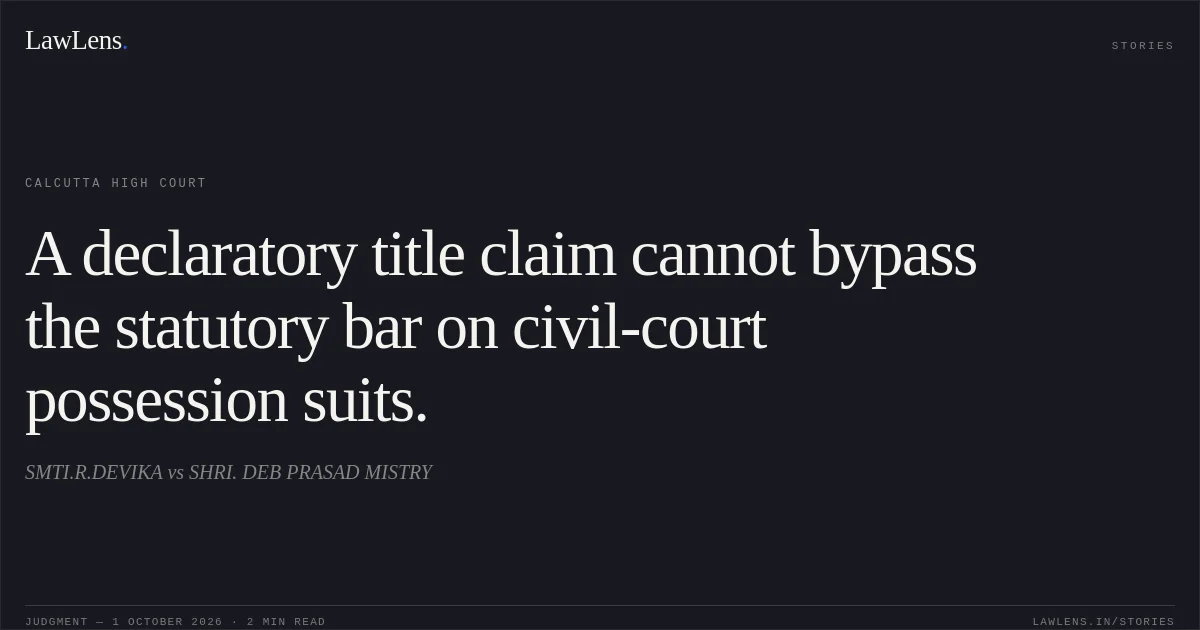
¶ 41–47 · pp. 16–20Section 34 could not be used to circumvent that bar.
¶ 41–47 · pp. 16–20The Court acknowledged that civil jurisdiction may remain where an independent, disputed civil title requires adjudication, but found that circumstance absent on the appellant’s case
¶ 41–47 · pp. 16–2005Holding
The Court answered the substantial questions of law against the appellant, holding that the First Appellate Court was justified in refusing recovery of khas possession under the statutory scheme
¶ 48–50 · p. 20It dismissed the second appeal and affirmed the First Appellate Court’s judgment and decree, including its declaration of the appellant’s right, title and interest; there was no order as to costs
¶ 51–53 · p. 20Original Court PDF
SMTI.R.DEVIKAvsSHRI. DEB PRASAD MISTRY
Click to open original judgment
Original judgment, available to read, download and summarize on LawLens.in