Facts
The plaintiffs in the underlying suit sought recovery of sums arising from a transaction involving, among other documents, a Debenture Trust Deed and a Registered Mortgage Deed concerning the ‘D’ Schedule property.
Source reference: paras. 1–7, pp. 14–17The petitioner was impleaded as defendant No. 22 as the purchaser of a flat constructed on that property and filed a written statement contesting the suit.
Source reference: paras. 1–7, pp. 14–17The plaintiffs later applied under Order I Rule 10 read with Section 151 of the Code of Civil Procedure, 1908 (CPC), to delete several defendants, including the petitioner.
Source reference: paras. 1–7, pp. 14–17The trial court rejected the application, finding the defendants sought to be deleted—except defendant No. 1—to be proper and necessary parties.
Source reference: paras. 1–7, pp. 14–17The petitioner challenged that rejection under Article 227 of the Constitution.
Source reference: paras. 1–7, pp. 14–17Issues
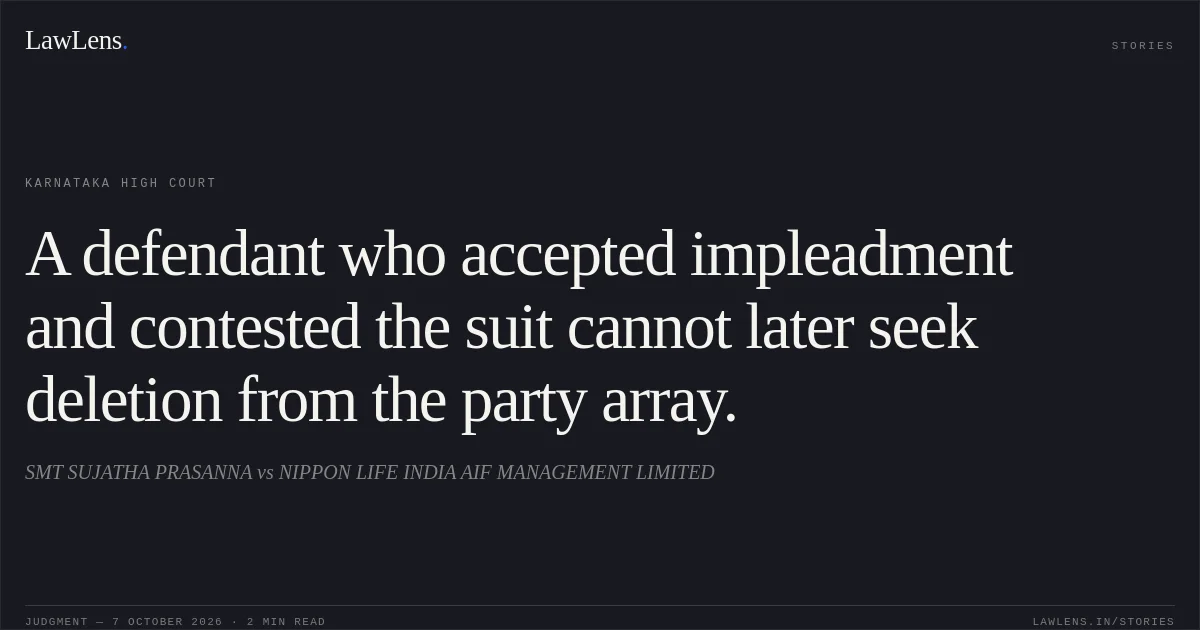
1. Whether defendant No. 22 could challenge the rejection of the plaintiffs’ application to delete him from the array of parties, having raised no objection to his impleadment and having participated in the suit.
Source reference: paras. 6–7, pp. 16–172. Whether, in light of the nature of the dispute and the petitioner’s status as a purchaser of a flat in the ‘D’ Schedule property, the trial court was justified in treating him as a proper and necessary party.
Source reference: paras. 3.1, 5–7, pp. 15–17Law Applied
Order I Rule 10 CPC governs the addition or deletion of parties, while Section 151 CPC preserves the court’s inherent powers; Article 227 of the Constitution provides the High Court’s supervisory jurisdiction over subordinate courts.
Source reference: paras. 6–7, pp. 16–17The court applied the principle that the trial court may retain parties it considers proper or necessary for effective adjudication of the dispute.
Source reference: paras. 6–7, pp. 16–17It also held, in the circumstances of this case, that a defendant who had not objected to being impleaded and had participated in the proceedings had no right to seek deletion by challenging the rejection of an application filed by the plaintiffs.
Source reference: paras. 6–7, pp. 16–17Reasoning
The petitioner had been impleaded as the purchaser of a flat on the mortgaged ‘D’ Schedule property, had filed a written statement, and had raised no objection to his impleadment.
Source reference: paras. 5–8, pp. 16–17The High Court considered that the trial court had assessed the nature of the dispute and the issues involved before concluding that the defendants sought to be deleted were proper and necessary parties.
Source reference: paras. 5–8, pp. 16–17Since the plaintiffs did not challenge that ruling, and the petitioner’s participation afforded him no right to pursue their deletion application, the High Court found no justification to interfere under Article 227.
Source reference: paras. 5–8, pp. 16–17Holding
The High Court dismissed the writ petition, declining to interfere with the trial court’s rejection of the application to delete defendant No. 22 from the array of parties.
Acts & Sections Cited
1 provisions across 1 statute referred to in this judgment. Each provision opens on LawLens.
Code of Civil Procedure, 19081
Original Court PDF
SMT SUJATHA PRASANNAvsNIPPON LIFE INDIA AIF MANAGEMENT LIMITED
Click to open original judgment
Original judgment, available to read, download and summarize on LawLens.in